IBPS PO Quant Preparation: Build Arithmetic and DI Accuracy
Move from reliable calculations to clean arithmetic setups, structured DI reading and timed mixed work. This adjustable 12-week ladder makes accuracy the gate for speed.
KnowledgeGate Team
Exam prep & CS education
Updated 29 Jul 20265 min read
You may know the percentage, ratio and average formulas, yet still lose quant marks by translating too quickly, calculating the same value twice or entering a DI set before checking its structure. This adjustable 12-week ladder moves from calculation fluency to arithmetic setup, DI extraction and timed selection, with accuracy gates before speed. One missed day does not mean doubling tomorrow's load. Begin this week by identifying the high-yield quant topics, then train the execution errors that cost you answers.
1. Start with a diagnostic that separates knowledge from execution
Build your own 40-question, 40-minute diagnostic from practice material: 10 calculation, 20 arithmetic and 10 across two small DI sets. Record attempted, correct, wrong, skipped and time used. Label each miss concept, setup, calculation or selection.
Suppose 30 are attempted: 24 correct, 6 wrong, 10 skipped. Attempted accuracy is 24 / 30 x 100 = 80%; throughput is 30 / 40 = 0.75 attempt per minute. If errors split into 1 concept, 2 setup, 2 calculation and 1 selection, work first on setup and calculation.
Make 85% attempted accuracy across two consecutive sets your gate for moving on. Below that line, extra speed only converts what you already know into wrong answers faster.
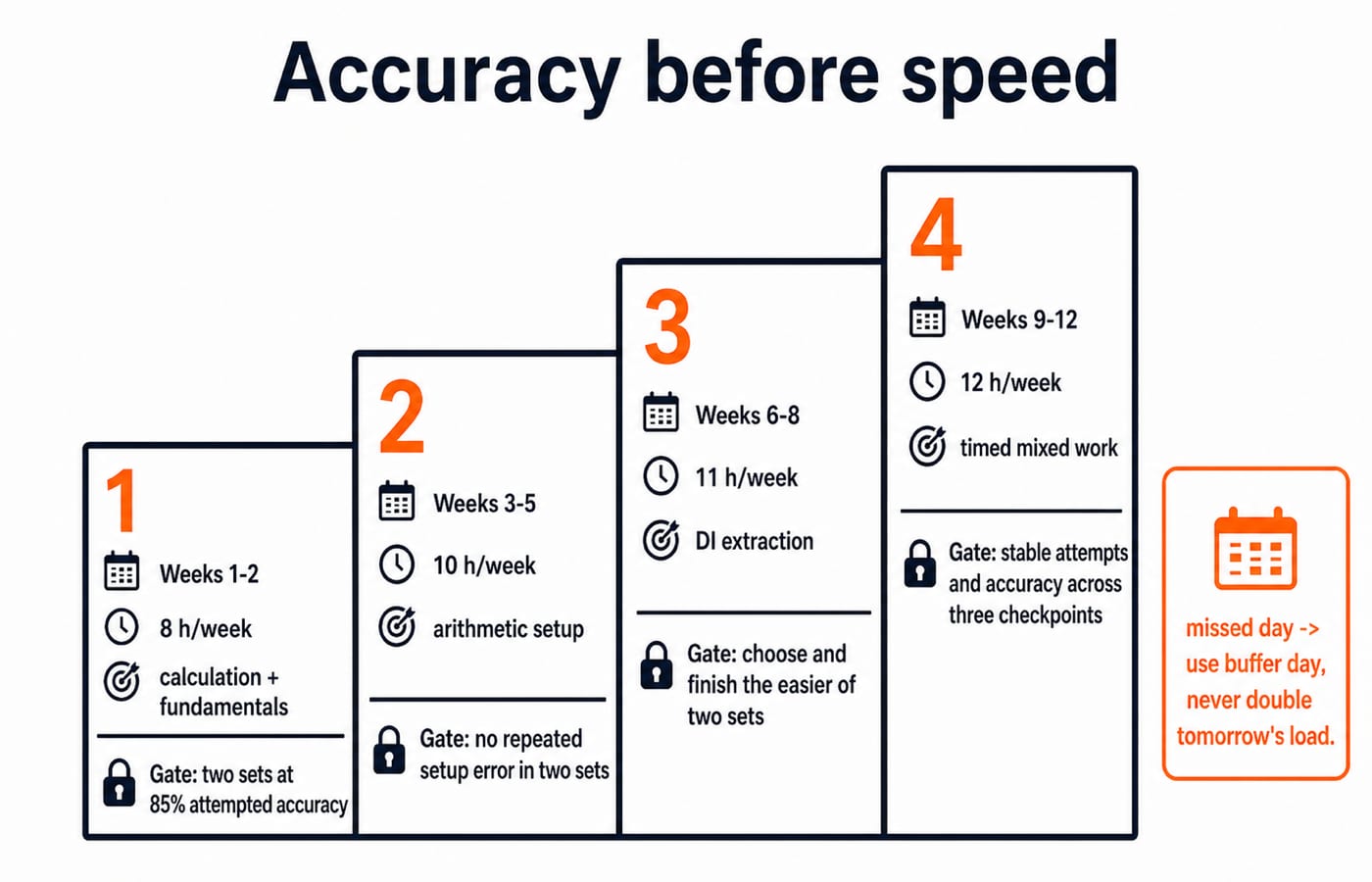
2. Use a 12-week time model with work that changes by phase
Weeks | Hours each week | Allocation |
|---|---|---|
1-2 | 8 | 2 h calculation, 4 h arithmetic fundamentals, 1 h mixed questions, 1 h review |
3-5 | 10 | 1.5 h calculation, 4.5 h arithmetic, 2 h DI, 1 h mixed, 1 h review |
6-8 | 11 | 1 h calculation, 3 h arithmetic, 4 h DI, 2 h mixed, 1 h review |
9-12 | 12 | 45 min calculation, 2 h 15 min arithmetic, 3 h DI, 4 h timed mixed work, 2 h review |
Use five study days, one checkpoint day and one rest or buffer day. A 10-hour week uses five 90-minute study blocks and one 150-minute checkpoint: 5 x 90 + 150 = 600 minutes. Adjust phase lengths to your timeline, but keep the order.
3. Weeks 1-2: make basic calculations dependable
Drill tables 1-25, squares 1-30, cubes 1-15, fraction-percentage pairs from 1/2 through 1/20, multiplication by 25 and 125, and division checks. Limit each drill to 15 minutes and record errors.
17.5% of 640 = (10% + 5% + 2.5%) of 640 = 64 + 32 + 16 = 11248 x 25 = 48 x 100 / 4 = 1,200375 x 16 = 375 x 8 x 2 = 3,000 x 2 = 6,000996 / 24 = (984 + 12) / 24 = 41 + 0.5 = 41.5
These decompositions teach repeatable routes. Use the IBPS PO Prelims course for structured practice.
4. Weeks 3-5: translate arithmetic before reaching for a formula
For percentage, ratio, average, profit and loss, simple and compound interest, time and work, pipes, mixture, speed-distance-time and partnership, write three lines: given, asked, connecting relation. Complete 10 untimed setups before timing answers.
A quantity starts at 2,400, rises 15% to 2,400 x 1.15 = 2,760, then falls 10% to 2,760 x 0.90 = 2,484. The change is 2,484 - 2,400 = 84, a net 84 / 2,400 x 100 = 3.5% increase, not 5%.
If A takes 12 hours and B takes 18, their combined hourly rate is 1/12 + 1/18 = 3/36 + 2/36 = 5/36. They need 36/5 = 7.2 hours. Since 0.2 x 60 = 12, that is 7 hours 12 minutes.
Log one sentence, such as “I added successive percentages” or “I inverted the combined rate”. Start the next session with a fresh question targeting it.
5. Weeks 6-8: read DI in a fixed order, then calculate
For every set, scan title, unit, row labels, column labels and question before calculating.
Units handled by three centres
Centre | Round 1 | Round 2 |
|---|---|---|
A | 240 | 300 |
B | 320 | 360 |
C | 400 | 340 |
Round 2 total is 300 + 360 + 340 = 1,000. A's increase is (300 - 240) / 240 x 100 = 60 / 240 x 100 = 25%. C's decrease is (400 - 340) / 400 x 100 = 60 / 400 x 100 = 15%. B:C in Round 2 is 360:340 = 18:17. Cross-check all cells: 240 + 320 + 400 + 300 + 360 + 340 = 1,960.
For selection practice, inspect two sets for 60 seconds, note why one is easier, solve it first, then review the choice. Not every set is compulsory.
6. Weeks 9-12: add timing only after the setup is stable
Use 20-question mixed checkpoints. Checkpoint A has 17 attempted, 14 correct, 3 wrong and 3 skipped, so accuracy is 14 / 17 x 100 = 82.35%. Review one setup, one calculation and one selection error. Checkpoint B has 18 attempted, 16 correct, 2 wrong and 2 skipped, so 16 / 18 x 100 = 88.89%. Start speed work only after a second consecutive set reaches the 85% accuracy gate.
Use three passes: direct calculation and familiar arithmetic; the clearest DI set and medium arithmetic; then marked questions whose setup is visible. If no first equation is clear after 30 seconds in practice, mark and leave.
Use the Prelims versus Mains preparation split, verify structure and timing in the latest Institute of Banking Personnel Selection notification, then adapt the ladder. The IBPS PO Mains course is the structured next step.
7. Review every week, recover missed days, and choose the next action
Track five Sunday numbers: attempts, attempted accuracy, median time per question, repeated errors and sets skipped after inspection. With 120 attempts, 102 correct and 18 wrong, 102 / 120 x 100 = 85%. If median time is 54 seconds, 7 errors are setup errors and 2 DI sets were correctly skipped, add one setup block next week, not questions everywhere.
Move one missed block to the buffer day. After two, keep higher-priority review and drop one new-question block. After a missed week, repeat the phase checkpoint. Never compress weeks or double hours.
The short version
Calculate cleanly, translate arithmetic, extract DI, then time mixed work. The IBPS PO Prelims course carries more than 1,200 Quantitative Aptitude questions: 400+ previous-year and 800+ practice, enough to hold the ladder's daily volume without hunting for material. Compare routes on the Banking and Insurance category, then begin Prelims practice.
Keep learning
IBPS SO IT Officer Syllabus: What to Study for Each Section
Separate the official IBPS exam structure from the detailed study map. See what to cover for English, Reasoning, Quantitative Aptitude, Professional Knowledge and Descriptive English.
Updated 21 Oct 20264 min readIBPS Exams
IBPS SO IT Officer Preparation Strategy: A 16-Week Phase-by-Phase Plan
Turn 18 weekly hours into a realistic IBPS SO IT Officer plan, from the first diagnostic to mock repair, tapering and a conditional next-stage bridge.
Updated 17 Oct 20266 min readIBPS Exams
IBPS SO IT Officer Exam Pattern and Marking Scheme: Prelims, Mains and Interview
Understand the CRP SPL-XVI stage sequence, section timings and marks, then use worked score calculations and a 12-hour study plan to prepare for each stage.
Updated 13 Oct 20264 min read115 viewsIBPS Exams
IBPS Clerk Eligibility and Selection Process: From Application to Allotment
Separate the eligibility gate from the selection gate using a dated checklist, three candidate profiles and a 124-to-62 Main-score example.
Updated 8 Oct 20264 min readIBPS Exams