IBPS PO Syllabus: What to Study in Every Prelims and Mains Section
Map every IBPS PO written section to a practical study basket, then use worked examples and a simple diagnostic to decide where your preparation time should go.
KnowledgeGate Team
Exam prep & CS education
Updated 21 Sep 20265 min read
The IBPS PO syllabus is often treated as one long list, even though Prelims rewards fast command of three foundations while Mains demands greater depth and adds new work. Use the section-by-section checklist to decide what to study first. Use it to point your next study hour at the section that needs it most.
Related reading: PO paper topic tallies and PO marking rules.
IBPS PO syllabus at a glance: map the two written stages
Prelims focuses on speed, while Mains adds depth, awareness, DI, and descriptive writing.
Written stage | Current test names | Syllabus focus | Matching course |
|---|---|---|---|
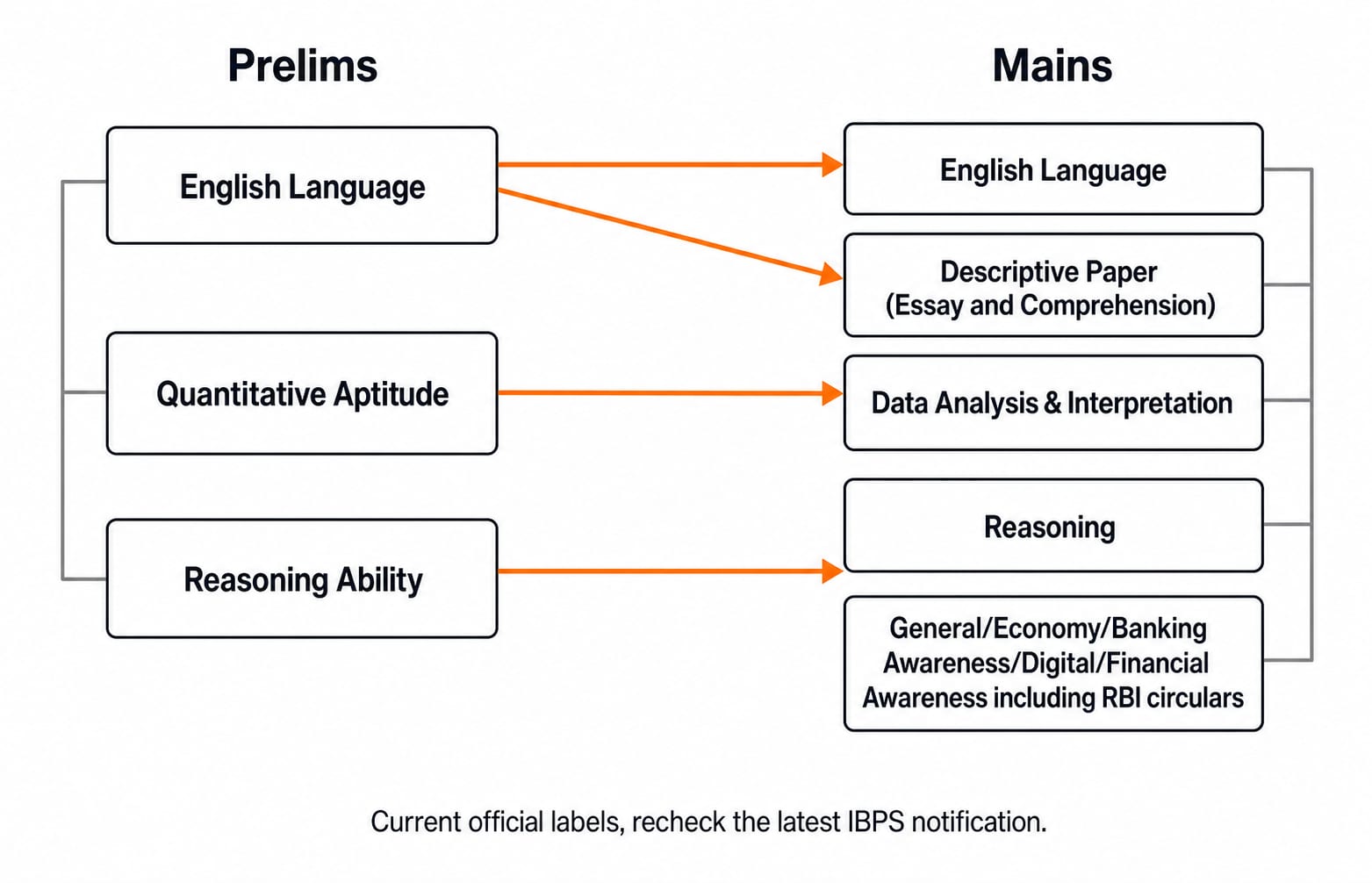
Prelims | English Language; Quantitative Aptitude; Reasoning Ability | Comprehension and usage; arithmetic and calculation; puzzles, relations, order, and logic | |
Mains | Reasoning; General/Economy/Banking Awareness/Digital/Financial Awareness including RBI circulars; English Language; Data Analysis & Interpretation; Descriptive Paper (Essay and Comprehension) | Longer reasoning and DI sets; objective English; awareness recall; essay and comprehension |
The transition is Quantitative Aptitude -> Data Analysis & Interpretation, Reasoning Ability -> deeper Reasoning, and English Language -> objective English plus Essay and Comprehension. Awareness is the new stream. Later stages belong to the official notice.
The official IBPS PO/MT XVI page and its latest notice and corrigenda set every cycle-specific number and rule, including marks, question counts, duration, sectional timing, penalty, eligibility, cutoffs, dates, and vacancies. Prioritise your study hours by section.
IBPS PO English Language syllabus: grammar, comprehension, and usage
The IBPS PO English Preparation Plan: Reading, Grammar and Descriptive Writing owns the full feedback loop across those three skills. For syllabus coverage, study comprehension, cloze tests, error spotting, sentence improvement, fillers, para jumbles, vocabulary in context, and grammar through usage. Consider: Neither the branch manager nor the clerks was ready to sign the report. With neither/nor, the verb follows the nearer subject, so plural clerks changes was to were. The same correction pattern appears in error-spotting and sentence-improvement drills.
Practise one short passage, ten grammar items, and one para-jumble set.
IBPS PO Quantitative Aptitude syllabus: arithmetic before shortcuts
Build three layers: calculation basics (simplification, approximation, number series, quadratic comparison); arithmetic (percentages, ratio, averages, profit and loss, interest, time and work, time-speed-distance, mixtures); then light charts and tables for Mains DI.
Digital applications rise from 240 to 300. Increase = 300 - 240 = 60, so percentage increase = (60 / 240) x 100 = 25%. If 300 split into approved and rejected in the ratio 7:3, ten parts give 300 / 10 = 30 each, hence 210 approved and 90 rejected. Longer DI uses these operations, so shortcuts cannot replace clean arithmetic.
IBPS PO Reasoning Ability syllabus: deductions before speed
Cover puzzles and seating; inequalities and syllogisms; coding-decoding and alphanumeric series; blood relations, directions, and order/ranking. Draw constraints rather than memorising them.
Five trainees A, B, C, D, E face north. C takes middle seat 3; A, immediately left, takes 2; E takes right-end seat 5. B is not adjacent to E, so cannot take 4 and takes 1. D takes 4. Final order: B - A - C - D - E. When facing changes, left follows the seated person's perspective. All face north, so no reversal is needed.
Mains Reasoning and Data Analysis & Interpretation: add depth and set selection
Progress to longer multi-variable puzzles, input-output, data sufficiency, and critical or logical reasoning. Reasoning is the current official label. Computer basics are supplementary coverage, not a guaranteed named section.
For DI, practise tables, bar and line charts, pie charts, caselets, missing-data sets, quantity comparison, and data sufficiency. Work through this practice set using branch values P to T: 120, 150, 135, 165, 180. Total = 120 + 150 + 135 + 165 + 180 = 750; average = 750 / 5 = 150; R's share = (135 / 750) x 100 = 18%; T exceeds P by 180 - 120 = 60, or (60 / 120) x 100 = 50%.
Mains English, awareness, and descriptive work: start early
Objective English deepens comprehension, usage, arrangement, and vocabulary. For general, economy, banking, digital, and financial awareness, including RBI circulars, keep concept notes, dated current-affairs notes, RBI summaries, and weekly recall. Assume no fixed weightage.
The current notice names the Descriptive Paper Essay and Comprehension, with themes such as economic and social issues, banking and technology trends, current events, and ethics. Set yourself this 40-minute drill: use 5 minutes to outline Should banks explain loan rejection reasons in plain language?, 25 to draft a claim, two reasoned paragraphs, counterpoint, and conclusion, then 10 to check logic, grammar, and repetition. Compress a 300-word passage into a 90-word summary preserving its claim and two reasons.
IBPS PO syllabus audit: turn topic coverage into a 12-hour week
Mark every basket as fresh, needs revision, or reliable: English comprehension and usage; Quant calculation and arithmetic; Reasoning standalone questions and puzzles; Mains DI; awareness; and descriptive work. Choose one fresh topic and one recurring error from each weak basket. The earlier IBPS PO Exam Pattern: A Stage-by-Stage Preparation Priority Map owns stage rules, score diagnostics, and preparation priorities. This syllabus audit decides which topic basket receives the next study block.
If Quant, DI, and awareness carry the most fresh or revision labels, allocate Quant plus DI 3.5 hours; Reasoning 2.5; English 2; awareness 2; descriptive work 1; and mixed review 1. The sum is 3.5 + 2.5 + 2 + 2 + 1 + 1 = 12 hours. Reclassify the baskets after three sessions and move 30 minutes only when a topic changes category. Keep awareness and descriptive work active while Prelims remains the immediate gate.
IBPS PO syllabus: the short version and the next check
Master English, Quant, and Reasoning for Prelims; deepen Reasoning and English, convert Quant into DI, and begin awareness plus descriptive work early for Mains. Recheck the latest detailed notice and corrigenda before fixing a cycle-specific plan. Then compare paths on IBPS PO & SO IT Exam Preparation.
The syllabus becomes manageable when every topic has a section, every weakness a measured practice value, and every official rule comes from IBPS.
Keep learning
IBPS PO Preparation Mistakes: 7 Errors That Cost Final Selection
Hard work is not enough when attempt counts, new resources and rigid timetables hide weak accuracy. Replace seven common errors with measurable habits.
Updated 4 Oct 20265 min readIBPS Exams
IBPS PO Last 60 Days Plan: Revision, Mocks and Error Repair
Turn the final 60 days into a measured cycle of diagnosis, revision, mocks, retests and tapering, with worked schedules for a realistic 14-hour week.
Updated 29 Sep 20264 min readIBPS Exams
IBPS PO Cutoff Trends: Set a Defensible Target Score
Learn how to separate IBPS PO cutoff history by cycle, stage, category and denominator, then turn comparable Main values into a transparent practice target.
Updated 25 Sep 20265 min readIBPS Exams
IBPS PO Previous Year Analysis: Recurring Question Formats and Attempt Priorities
See what genuinely recurs across IBPS PO papers, solve representative format drills, and turn your own accuracy and speed into a practical attempt priority.
Updated 24 Sep 20265 min readIBPS Exams