

IBPS RRB PO Exam Pattern and Marking Scheme: Prelims, Mains and Interview Explained
Understand the Officer Scale I selection ladder, separate section timings, negative marking and mains-interview merit calculation through worked examples.
KnowledgeGate Team
Exam prep & CS education
Updated 30 Oct 20264 min read
“RRB PO” means IBPS Regional Rural Banks Officer Scale I, distinct from Railway Recruitment Board NTPC and the separate IBPS PO/MT exam. The selection ladder, negative-marking calculation and score flow show which results matter. The current notification controls the next attempt.
IBPS RRB PO is Officer Scale I: read the selection ladder first
The figures below come from the 2025 CRP RRBs XIV detailed notification on ibps.in. A later cycle can change the structure, so verify the current notification and call-letter handout before acting on them.
The reference flow was Preliminary Examination, Main Examination, then Interview. Prelims was qualifying. Officer Scale I mains marks were used for interview shortlisting and final merit, with interview performance added at the final stage.
A strong prelims score clears a gate but does not add to final merit.
IBPS RRB PO prelims pattern: two separately timed tests
The CRP RRBs XIV reference pattern was:
Test | Questions | Maximum marks | Separate time |
|---|---|---|---|
Reasoning | 40 | 40 | 25 minutes |
Quantitative Aptitude | 40 | 40 | 20 minutes |
Total | 80 | 80 | 45 minutes |
Separate timing prevents moving unused Reasoning time into Quantitative Aptitude. Candidates had to qualify in both tests. The linked KnowledgeGate IBPS PO/MT resources cover a separate recruitment and are included for overlapping banking-exam practice. Bank PO Prelims vs Mains: Split Your Prep offers a broader method for balancing the two stages.
IBPS RRB PO mains pattern: five tested areas and one language choice
Test | Questions | Maximum marks | Separate time |
|---|---|---|---|
Reasoning | 40 | 50 | 30 minutes |
Computer Knowledge | 40 | 20 | 15 minutes |
General Awareness | 40 | 40 | 15 minutes |
English Language OR Hindi Language | 40 | 40 | 30 minutes |
Quantitative Aptitude | 40 | 50 | 30 minutes |
Total | 200 | 200 | 120 minutes |
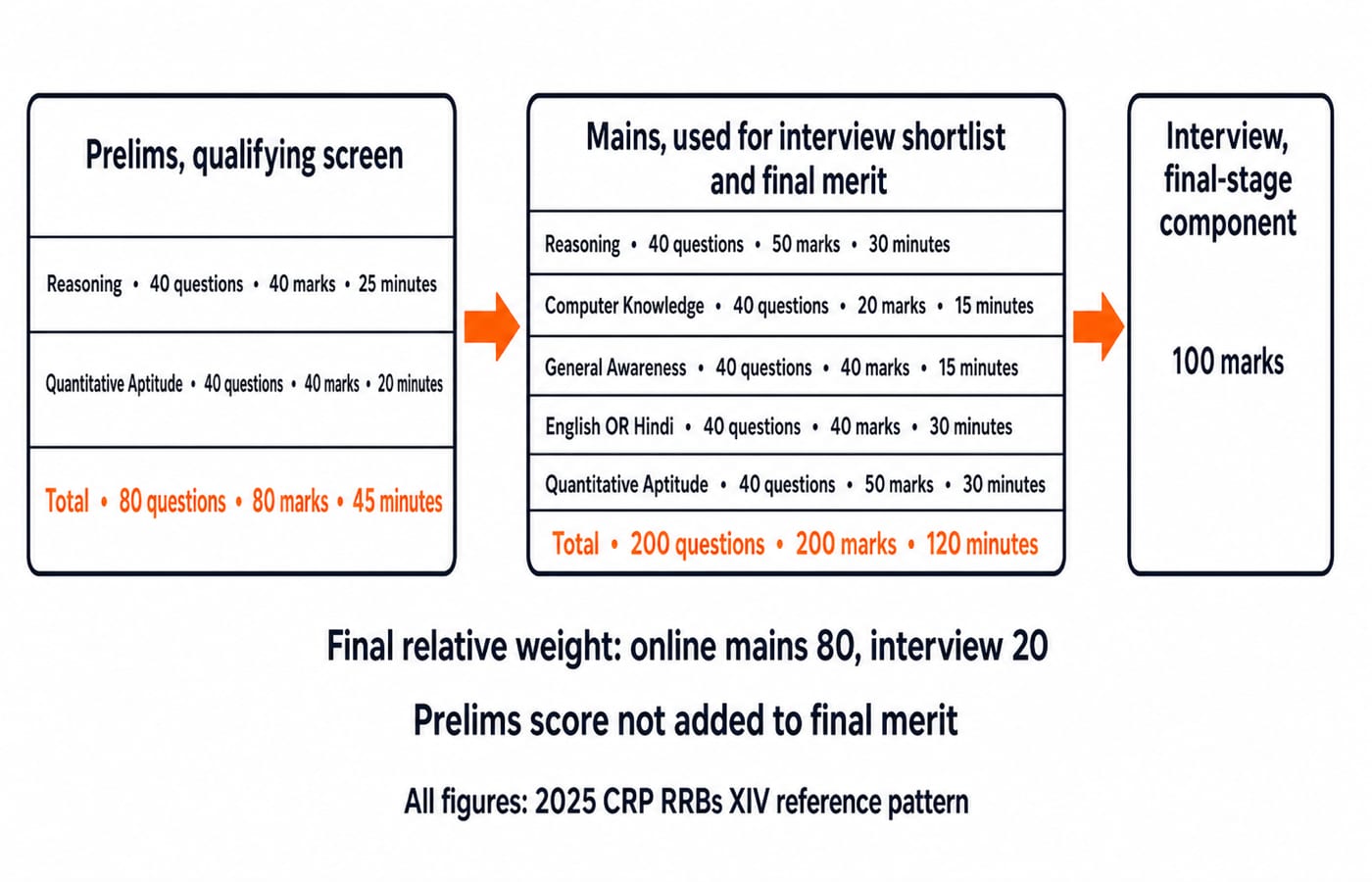
English and Hindi are alternatives, not two tests to add together. Reasoning and Quantitative Aptitude carried 100 of 200 maximum marks, but every mains test required a minimum score.
IBPS RRB PO negative marking: calculate the penalty correctly
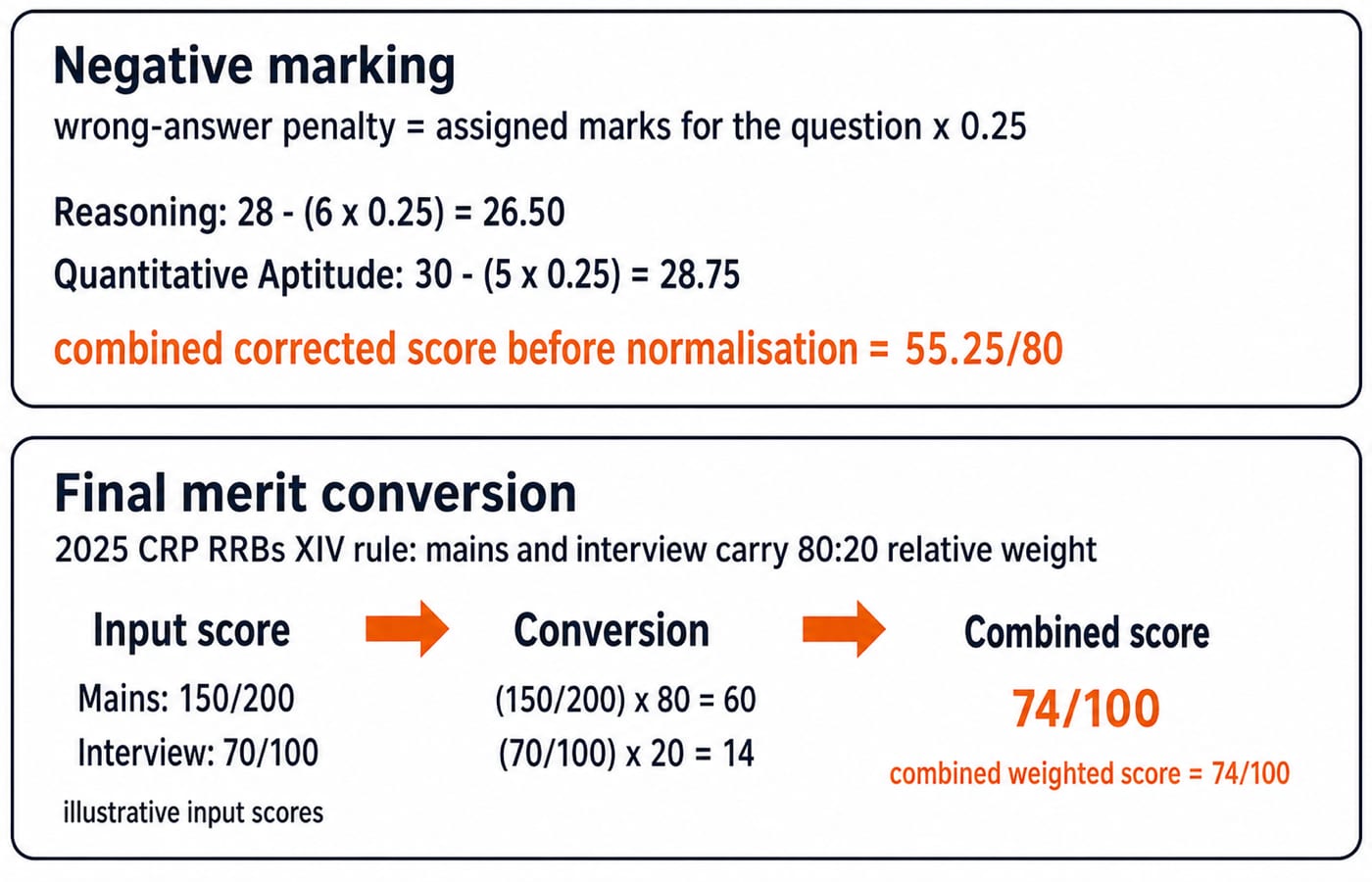
A wrong objective answer lost one fourth, or 0.25, of that question's assigned marks. A blank had no penalty. The rule is not automatically 0.25 marks everywhere.
Using the one-mark prelims format:
Reasoning: 28 correct, 6 wrong, 6 blank.
28 - (6 x 0.25) = 28 - 1.50 = 26.50.Quantitative Aptitude: 30 correct, 5 wrong, 5 blank.
30 - (5 x 0.25) = 30 - 1.25 = 28.75.Combined corrected score:
26.50 + 28.75 = 55.25 out of 80, before official score normalisation.
For any objective question, multiply its assigned marks by 0.25 to find the wrong-answer penalty, then subtract the total penalty from the marks earned on correct answers.
IBPS RRB PO final merit: mains and interview are not added raw
Prelims only shortlisted candidates for mains. Officer Scale I mains supplied the written score for interview shortlisting and final merit. Candidates had to qualify mains and interview.
The notification gives mains and interview a final relative weight of 80:20. Using illustrative scores, a mains score of 150/200 becomes (150 / 200) x 80 = 60/80, while an interview score of 70/100 becomes (70 / 100) x 20 = 14/20. The combined score is 60 + 14 = 74/100. That 74 is neither a predicted cutoff nor a selection guarantee.
For another stage-planning model, see IBPS PO Exam Pattern: Stage-by-Stage Prep Priority Map.
IBPS RRB PO preparation map: use the pattern without mixing exams
RRB need | Concrete preparation use | KnowledgeGate resource |
|---|---|---|
Prelims Reasoning and Quant speed | Timed fundamentals, practice sets and mock review | |
Mains-level Reasoning, Quantitative Aptitude, language and awareness continuity | Deeper mixed practice after the prelim base | IBPS PO Mains Preparation Course |
For a 12-hour week, allocate 2.5 hours each to Reasoning and Quantitative Aptitude; 1.5 hours each to General Awareness and error-log review; and 1 hour each to Computer Knowledge, language, separately timed section tests and retesting. This keeps mains active.
Use the IBPS PO & SO IT Exam Preparation category to compare the live IBPS course line-up.
IBPS RRB PO attempt control: practise the notification clock
Test a 25-minute Reasoning rehearsal as a 14-minute first pass, 7-minute second pass and 4-minute review. For a 20-minute Quantitative Aptitude rehearsal, test 10, 7 and 3 minutes. Use the passes for clear methods, longer solvable items and review, respectively. Leave unresolved guesses blank.
Judge these splits by mock accuracy and adjust them. The current interface and handout govern the real attempt. For your cycle, confirm stage names, sections, question counts, maximum marks, separate timings, language choice, penalty wording and score-weight rule in the notification and call-letter handout.
IBPS RRB PO pattern: the short version and the next step
Prelims was a two-test qualifying screen in the 2025 reference.
Mains covered five tested areas, with English or Hindi as a choice.
A wrong answer lost 25% of that question's assigned marks, while a blank lost nothing.
Final merit used mains plus interview at an 80:20 relative weight.
For adjacent higher-stage practice after mastering prelims fundamentals, consider the IBPS PO Mains Preparation Course.
Now copy the current official section table onto one page, add the penalty formula, run both timed prelims rehearsals, and record your accuracy before changing attempt targets.
Go deeper with the full courseIBPS PO Prelims
Keep learning
IBPS RRB Clerk Syllabus: Prelims and Mains Topic Map
Separate RRB Office Assistants from the IBPS CSA exam, then turn each Prelims and Mains section into a clear study and self-testing plan.
Updated 4 Nov 20264 min readIBPS Exams
IBPS PO Preparation Strategy: A 16-Week Plan for Prelims and Mains
Turn 16 weeks into a workable IBPS PO routine. This plan shows how to divide study time, analyse drills, repair errors and retain Mains continuity.
Updated 30 Oct 20265 min readIBPS Exams
IBPS PO Syllabus: What to Study in Every Prelims and Mains Section
Map every IBPS PO written section to a practical study basket, then use worked examples and a simple diagnostic to decide where your preparation time should go.
Updated 30 Oct 20265 min read91 viewsIBPS Exams

IBPS PO Exam Pattern and Marking Scheme: Prelims, Mains and Score Calculation
Understand the current IBPS PO stage flow, separately timed tests, negative marking and final weighting through compact tables and checked calculations.
Updated 20 Sep 20265 min read150 viewsIBPS Exams