IBPS PO Bank Preference Order: A 20-Minute Deadline Triage
Use a 20-minute IBPS PO bank preference triage when the submission window is closing: screen personal deal-breakers, settle close choices pairwise, and verify the portal entry.
KnowledgeGate Team
Exam prep & CS education
Updated 10 Sep 20264 min read
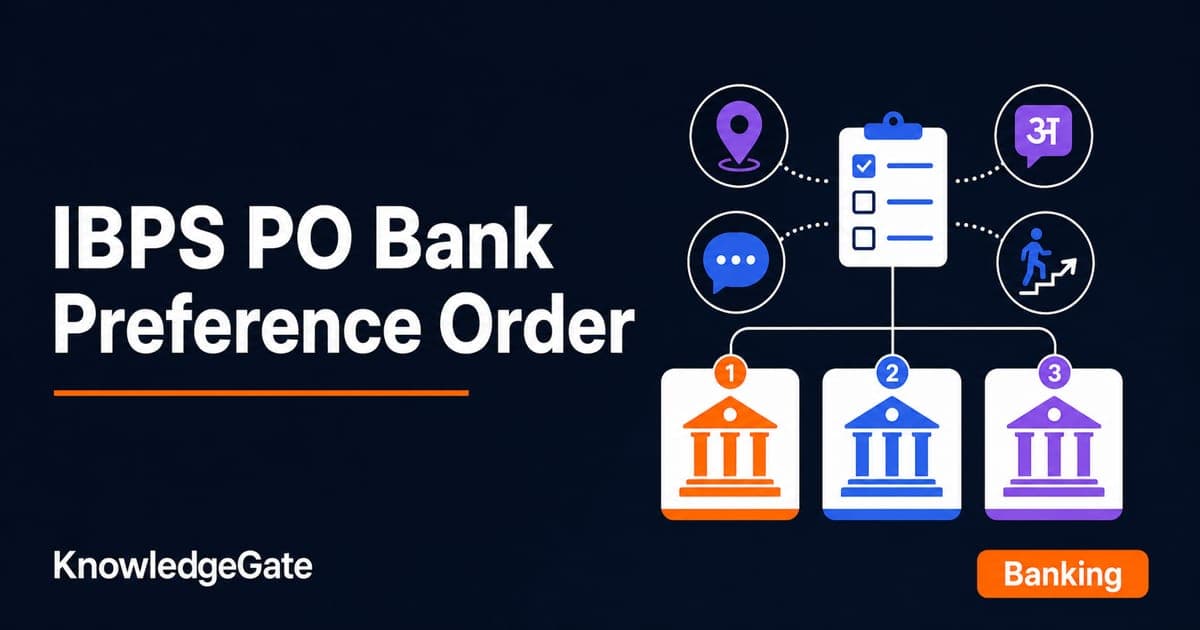
The submission window is nearly over, and a detailed bank-research project will now create more confusion than clarity. You need a safe last-mile method that uses what you already know, removes choices that genuinely conflict with your life, settles close calls, and catches entry errors. This is deadline triage, not a universal ranking of banks.
IBPS PO bank preference order: confirm the live choice set first
Open the current notice or preference portal on the official IBPS website. Match the organisation names and visible instructions exactly. An older article, screenshot, coaching video, or saved form must not supply the current list.
Do not use these 20 minutes to predict a branch, city, transfer frequency, promotion path, or exact role. If you do not already have reliable evidence for a claim, mark it unknown. The aim is to submit a defensible personal order without turning uncertainty into a bank fact.
If you have at least 90 minutes and can still research primary sources, use IBPS PO Bank Preferences: A 5-Factor Ranking Framework Before You Submit. That guide builds weights, an evidence sheet, worked scores, and a sensitivity test. This page serves the different need of a closing-window candidate: screen hard constraints, make direct pairwise choices, and audit the portal entry without inventing last-minute research.
IBPS PO preference triage: write three hard constraints
Write no more than three statements that would make a placement genuinely difficult to sustain. A hard constraint is personal, concrete, and serious enough to change your order. It is not a vague hope such as "good growth" or "best bank".
For a fictional candidate, Neha, the three statements are:
I need a practical route home because I provide regular family support.
I can work in Hindi and English, but I must not claim comfort in another local language without evidence.
I can relocate, but repeated uncertainty would be difficult to manage.
These are Neha's planning constraints, not facts about any organisation. Your card may be different. Keep the wording about your capacity, not about a promised posting outcome.
IBPS PO bank screening: use red, amber and green cards
Place each organisation shown in the live form into one temporary card. This is a screening device, not a score.
Card | Use it when | What happens next |
|---|---|---|
Red | Reliable information directly conflicts with one of your hard constraints | Move it below every acceptable option, but read the current form before omitting anything |
Amber | A high-impact point is unknown or only partly supported | Keep it in the order and compare it conservatively |
Green | Nothing you know conflicts with a hard constraint | Take it to the pairwise ladder |
Missing evidence does not make a bank red. A popular name does not make it green. If all choices are amber, keep them all and move to direct comparisons. Deadline pressure is a reason to narrow the decision rule, not a reason to manufacture confidence.
IBPS PO close choices: build a pairwise ladder
Start with the first two acceptable organisations on your rough list. Ask one question: "If only these two remained, which would I place higher based on a known personal constraint?" Put the answer above the other, then compare the next organisation with the current higher choice. Continue until every acceptable organisation has entered the ladder.
Suppose Neha compares Bank P and Bank Q. She has reliable information that P better fits her home-access constraint, while the transfer picture for both remains unknown. She puts P above Q because one supported difference matters to her. She does not give either bank a transfer score.
She then compares P with Bank R. Nothing known separates them on her hard constraints. She keeps her original order and marks the tie unresolved rather than searching social media for a convenient answer. A stable tie-break rule is safer than a late unsupported claim.
For every adjacent pair in the final list, write one short reason: "P above Q because..." If the sentence relies on prestige, hearsay, or a promised location, delete the reason and compare again. If the sentence names a verified personal fit, keep it.
IBPS PO preference submission: run the 20-minute clock
The four blocks below total 20 minutes: 3 + 5 + 7 + 5 = 20.
Minutes 0 to 3: match the organisation names and instructions against the live IBPS material.
Minutes 3 to 8: write up to three hard constraints and place each choice on a red, amber, or green card.
Minutes 8 to 15: build the pairwise ladder and write one reason for each adjacent choice.
Minutes 15 to 20: enter the order, read it top to bottom, check for a missing or duplicated name, and review the portal record available to you.
Do not assume the form can be edited later. Do not spend the final block reopening low-value commentary. Protect the official check and the entry audit even if the comparison block runs short.
IBPS PO bank preference order: the final check
Your finished order should pass four questions. Does every name match the live form? Did you separate personal constraints from claims about banks? Can you explain each adjacent choice without a rumour? Did you verify the entered order before leaving the portal?
The short version is simple: confirm the choice set, screen only genuine non-fits, order acceptable choices through direct comparisons, and audit the entry. When the preference task is complete, return to preparation through the IBPS PO Prelims Preparation Course or browse the wider Banking & Insurance Exam Preparation category. Preparation resources can structure study, but the current IBPS material remains the authority for the form.
Keep learning
IBPS PO Preparation Mistakes: 7 Errors That Cost Final Selection
Hard work is not enough when attempt counts, new resources and rigid timetables hide weak accuracy. Replace seven common errors with measurable habits.
Updated 4 Oct 20265 min readIBPS Exams
IBPS PO Last 60 Days Plan: Revision, Mocks and Error Repair
Turn the final 60 days into a measured cycle of diagnosis, revision, mocks, retests and tapering, with worked schedules for a realistic 14-hour week.
Updated 29 Sep 20264 min readIBPS Exams
IBPS PO Cutoff Trends: Set a Defensible Target Score
Learn how to separate IBPS PO cutoff history by cycle, stage, category and denominator, then turn comparable Main values into a transparent practice target.
Updated 25 Sep 20265 min readIBPS Exams
IBPS PO Previous Year Analysis: Recurring Question Formats and Attempt Priorities
See what genuinely recurs across IBPS PO papers, solve representative format drills, and turn your own accuracy and speed into a practical attempt priority.
Updated 24 Sep 20265 min readIBPS Exams