IBPS PO Mains Descriptive Writing: Essay and Formal Letter Formats with Scored Examples
Use reusable essay and formal letter blueprints, compare weak and repaired answers, and climb a ten-attempt practice ladder scored on one fixed 20-point rubric.
KnowledgeGate Team
Exam prep & CS education
Updated 24 Aug 20267 min read743 views
You may have enough ideas in English, yet lose control once a timer starts. The essay becomes generic, or the formal letter reaches its last line without a clear request. Both failures are structural rather than linguistic: the essay never gives each paragraph a job, and the letter never states an action the reader can take, so a five-block essay plan, a five-field letter plan and a 20-point self-scoring scale repair more than any vocabulary drill. The word counts and timers here are practice targets; the applicable IBPS notification and call letter set the exam's own.
Score every Mains essay and letter on one 20-point rubric
Score every practice attempt on the same five criteria, four marks each:
Criterion | Maximum |
|---|---|
Task fulfilment | 4 |
Organisation | 4 |
Idea development or factual completeness | 4 |
Language control | 4 |
Format plus final check | 4 |
Levels are 4 = complete and controlled, 3 = clear with a minor lapse, 2 = uneven, 1 = seriously weak, 0 = missing or off-task. Check: 5 criteria x 4 = 20.
Start by writing one essay and one letter unaided, then score both yourself. Write down all five row scores and name the fault behind each low one: generic opening, paragraph without a single job, and unclear requested action. Expect a low first total and treat it as a baseline, not a verdict: the two unaided attempts repaired below open at 11/20 and 9/20. See IBPS PO and SO IT Exam Preparation for wider context.
IBPS PO essay format: build five purposeful paragraphs
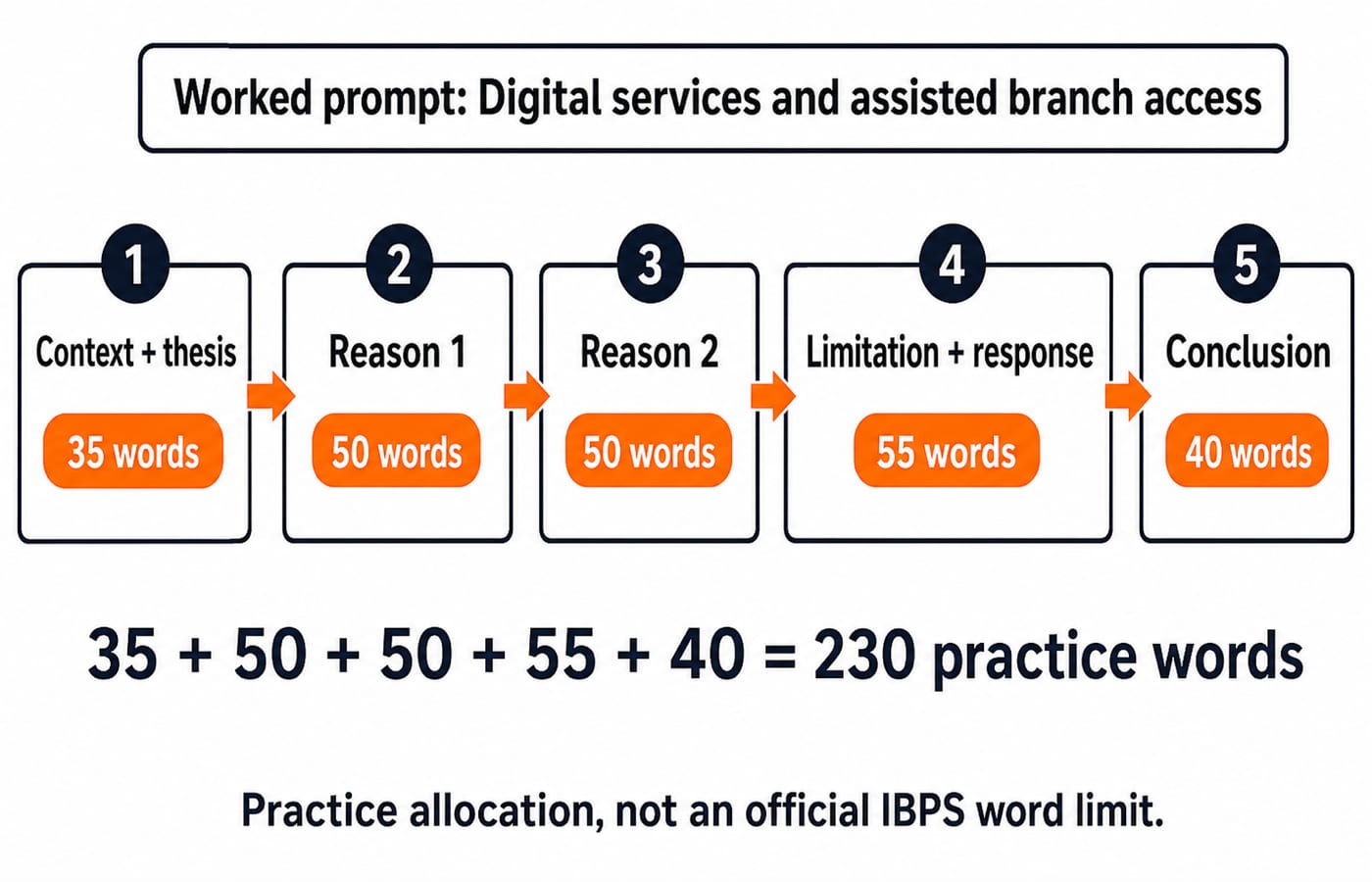
Prompt: Should financial literacy be a compulsory school subject rather than a service banks provide to adult customers? Allocate 35 words to context plus thesis, 50 to classroom reach and early habit formation, 50 to curriculum cost and teacher-capacity limits, 55 to the risk that lessons age faster than financial products plus your response, and 40 to a balanced conclusion with no new argument. Check: 35 + 50 + 50 + 55 + 40 = 230 practice words.
End paragraph 1: “Financial literacy should be a compulsory school subject because classrooms reach every future customer early, while banks continue to explain the products they sell.” Paragraph 4 concedes that lessons can age faster than financial products, then answers it by anchoring the syllabus in durable ideas such as interest, budgeting and contract reading rather than product walkthroughs.
Use reasoning, not invented statistics. A labelled hypothetical carries the argument safely: suppose 100 school leavers open first accounts, of whom 40 can read a loan statement unaided, 35 need guided help, and 25 sign without reading. Keep the word suppose inside the sentence, so an examiner reads a modelling step rather than a survey you are quoting. The IBPS PO English Preparation Plan owns the weekly minute budget and the reading and grammar loops that this writing slot sits inside, and runs a quick four-line score for its weekly drill; this guide owns what happens inside the slot, scored on the full rubric above.
IBPS PO essay scored example: turn an 11 into an 18
“Financial literacy is very important for everyone because money matters in life” merely asserts, excludes the counter-case, and gives no paragraph job. In rubric order, 3 + 2 + 1 + 2 + 3 = 11/20.
Repair it: “Financial literacy taught in school can reach every future customer before habits harden, but a fixed syllabus cannot track new products, so banks should still explain product terms at the point of sale. A split model keeps foundational skills in the classroom and leaves the fast-moving parts to providers.” It adds a qualified claim, mechanism, and boundary without fake statistics.
The revision scores 4 + 4 + 3 + 3 + 4 = 18/20. Idea development stays at 3 because foundational skills is named but never specified, so a reader still cannot tell which skills the classroom should own. Language control stays at 3 because the same category is called new products in one sentence and the fast-moving parts in the next, leaving the reader to map the two.
IBPS PO formal letter format: make the requested action unmistakable
Practice task: Write to the Branch Manager about a duplicate UPI debit of INR 4,850 and request investigation and reversal. Swap in whatever the prompt gives you: the name, address, bank and reference number below are placeholders, never data to reuse.
Arun Mehta
22 Lake Road, Bhopal
12 July 2026
The Branch Manager
ABC Bank, Lake Road Branch, Bhopal
Subject: Request for investigation and reversal of duplicate UPI debit of INR 4,850
Dear Sir or Madam,
I request an investigation into a duplicate debit of INR 4,850 recorded on 12 July 2026 under reference TXN-EXAMPLE-4821.
The transaction appears twice although only one payment was intended. I enclose the transaction extract.
Please verify the duplicate entry, reverse any incorrect debit and confirm the action taken through the registered contact channel.
I would appreciate a written update. Thank you for your assistance.
Yours faithfully,
Arun Mehta
Allocate 35 words to identification/event, 40 to facts/reference, 35 to investigation/reversal, and 20 to enclosure/close: 35 + 40 + 35 + 20 = 130 practice words. Five fields must survive the final check: date, amount, reference number, event, and requested action. Never write a full account number, PIN, OTP, or real personal data. Prefer request, verify, investigate, and reverse; avoid threats, pleading, and abbreviations.
IBPS PO formal letter scored example: repair tone, facts and closure
“Money problem” and “My money was cut twice and I am very upset” lack precise tone and facts. With no date, reference, or request, the rubric gives 2 + 2 + 1 + 2 + 2 = 9/20.
The repair fixes all three. The subject becomes “Request for investigation and reversal of duplicate UPI debit of INR 4,850”. The opening carries the amount INR 4,850, the date 12 July 2026 and the reference TXN-EXAMPLE-4821. The closing asks for three named actions: verify, reverse, confirm. Score 4 + 4 + 4 + 3 + 3 = 18/20. Language stays at 3 because “duplicate” does the work three times where a synonym would help, and format stays at 3 until every field has been checked against the prompt.
IBPS PO descriptive writing practice plan: a ten-attempt ladder
Attempt | Format | Target rubric row | Exit bar |
|---|---|---|---|
1 | Essay, baseline | All five rows scored | Score only, no target |
2 | Letter, baseline | All five rows scored | Score only, no target |
3 | Essay repair | Lowest essay row from attempt 1 | Repaired row rises one level |
4 | Essay repair | Second-lowest essay row from attempt 1 | Repaired row rises one level |
5 | Letter repair | Lowest letter row from attempt 2 | Repaired row rises one level |
6 | Letter repair | Second-lowest letter row from attempt 2 | Repaired row rises one level |
7 | Essay, fresh prompt | All five rows | 15/20 |
8 | Letter, fresh task | All five rows | 15/20 |
9 | Paired simulation: essay | All five rows | 16/20 |
10 | Paired simulation: letter | All five rows | 16/20 |
Ten scored attempts across two weeks carry the whole plan: roughly one attempt per sitting, with the paired simulation closing week two. Progress is measured in scored attempts completed, never in minutes on a clock. The IBPS PO Paper Analysis covers the topic-wise weightage method for the rest of Mains, so this ladder does not crowd out a weaker section.
Miss a day and the whole ladder shifts forward one day; never double up two attempts in one sitting to catch up, because an unscored rush teaches nothing the rubric can verify. The exit bars decide when you are done: clear 15/20 on attempts 7 and 8 and 16/20 on both simulation pieces, or insert extra repair attempts before moving up.
IBPS PO descriptive exam workflow: scale the method to the live instructions
Use 15% to plan, 70% to write, 15% to edit. A self-set 40-minute block is 6 minutes plan + 28 minutes write + 6 minutes edit = 40 minutes. Scale it to the live allowance.
When a paper offers a choice of prompts, score each on topic clarity, usable examples, and your ability to hold a balanced position, 0 to 2 per item. One such set scores digital banking 2 + 2 + 2 = 6, cryptocurrency regulation 1 + 1 + 2 = 4, and rural credit 2 + 1 + 2 = 5. Take the 6, then read its full wording again before you commit.
Check ibps.in for the applicable CRP PO/MT notification and call letter. They control task name, mode, languages, prompt count, marks, duration, word limits, typing, and evaluation. The IBPS PO Eligibility and Exam Pattern 2026 overview covers where the descriptive paper sits inside the wider Mains sequence.
IBPS PO descriptive writing: the short version and next step
Final check: answer the exact task; make one clear thesis or request; give every paragraph one job; use specific facts without invented statistics; keep formal tone; remove repetition; check fields and spelling; obey live official instructions.
Use plan, write, score, repair until both formats are controlled. If either is below 15/20 on this practice rubric, repair its weakest row before chasing speed. Writing skill built this way transfers between cycles, even when the prompt type changes. If grammar errors, not structure, are what the rubric keeps flagging, run the rule-family repair loop in the IBPS PO English Preparation Plan before the next ladder attempt. Use the IBPS PO Mains Preparation Course if structured wider Mains coverage plus descriptive practice would help. Focused self-practice at home with this rubric remains an honest alternative.
Keep learning
IBPS SO IT Officer Syllabus: What to Study for Each Section
Separate the official IBPS exam structure from the detailed study map. See what to cover for English, Reasoning, Quantitative Aptitude, Professional Knowledge and Descriptive English.
Updated 21 Oct 20264 min readIBPS Exams
IBPS SO IT Officer Preparation Strategy: A 16-Week Phase-by-Phase Plan
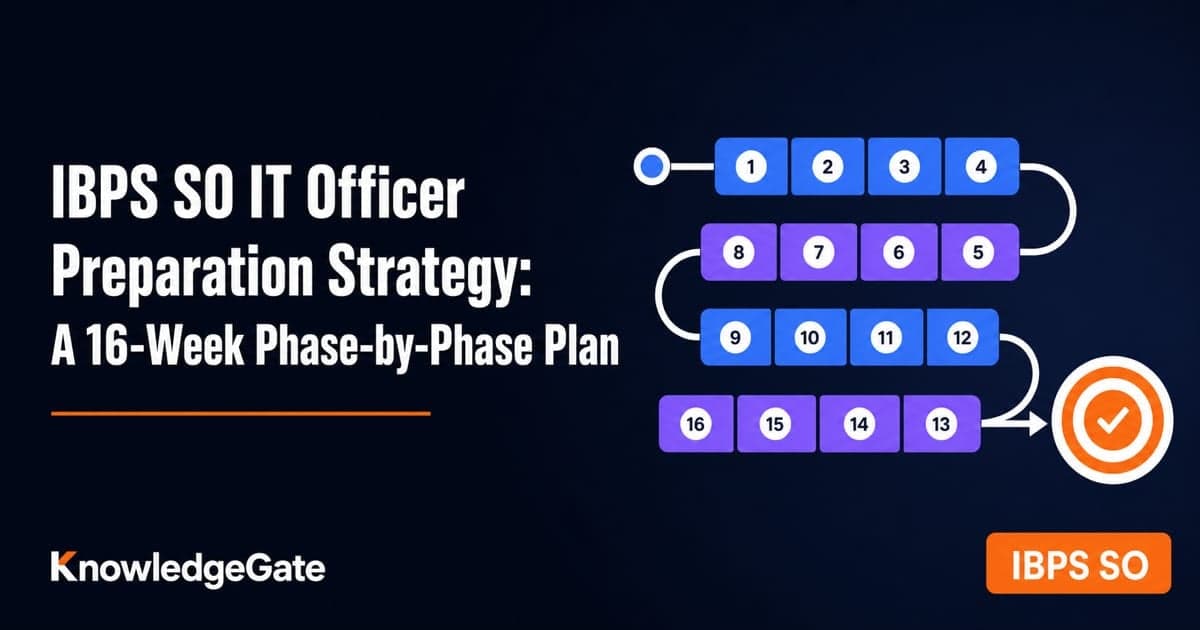
Turn 18 weekly hours into a realistic IBPS SO IT Officer plan, from the first diagnostic to mock repair, tapering and a conditional next-stage bridge.
Updated 17 Oct 20266 min readIBPS Exams
IBPS SO IT Officer Exam Pattern and Marking Scheme: Prelims, Mains and Interview
Understand the CRP SPL-XVI stage sequence, section timings and marks, then use worked score calculations and a 12-hour study plan to prepare for each stage.
Updated 13 Oct 20264 min read115 viewsIBPS Exams
IBPS Clerk Eligibility and Selection Process: From Application to Allotment
Separate the eligibility gate from the selection gate using a dated checklist, three candidate profiles and a 124-to-62 Main-score example.
Updated 8 Oct 20264 min readIBPS Exams