IBPS PO Preparation Strategy: A 16-Week Plan for Prelims and Mains
Turn 16 weeks into a workable IBPS PO routine. This plan shows how to divide study time, analyse drills, repair errors and retain Mains continuity.
KnowledgeGate Team
Exam prep & CS education
Updated 23 Sep 20265 min read
You can study for months yet reach mocks with slow selection, unreviewed errors and no Mains continuity. Use 16 weeks at 14 hours per week for 224 hours of foundation, timed practice, repair and rehearsal. Count backwards from your Prelims date, then adjust the weekly allocation after each four-week review. Treat the hour budgets, set sizes and thresholds as starting points, and keep only the rules that improve comparable results. Check the live pattern and calendar in the current CRP PO/MT notice.
1. IBPS PO preparation strategy: build the 224-hour framework
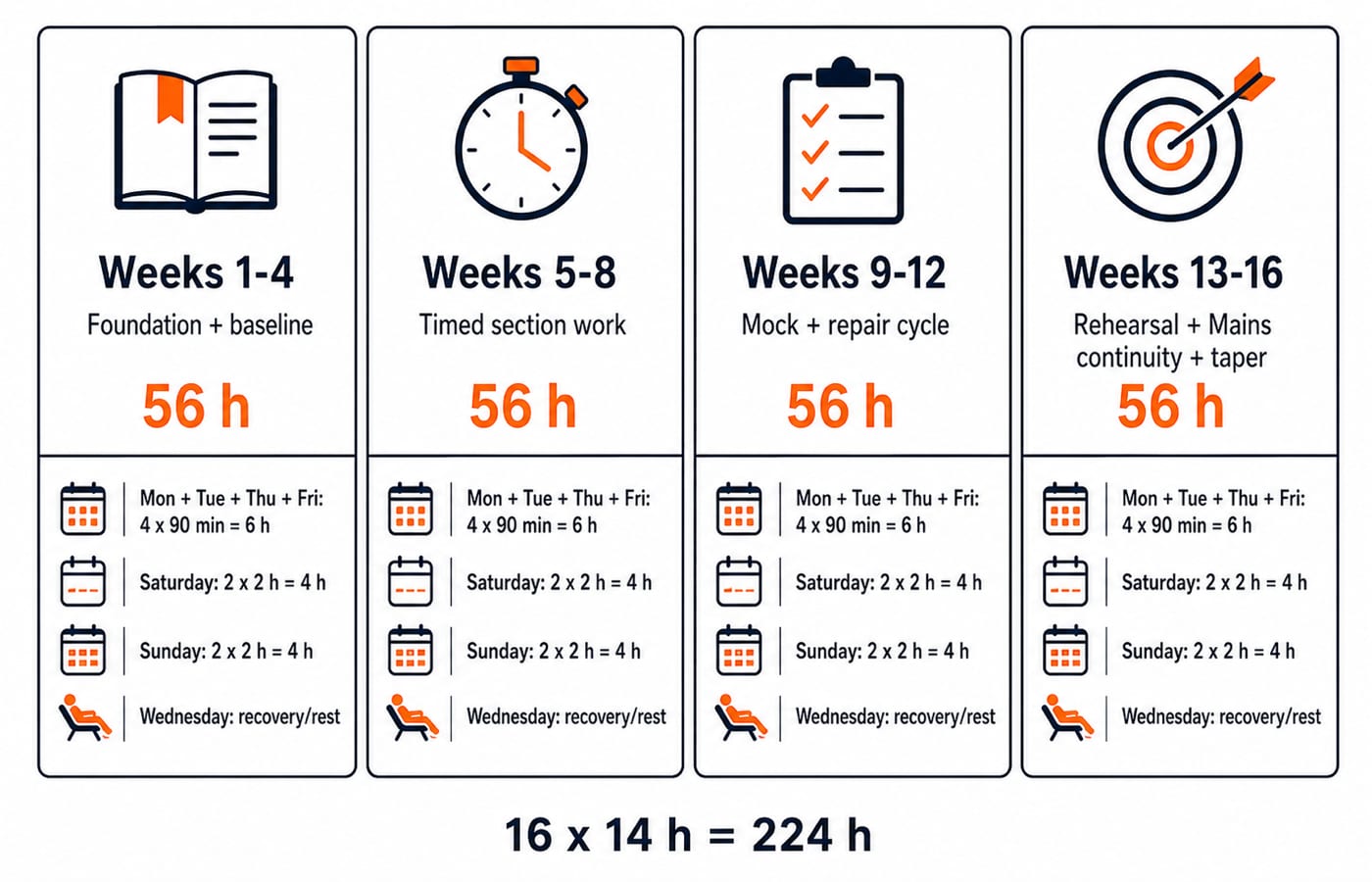
The recurring week is:
Monday, Tuesday, Thursday, Friday:
4 x 1.5 = 6 hours.Saturday:
2 x 2 = 4 hours; Sunday:2 x 2 = 4 hours.Total:
6 + 4 + 4 = 14 hours; 16 weeks:14 x 16 = 224 hours.Wednesday: recovery.
Weekday 90 minutes: 35 concepts, 35 timed, 20 review and logging. Weekend 2 hours: test and review, or 50 repair, 50 re-solving, 20 recall. Confirm the format on the IBPS website.
Weeks | Focus | Hours |
|---|---|---|
1-4 | Foundation and baseline | 56 |
5-8 | Timed sectional work | 56 |
9-12 | Mock cycle and targeted repair | 56 |
13-16 | Rehearsal, Mains continuity and taper | 56 |
Total | Four phases | 224 |
For the wider route into these subjects, see the IBPS PO & SO IT Exam Preparation category. Work through these subjects in four phases: foundation, timed sectional work, mock cycle and targeted repair, then rehearsal and taper.
2. IBPS PO Phase 1, Weeks 1-4: measure the baseline before chasing speed
Allocate 56 hours: Quantitative Aptitude 18, Reasoning Ability 18, English Language 10, early Mains 6 (3 awareness notes, 3 descriptive writing), diagnostics and error-log review 4. KnowledgeGate's Prelims course covers the first three. Match every timed drill to the current notification.
Take three self-made 30-item diagnostic drills:
Drill | Attempted | Correct | Wrong | Unattempted | Accuracy |
|---|---|---|---|---|---|
Quant | 18 | 14 | 4 | 12 |
|
Reasoning | 23 | 19 | 4 | 7 |
|
English | 26 | 22 | 4 | 4 |
|
Four wrong each, but Quant's 12/30 = 40% untouched makes it the speed bottleneck. Tags: C concept, M slow method, R reading error, S deliberate skip. For 6 C + 5 M + 2 R + 3 S, allocate 6 hours: 2.5 concepts, 2 alternative methods, 0.5 reading discipline, 1 re-test. Use IBPS PO Paper Analysis: Topic-wise Weightage for evidence-led review, not prediction.
3. IBPS PO Phase 2, Weeks 5-8: turn methods into timed section choices
Hours: timed Quant 14, Reasoning 14, English 8, sectional and mixed tests 8, awareness 6, descriptive writing 4, audits 2. Check: 14 + 14 + 8 + 8 + 6 + 4 + 2 = 56.
Weekly: three timed section drills, one mixed drill, one audit. Phase total: 12 section, 4 mixed, 4 audits. Only reviewed work counts.
Self-made 40-item, 35-minute drill. Pass one: 24 attempted, 21 correct, 3 wrong. Pass two: 7 attempted, 5 correct, 2 wrong. Totals: attempted 24 + 7 = 31; correct 21 + 5 = 26; wrong 5; omitted 40 - 31 = 9; accuracy 26/31 x 100 = 83.9%; coverage 31/40 x 100 = 77.5%. Review 5 + 9 = 14 unresolved items for knowledge, method or skipping. Use these two rates to compare like-for-like practice sets, not to forecast a score.
4. IBPS PO Phase 3, Weeks 9-12: make mock analysis drive the next week
Hours: mocks plus review 20, sectional repair 10, Quant 8, Reasoning 6, English 4, awareness 4, descriptive 4. Check: 20 + 10 + 8 + 6 + 4 + 4 + 4 = 56. Do two current-format simulations weekly, eight overall.
Self-made 80-item set: 64 attempted, 52 correct, 12 wrong, 16 unattempted. Accuracy: 52/64 x 100 = 81.25%; coverage: 64/80 x 100 = 80%; whole-set correct: 52/80 x 100 = 65%; review pool: 12 + 16 = 28.
Classify the 28: 8 concept gaps, 7 slow methods, 5 misreads, 8 sensible skips. Next 14 hours: concepts 4, methods 3, reading and selection 2, two mocks plus review in 4, Mains 1. Re-solve 20 non-deliberate errors without notes first. Follow attempt -> classify -> repair -> re-test.
5. IBPS PO Phase 4, Weeks 13-16: rehearse, protect review and taper honestly
Hours: simulations plus review 24, weak-area repair 12, awareness 8, descriptive 6, formula, vocabulary and error-log recall 4, buffer 2. Check: 24 + 12 + 8 + 6 + 4 + 2 = 56. Maximum three simulations weekly, all reviewed.
Final 14-hour week: two simulations plus review 5, top-two weak areas 3, awareness 2, two reviewed descriptive pieces 2, formula and vocabulary 1, contingency 1. Add no new source.
Move one missed 90-minute session to Wednesday. For two, use Wednesday and the 2-hour contingency; its extra 30 minutes becomes review. For three or more, record the real total and extend if possible. Otherwise cut new notes and enrichment, never mock review, sleep or Mains continuity.
6. IBPS PO Prelims and Mains: keep a sidecar before the result
Mains receives 6 hours in Phase 1, 10 in Phase 2, 8 in Phase 3, 14 in Phase 4: 6 + 10 + 8 + 14 = 38 hours. The Mains course prepares Reasoning and Computer Aptitude, Data Analysis and Interpretation, English, General, Economy and Banking Awareness, and descriptive English. Check the current notification before matching these areas to the live structure.
With unstable fundamentals, keep the 6-hour sidecar and favour core speed. After clearing your threshold, raise Mains to 10 to 14 hours per phase. Waiting creates a restart.
After Prelims, switch to IBPS PO Mains Preparation After Prelims: A Realistic 6-Week Transition Plan, which owns the six-week post-Prelims timetable, rising mock cadence and Mains-only recovery rules. This 16-week plan owns the earlier foundation, timed-section and continuity phases.
7. IBPS PO progress tracking: use trends, not one flattering mock
Track date, source, attempted, correct, wrong, omitted, accuracy, coverage, time lost, top error tag and re-test date. Compare like conditions only.
Four equal self-made 60-item sets, 50 attempted each. Correct: 36, 39, 41, 42. Accuracy: 36/50 = 72%, 39/50 = 78%, 41/50 = 82%, 42/50 = 84%. Last-three average: (78 + 82 + 84)/3 = 81.3%. Across comparable practice sets, the trend improves while 10/60 = 16.7% remains unattempted.
Set rules before the next mock:
At 5 concept errors or more, replace one mock with repair.
At least 80% accuracy with 12 unattempted or more means practise method choice and first-pass selection.
A 5-point fall across two comparable tests means inspect sleep, difficulty, source and time split before changing the plan.
8. IBPS PO preparation plan: the short version and next step
Protect 14 honest hours. Build for four weeks, time sections for four, repair from mocks for four, then rehearse and taper. Keep 38 Mains hours so the later transition does not begin from zero.
Schedule four 90-minute sessions. Take three 30-item baselines, calculate attempted, accuracy and unattempted, then assign C/M/R/S repair. The optional IBPS PO Prelims Preparation Course structures English, Quant and Reasoning. The optional IBPS PO Mains Preparation Course supports the deeper Mains lanes and the post-Prelims transition.
Keep learning
IBPS PO Preparation Mistakes: 7 Errors That Cost Final Selection
Hard work is not enough when attempt counts, new resources and rigid timetables hide weak accuracy. Replace seven common errors with measurable habits.
Updated 4 Oct 20265 min readIBPS Exams
IBPS PO Last 60 Days Plan: Revision, Mocks and Error Repair
Turn the final 60 days into a measured cycle of diagnosis, revision, mocks, retests and tapering, with worked schedules for a realistic 14-hour week.
Updated 29 Sep 20264 min readIBPS Exams
IBPS PO Cutoff Trends: Set a Defensible Target Score
Learn how to separate IBPS PO cutoff history by cycle, stage, category and denominator, then turn comparable Main values into a transparent practice target.
Updated 25 Sep 20265 min readIBPS Exams
IBPS PO Previous Year Analysis: Recurring Question Formats and Attempt Priorities
See what genuinely recurs across IBPS PO papers, solve representative format drills, and turn your own accuracy and speed into a practical attempt priority.
Updated 24 Sep 20265 min readIBPS Exams