Counteroffer Decision Framework: Separate Retention Pressure from Career Fit
A practical way to revisit why you resigned, grade each new claim by evidence, compare both roles with weighted priorities, and communicate a final decision.
KnowledgeGate Team
Exam prep & CS education
Updated 3 Aug 20265 min read
After you resign, your employer may respond with recognition, a deadline and a higher number. The old role can suddenly look better even when the reasons for leaving have not changed. Three things usually arrive together in that conversation and only one of them is decision-grade: pressure (a deadline with nothing attached to it), a promise (a stated intention) and proof (a written, dated term with a named owner). Neither accepting nor rejecting is automatically right.
Rebuild the original case for leaving
Reconstruct your reasons from notes, messages and calendar events recorded before resigning. Separate fixable conditions from structural problems before discussing revised compensation, so the new number does not rewrite the old problem.
Consider an early-career software developer, Aarav, who had written down four reasons:
Support tickets occupied about 70% of his week.
Two earlier scope conversations produced no ownership change.
Promotion criteria were still not documented.
Compensation was a concern, but not the only one.
Mark each reason resolved with evidence, promised but unverified, or unchanged. Label anything first raised after the counteroffer as new information, not an original reason.
Sort each statement into pressure, promise or proof
Use a five-column evidence ledger. Pressure is urgency without career-fit evidence. A promise is a future intention. Proof is an inspectable term or operating change.
Statement | Bucket | Accountable owner | Evidence | Effective date or checkpoint |
|---|---|---|---|---|
"We need an answer by 5 pm" | Pressure | HR contact | Deadline only | 5 pm |
"We see you leading the module soon" | Promise | Manager | Verbal intention | Unspecified |
"Module ownership begins on day 1, the reporting line is named, and a day-60 review is written into the plan" | Proof | Named manager | Written role plan | Day 1 and day 60 |
A written term is easier to verify, though writing does not erase a weak delivery history. The test is not legal enforceability but specificity: each term should name an owner, a start date and an observable change in the work, so you can compare it now and check it again later.
Score career fit, not just the headline number
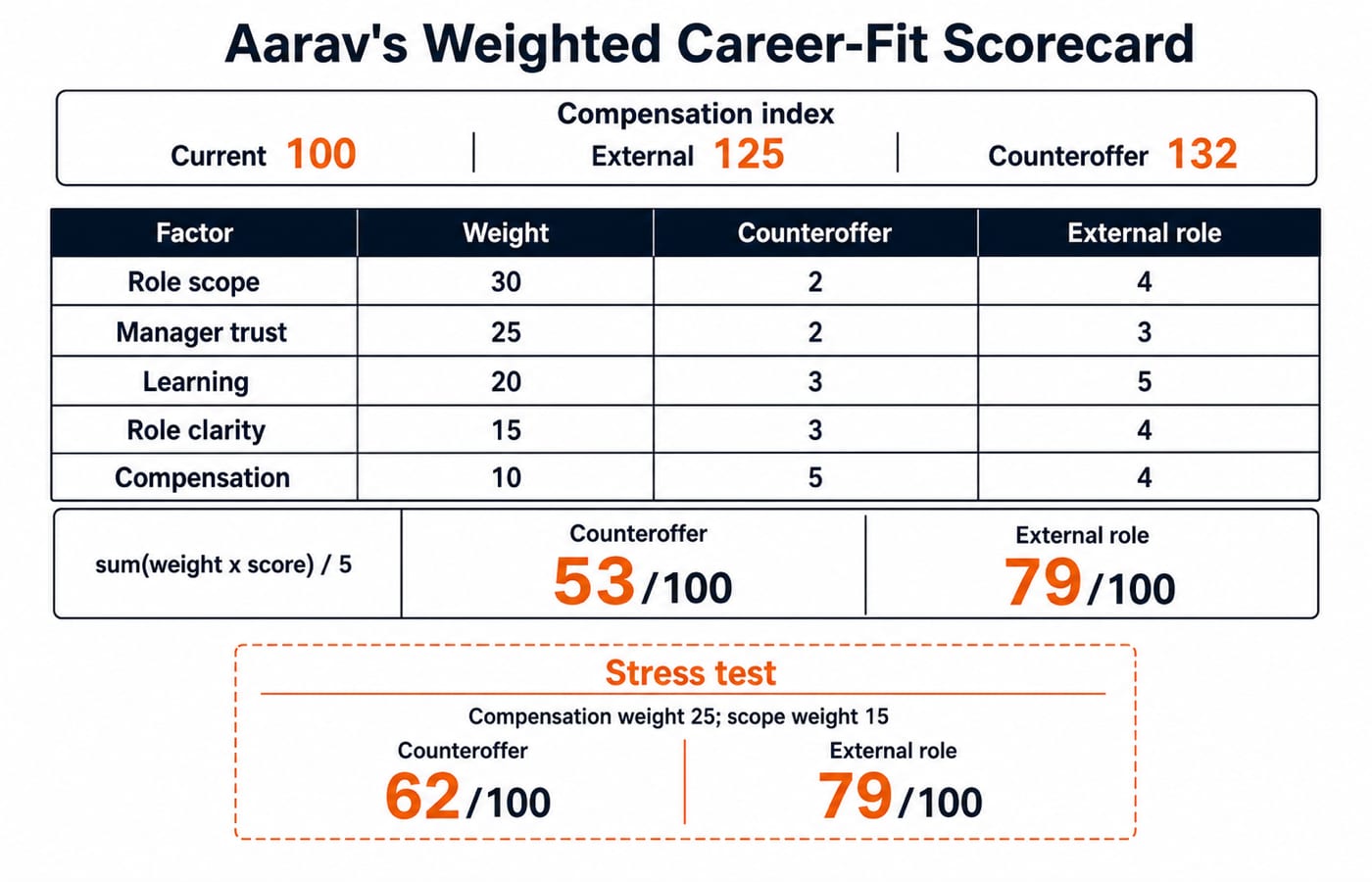
Aarav weights five priorities to total 100, then scores each option from 1 to 5.
Priority | Weight | Counteroffer score | External role score |
|---|---|---|---|
Role scope | 30 | 2 | 4 |
Manager trust | 25 | 2 | 3 |
Learning | 20 | 3 | 5 |
Role clarity | 15 | 3 | 4 |
Compensation | 10 | 5 | 4 |
Use weighted total = sum(weight x score) / 5. Because the weights total 100 and the highest score is 5, a perfect option scores 100.
Counteroffer:
(30 x 2 + 25 x 2 + 20 x 3 + 15 x 3 + 10 x 5) / 5 = (60 + 50 + 60 + 45 + 50) / 5 = 265 / 5 = 53.External role:
(30 x 4 + 25 x 3 + 20 x 5 + 15 x 4 + 10 x 4) / 5 = (120 + 75 + 100 + 60 + 40) / 5 = 395 / 5 = 79.
On a compensation index, current is 100, external is 125 and counteroffer is 132. The counteroffer wins on compensation, but loses Aarav's career-fit comparison.
Stress-test rather than treating the score as truth. Raising compensation from 10 to 25 and cutting scope from 30 to 15 gives the counteroffer (15 x 2 + 25 x 2 + 20 x 3 + 15 x 3 + 25 x 5) / 5 = 310 / 5 = 62. The external role remains (15 x 4 + 25 x 3 + 20 x 5 + 15 x 4 + 25 x 4) / 5 = 395 / 5 = 79. Evidence and hard constraints still matter.
Test trust and future scope against delivery
For each change, ask: Who owns it? When does it start? What observable work changes? What happens at the checkpoint? Replace "more backend exposure" with ownership of services A and B from day 1, a named reviewer and a day-60 scope review.
Aarav's two earlier scope conversations changed nothing, so a third verbal assurance deserves less trust than a staffed change with a named owner. A sincere counteroffer can still leave role design, manager behaviour or progression unfixed. Score verifiable change, not assumed motive.
Run the no-premium test and a 90-day pre-mortem
Ask: if the counteroffer index were 125, equal to the external role instead of 132, would Aarav stay for the documented role? If yes becomes no, the extra 7 points are carrying the decision. Review the underlying fit.
Next, imagine each choice going badly after 90 days:
Accept and the old job returns: likelihood 4/5, impact 4/5, recoverability 3/5. Written ownership, changed staffing and a named checkpoint could lower the likelihood.
Join and the external scope disappoints: likelihood 2/5, impact 4/5, recoverability 2/5. Speaking with the future manager and team about actual first-quarter work could lower the likelihood.
Do not add the ratings. Identify evidence that would change each risk. Then ask: if the external offer disappeared today, would the documented counteroffer make this role worth another 12 months? Answer in one reasoned sentence, not from relief or guilt.
Complete a three-hour decision sprint across 48 hours
Spread the work over two calendar days:
Spend 45 minutes rebuilding the original reasons.
Spend 60 minutes verifying terms and completing the evidence ledger.
Spend 45 minutes scoring both roles and stress-testing the weights.
After a sleep break, spend 30 minutes writing the decision note.
That is 45 + 60 + 45 + 30 = 180 minutes. For a compressed deadline, use 20 minutes for reasons, 30 for evidence, 15 for scoring and 10 for the response: 20 + 30 + 15 + 10 = 75 minutes. Cut formatting and opinions, not evidence checks. Mark unverifiable promises unverified.
If you continue the transition, Placement Preparation can help organise the next stage. It cannot decide whether you should stay.
Decide with hard constraints, then communicate clearly
Identify hard constraints before using the score. An unacceptable reporting relationship or unchanged role condition cannot be averaged away. Write a one-page note with your choice, top three reasons, evidence, main risk and one mitigation.
Respond with appreciation, a clear decision, the next step and a date. Avoid accusations and do not reopen the negotiation history. If moving on, use HR interview questions and answers to rehearse a calm explanation of your goals and reasons for change. No script guarantees an offer.
The short version and next practical step
Recover the original reasons. Classify pressure, promise and proof. Compare documented career fit with weights chosen before the new number dominates.
A close score calls for another evidence and constraints review, not more elaborate arithmetic.
If leaving, update your role-specific resume with the resume guide for early-career candidates. For structured practice on the resume and the interview together, the Interview & Resume Preparation Course covers both in one track. Write the decision note, send the response, and begin the next action.
Keep learning
Placement Mock Analysis: One Error Ledger Across Every Test Round
Use one error ledger without flattening unlike round results. This worked example shows how to find the first wrong step, prioritise repairs and close errors only after fresh retests.
Updated 4 Oct 20265 min readInterview Corner
Internship to PPO: Build a Weekly Evidence Trail Before the Final Review
Use a weekly outcome ledger to make your internship work visible before the final review. This practice model shows how to record delivery, feedback, effect and handoff honestly.
Updated 28 Sep 20265 min readInterview Corner
DSA Mock Interview Rubric: A 100-Point Scorecard for Reasoning, Code and Communication
A practical six-part scorecard for running comparable DSA mocks, grading visible evidence and turning weak areas into the next week's practice.
Updated 25 Sep 20265 min readInterview Corner

Campus Recruitment Timeline: Stage by Stage from Pre-Placement Talk to Written Offer
Follow a campus drive without guessing. Build an evidence sheet, verify eligibility, plan each preparation window and check the written offer before responding.
Updated 24 Sep 20265 min readInterview Corner