
A backend learner rarely needs an abstract winner between Go and Rust. They need to weigh fast implementation and a small concurrency vocabulary against compile-time ownership and thread-safety checks. The same ThumbnailJob worker in both languages uses six jobs, two handlers, a queue with capacity 3, 4096-byte payloads and 12 ms deadlines. With the same architecture, each language makes some mistakes easy, some visible and others impossible in its safe subset, while the Coding & DSA Courses for Placements catalogue provides a broader learning path.
Go vs Rust: define simplicity and stronger guarantees
Simplicity means Go's small surface, garbage-collected ownership, goroutines, channels and cancellation. It never means race freedom: queues, synchronization and measurement stay explicit.
Stronger guarantees means safe Rust uses ownership, borrowing and Send or Sync to reject many use-after-free, aliasing and cross-thread mutation errors. It proves neither business correctness, deadlines, deadlock freedom nor absence of logical races. unsafe and FFI define audit boundaries.
Decision axis | Go emphasis | Rust emphasis | Project question |
|---|---|---|---|
Concurrency model | Goroutines/channels | Owned runtime tasks | Debuggability? |
Ownership | Convention/locks | Moves/borrows | May buffers alias? |
Memory reclamation | Tracing GC | Ownership | Written constraint? |
Tail-latency investigation | GC/scheduler | Allocator/executor | Profiling plan? |
Compile feedback | Less ownership friction | More constraints | Build-blocking defects? |
Binary dependencies | Toolchain/cgo | Target/native libraries | Image contents? |
Team learning curve | Smaller surface | Ownership model | Future operators? |
Hold contract, queue, workers and machine fixed. Ignore popularity, salary, benchmark headlines and slogans.
Go vs Rust network worker: trace the same six jobs
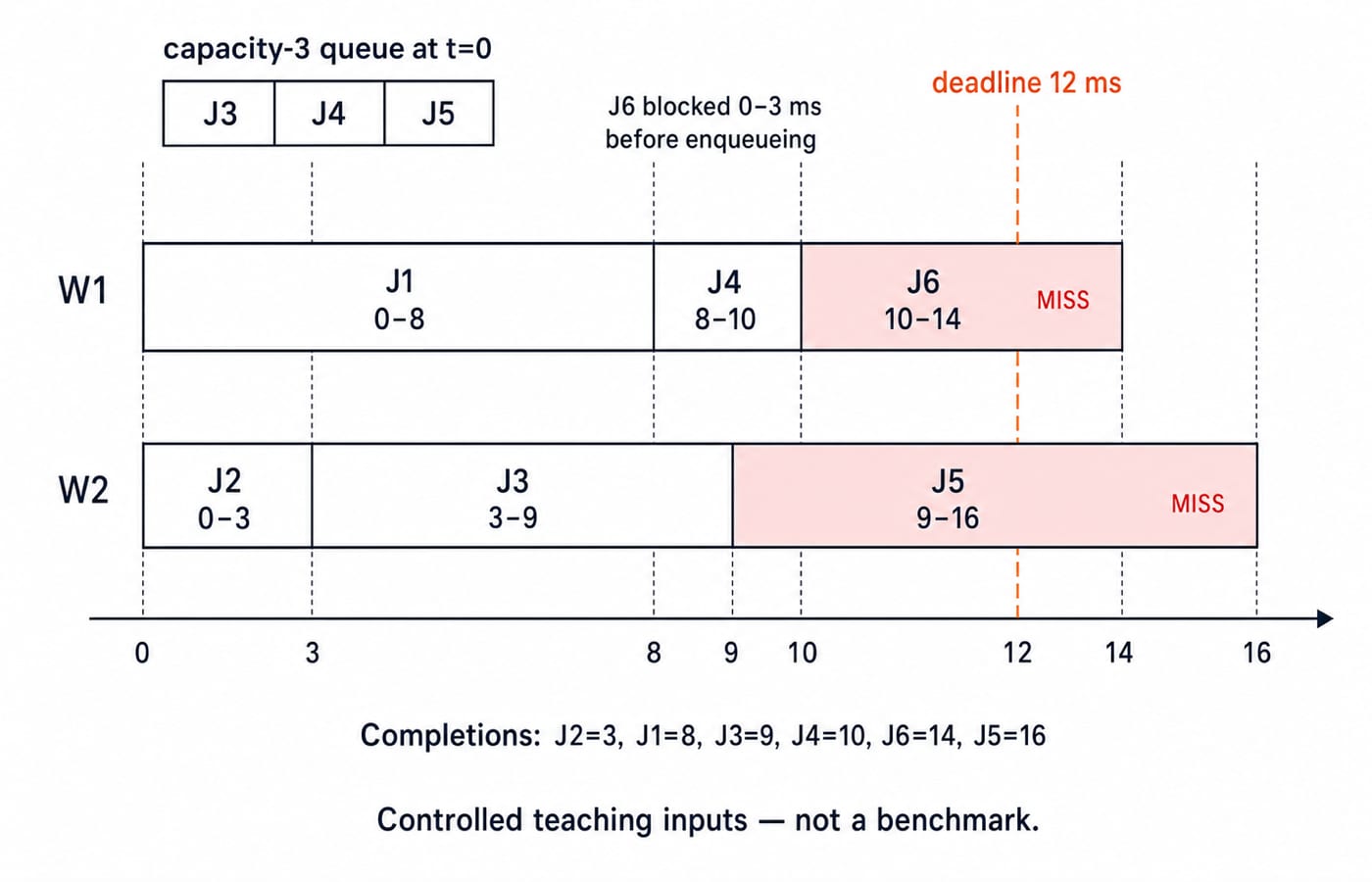
ThumbnailJob{id, payload, deadline_ms} fixes 4096 payload bytes and a 12 ms absolute deadline after t=0. Ordered jobs J1 through J6 take [8, 3, 6, 2, 7, 4] ms. Slots W1,W2 share a capacity-3 FIFO queue.
At t=0, W1 starts J1, W2 starts J2, and J3,J4,J5 fill the queue, blocking producer J6. At t=3, J2 finishes, W2 takes J3, and J6 enters the free slot. At t=8, W1 takes J4; at t=9, W2 takes J5; at t=10, W1 takes J6.
If work finishes, completion times are J2=3, J1=8, J3=9, J4=10, J6=14 and J5=16 ms; makespan is 16 ms. J1 to J4 meet 12 ms; J5 and J6 miss unless cancelled. Both get this schedule. Queueing and service times cause the misses.
Go vs Rust concurrency: channels are a shape, not a proof
Go can use jobs := make(chan Job, 3), two worker goroutines and a sending select that observes cancellation. A context.Context carries the 12 ms deadline. The channel supplies capacity and blocking behavior, not fair scheduling, correct shutdown or race freedom elsewhere.
Rust can use a capacity-3 async channel, at most two handler futures or tasks, owned jobs and explicit timeouts. An async runtime or library supplies its executor and channel; the standard library alone is not a full async runtime.
Safety differs from liveness. Rust rejects unsuitable unsynchronized cross-thread access, yet mutexes can deadlock and bounded channels can back up. Go keeps the loop concise, yet shared maps and shutdown need coordination. Process Synchronization and Semaphores develops races, critical sections and signalling.
Go vs Rust memory safety: follow one 4096-byte payload
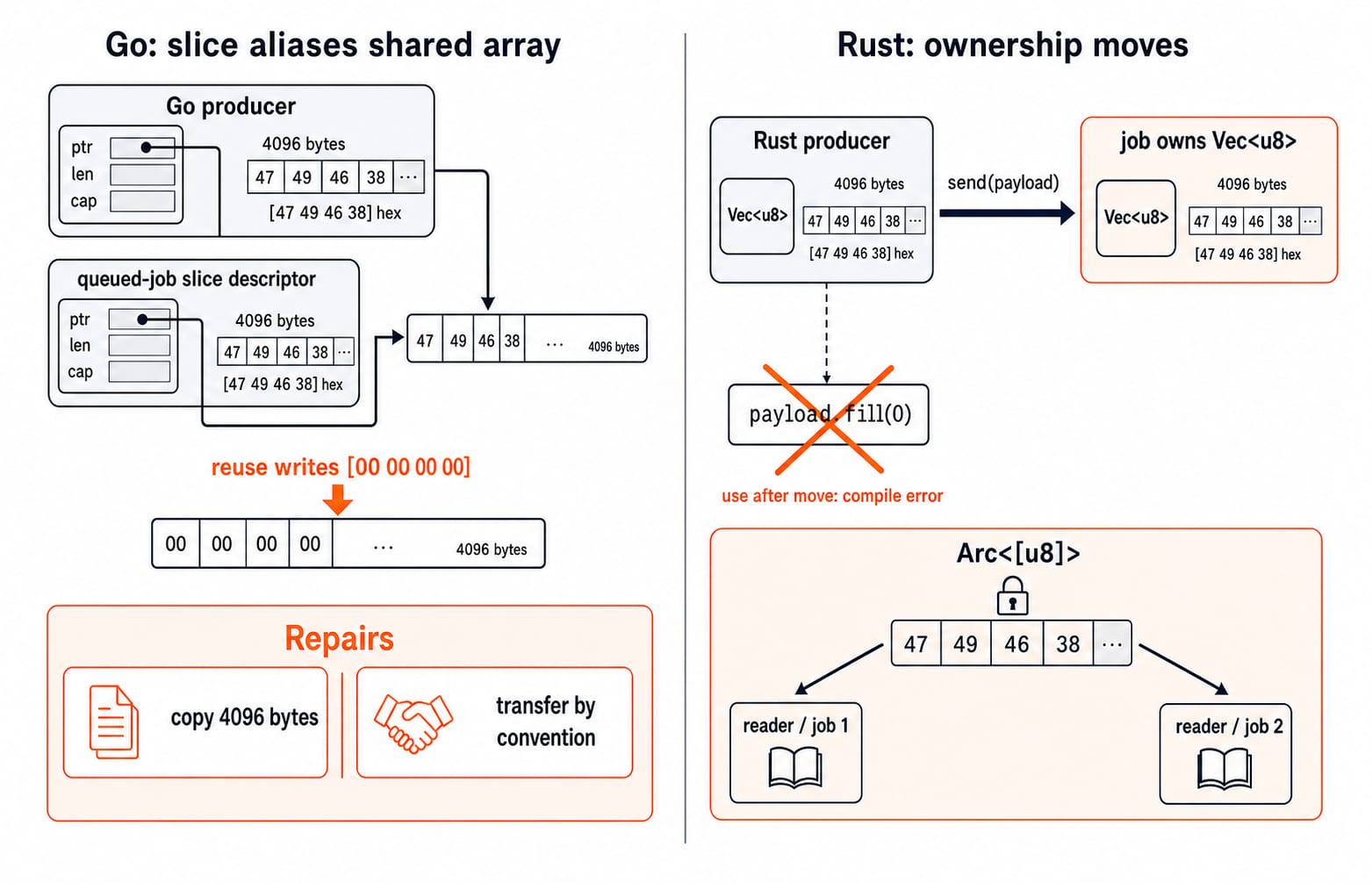
In Go, a producer makes payload := make([]byte, 4096), writes [0x47, 0x49, 0x46, 0x38], then sends it. The channel copies its descriptor, not the backing bytes. If the producer immediately zeros them, the worker may read four zeroes or race. Pointers in C for GATE shows how two descriptors or pointers can name one storage area.
Go can copy 4096 bytes before sending, paying allocation and copy; or transfer ownership by convention and forbid reuse until return. Garbage collection keeps memory alive, not the rule.
In Rust, send an owned Vec<u8> by value. After send(payload), payload.fill(0) is a use-after-move error. Sharing requires an explicit form such as immutable Arc<[u8]> or synchronized mutable state. Safe Rust blocks this use-after-free and data-race pattern, but unsafe, FFI, deadlocks and bad ownership designs still need review.
Go vs Rust latency control: measure the tail
Test 10,000 requests at concurrency 64, with 4096-byte payloads, queue 128, deadline 50 ms, and a fixed machine and dataset. Force 100 handlers to take 80 ms; give 9,900 a deterministic normal fixture. Record throughput, timeouts, allocation rate, peak memory and p50, p95, p99 end-to-end latency for both builds. These are inputs, not results.
Budget 5 ms for ingress and parse, 10 ms for queueing, 25 ms for handling, 5 ms for response and 5 ms reserve: 5 + 10 + 25 + 5 + 5 = 50 ms. An 80 ms handler needs rejection, cancellation, degradation or asynchronous execution.
For Go, inspect allocations, GC, scheduler delay, locks and blocked goroutines. For Rust, inspect allocations, allocator and executor delay, locks and destructor work. Tracing GC alone does not settle tail latency.
Go vs Rust compile-time complexity: when friction buys safety
Go can compile while two goroutines retain aliases to one slice, leaving correctness to review, ownership convention and race-focused tests. Safe Rust rejects reuse of a moved vector, forcing a deliberate move, copy, borrow or share before execution.
Add a tenant_id -> completed_jobs map. Go needs a mutex, actor-style owner or another synchronization strategy. Rust requires cross-thread values to meet thread-safety constraints and makes mutable sharing explicit, often through a lock or message owner. Neither proves lock order or counter semantics correct.
Measure rather than guess build speed: run 20 clean and 50 incremental builds after the same one-line edit on one CI runner, comparing median and p95 feedback. The C++ Tutorial builds pointer and memory foundations for evaluating ownership models.
Go vs Rust deployment: compare the whole operating model
Target linux/amd64, one service process per container, 1 CPU, 256 MiB, maximum 64 in-flight requests, /healthz, and 10 s termination grace. Compare cold start, memory, dependencies, cross-builds, observability, crashes and debugging.
Pure Go often ships as one executable, but cgo and native dependencies change that. Rust also produces a native executable; its target and native libraries determine runtime needs. Inspect the image because neither is always static.
Choose Go when five Go-familiar engineers need an internal JSON prototype in 2 weeks. Choose Rust for a hostile-input parser requiring no tracing GC and strict memory bounds. Mix a Go control service with a Rust worker only when profiling justifies extra IPC or FFI complexity. These are scoped calls, not rankings. Verify version-sensitive behavior for the chosen toolchain.
Go vs Rust decision matrix: score, then prove
Ratings guide discussion, not objective truth. Maximum weighted total: 500.
Criterion | Team A weight | Hostile worker weight | Go rating | Rust rating |
|---|---|---|---|---|
Time to first operable service | 30 | 10 | 5 | 3 |
Compile-time ownership and thread-safety checks | 25 | 35 | 3 | 5 |
Tail-latency control | 20 | 25 | 3 | 4 |
Artifact control | 15 | 15 | 4 | 4 |
Current team fluency | 10 | 15 | 4 | 2 |
Team A: Go 385/500, Rust 375/500. Hostile worker: Go 350/500, Rust 395/500. Each sums weight × rating, so priorities change the result.
Reproduce 16 ms; explain both 12 ms misses; repair Go's slice reuse; state the move check's protection and limits.
The short version
Prefer Go when delivery and fluency dominate. Prefer Rust for written requirements around ownership, no tracing GC or a narrow safety boundary. Load-test either. The C++ Programming Course builds adjacent systems-language foundations, not Go or Rust. Next, build the worker twice and compare failures.