C++ Tutorial: The Complete Learning Path from First Program to STL
Learn C++ in the order that makes difficult ideas manageable. This roadmap gives you six stages, practical checkpoints and a clear route into exam and placement practice.
KnowledgeGate Team
Exam prep & CS education
Updated 21 Jul 20266 min read175 views
You have watched three random C++ videos, read half a tutorial site and written a few disconnected programs. You still cannot say what comes next. C++ is not hard because every topic is hard; it becomes hard when learners meet pointers or object-oriented programming before the foundation is ready. Order fixes that. Six stages, each with an honest time band and one checkpoint program: if you cannot write that program from a blank file, you are not ready for the next stage.
1. The full C++ ladder at a glance
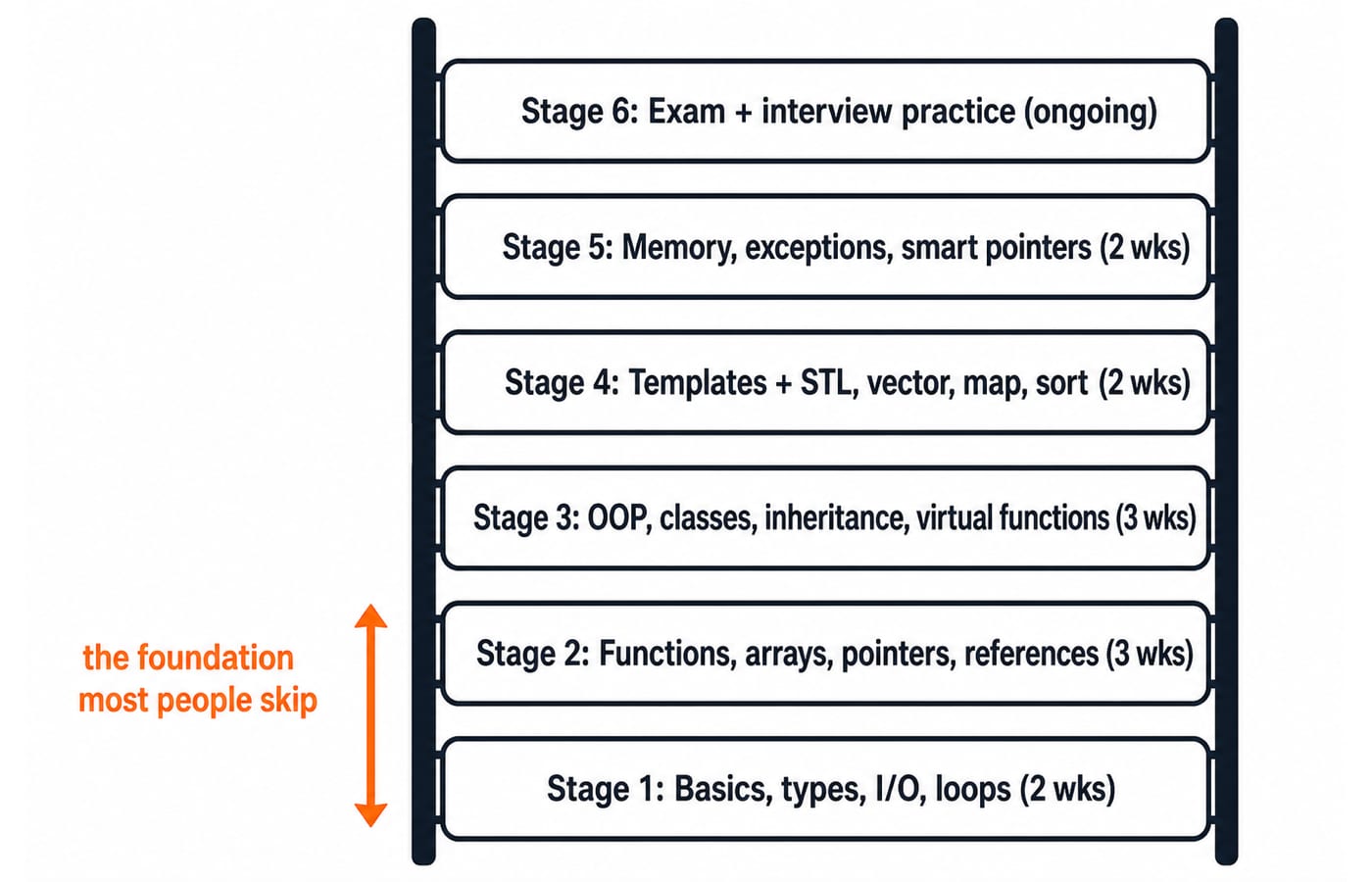
For a student studying 1 to 1.5 hours a day, the learning ladder looks like this:
Basics, 2 weeks: types, input and output, conditions and loops.
Functions, arrays, pointers and references, 3 weeks: how data moves through a program.
Object-oriented programming, 3 weeks: classes, inheritance and virtual functions.
Templates and the STL, 2 weeks: reusable types, containers and algorithms.
Memory, exceptions and modern C++, 2 weeks: resource ownership and safer language features.
Exam and interview practice, ongoing: output questions, error spotting and coding tasks.
The five finite stages add up to roughly 12 weeks. At that point, your C++ should be genuinely usable, though fluency still comes from continued practice.
The one rule is simple: do not skip Stage 2. Many learners jump from loops to classes without becoming comfortable with pointers and references. They then blame OOP for confusion that began one stage earlier.
2. Stage 1: Basics, types, input and control flow
Start with variables and the fundamental types int, double, char and bool. Then learn cin, cout, if/else, switch, for and while. Also separate compile errors from logic errors: a compile error stops the program from being built, while a logic error lets it run and produce the wrong result.
Your checkpoint is a marks program. Read 72, 85 and 64, then calculate the total and average.
int a = 72, b = 85, c = 64;
int sum = a + b + c;

cout << sum << "\n";          // 221
cout << sum / 3 << "\n";      // 73
cout << sum / 3.0 << "\n";    // 73.6667 with suitable formatting
The arithmetic is 72 + 85 + 64 = 221. With integers, 221 / 3 produces 73 because integer division drops the fractional part. Using 3.0 changes the calculation to floating-point division: 221 / 3.0 = 73.666666..., displayed as 73.6667 to four decimal places or 73.67 to two decimal places.
You are ready to leave Stage 1 when you can write this program from a blank file without looking anything up.
3. Stage 2: Functions, arrays, pointers and references
Learn this stage in a strict order: function declaration and definition, pass by value, arrays and their decay to pointers, the pointer operators * and &, then references as safer aliases when a function needs to work with an existing object.
The swap checkpoint makes the difference visible:
void swapByValue(int x, int y) {
    int temp = x;
    x = y;
    y = temp;
}

void swapByReference(int &x, int &y) {
    int temp = x;
    x = y;
    y = temp;
}
Start both demonstrations with a = 10 and b = 25. The outputs should be:
Before value swap: a = 10, b = 25
After value swap:  a = 10, b = 25

Before reference swap: a = 10, b = 25
After reference swap:  a = 25, b = 10
The value version changes copies named x and y, so the original variables stay unchanged. The reference version makes x and y aliases for the originals, so the swap succeeds.
This is where many self-learners quit. The remedy is not another long video. Solve 20 to 30 small pointer and reference exercises until tracing an address, dereferencing a pointer and passing by reference become routine.
4. Stage 3: Object-oriented C++, from classes to virtual functions
Begin with a class and its objects. Add constructors and destructors, then use private data with public methods to understand encapsulation. Learn inheritance only after that. Virtual functions and runtime polymorphism belong at the end of the sequence.
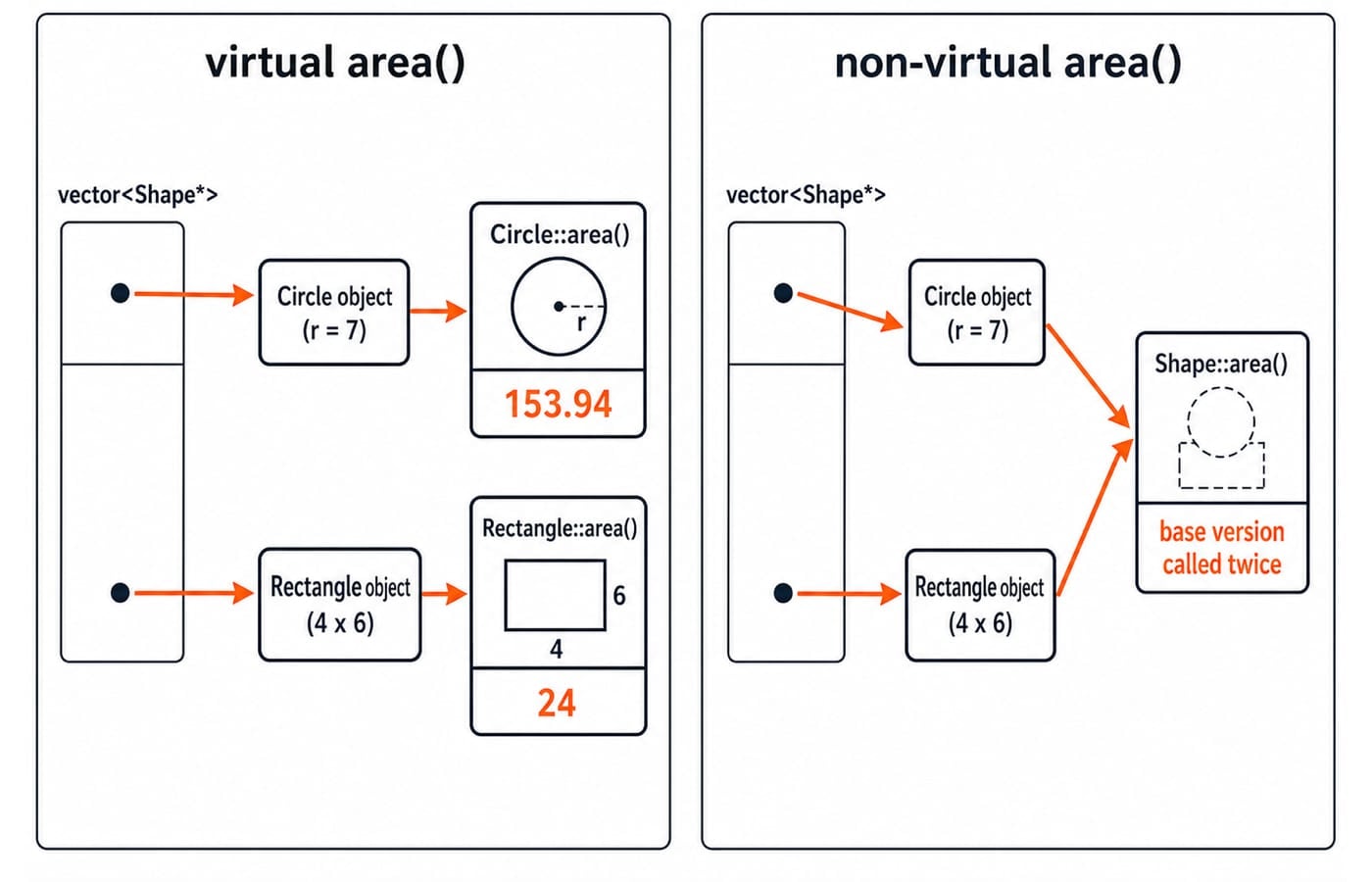
For the checkpoint, let a base class Shape declare virtual double area(). A Circle with radius 7 returns:
3.1416 × 7 × 7
= 3.1416 × 49
= 153.9384
= 153.94 to two decimal places
A Rectangle with sides 4 and 6 returns 4 × 6 = 24. Store pointers to both objects in a vector<Shape*> and call area() in a loop. The output is 153.94 followed by 24, because each virtual call dispatches to the method of the actual object.
Remove virtual, and calls made through Shape* use the base version instead. That contrast is a favourite output-prediction pattern: the declared pointer type controls a non-virtual call, while the actual object type controls a virtual call.
5. Stage 4: Templates and the STL
Start templates with one small function such as max(a, b). Its type parameter lets the same comparison work for integers, doubles or another comparable type. That is enough template knowledge for this stage. Template metaprogramming can wait.
Your working STL set is vector, string, map, set and pair, plus the algorithms sort, find and count. Two short programs exercise most of what you will actually reach for:
vector<int> v = {42, 7, 19};
sort(v.begin(), v.end());       // {7, 19, 42}

map<string, int> freq;
for (string word : {"gate", "gate", "net"}) {
    freq[word]++;
}
// gate 2
// net 1
Once you can use sort, learn what it is doing underneath in Sorting Algorithms: Comparison, Complexity, and When to Use Each. Then use Data Structures MCQs to practise choosing containers and tracing operations.
6. Stage 5: Memory, exceptions and modern C++
First understand stack storage and heap allocation. Learn new and delete, then see why manual cleanup is fragile. A memory leak occurs when allocated memory remains unavailable because the program has lost the pointer needed to release it.
Suppose a loop allocates 1,000 integers and deletes none. On a system where one int occupies 4 bytes, the unreleased memory is 1,000 × 4 = 4,000 bytes. A wider int on another platform changes the total, not the leak.
Next learn basic try and catch. Finish with type-deducing auto, range-based for and unique_ptr, which makes ownership explicit and releases its object automatically. These are C++11 facilities, as documented by the ISO C++ C++11 FAQ. For exact library signatures and version notes, cppreference is the standard community reference.
For most exams and placement rounds, recognising RAII, smart-pointer ownership and a leak matters more than writing a custom allocator.
7. How exams and interviews test C++
Three question shapes appear repeatedly:
Output prediction: integer division, pointer arithmetic, pass by value, pass by reference, and virtual dispatch.
Spot the error: a missing return, an invalid dereference, a forgotten delete or incorrect class access.
Short coding tasks: loops and arrays wrapped around STL fluency, sorting, counting or lookup.
You will see these in semester papers, placement coding rounds, company online tests and technical exams with a programming section. Interview follow-ups often probe Stage 3 and Stage 5 vocabulary: virtual, override, leak, RAII and smart pointer.
Prepare for them by predicting outputs on paper before you compile, and by rewriting the swap and Shape checkpoints from a blank file. The answer that gives a candidate away is saying that a virtual call through Shape* runs the base version, because that is exactly what virtual dispatch prevents.
8. The short version and your next step
Learn basics, then functions and pointers, then OOP, STL, memory management and sustained practice. The first five stages take roughly 12 weeks at about an hour a day. Never skip Stage 2, because pointers and references support nearly everything that follows.
For a structured version of this path with lectures, MCQs and coding practice, use the C++ Programming Course: Concepts, MCQs & Coding. If you are preparing across languages for placement tests, Coding for Placements: C, C++, Java, Python brings them together. You can also explore the wider Coding & Skill Development Courses shelf and choose the next course that matches your goal.
Keep learning
C++ Object Lifetime and Storage Duration: Trace Construction, Destruction, and Dangling State
Learn to separate scope, storage duration, lifetime, and ownership. Trace seven objects precisely, then repair dangling pointers, references, and views.
Updated 19 Oct 20265 min readC++
C++ Diamond Problem: Ambiguity, Duplicate State and Virtual Inheritance
See why a C++ diamond duplicates base state, how virtual inheritance shares it, and when qualification, interfaces, or composition is the clearer design.
Updated 15 Oct 20265 min readC++
C++ Abstract Classes and Interfaces: Build a Usable Storage Contract
Build a C++17 ScoreStore interface, swap vector and hash-backed implementations behind it, and verify both with the same runnable contract test.
Updated 11 Oct 20265 min readC++
C++ Virtual Functions and Polymorphism: Trace Dynamic Dispatch Step by Step
Trace a Shape hierarchy line by line to see how static type, dynamic type, final overriders, object slicing, and virtual destructors determine C++ output.
Updated 7 Oct 20265 min readC++