

Programming Paradigms Explained: Concepts, Classifications and Worked Examples
Learn how imperative, procedural, object-oriented, functional and declarative styles organise the same computation, and how to classify code from visible evidence.
KnowledgeGate Team
Exam prep & CS education
Updated 15 Nov 20265 min read
C is often labelled procedural, Java object-oriented and SQL declarative. Those labels are useful starting points, but real languages and programs often combine several styles. Classify the code itself by tracing its control flow, inspecting how it handles state and identifying its main unit of abstraction. The same calculation can then be expressed and compared in four ways.
Programming paradigms: what the term actually classifies
A programming paradigm is a recurring model for expressing computation. It shapes what the programmer states, how control proceeds, how state changes and how code is organised.
Syntax is the notation used to write code. An algorithm is a procedure for solving a problem. A language can support several paradigms. Software architecture describes the larger organisation of components.
Use three questions when classifying a construct:
Does the code prescribe an execution sequence, or mainly describe the required result?
Does it mutate stored state, or transform input values into new values?
Is behaviour organised around procedures, objects, functions, rules or queries?
Classify the shown construct first, and state whether the label applies to a language, program or fragment. Types of Programming Languages: Levels, Paradigms and Execution Models owns the broader four-axis map of abstraction level, paradigm, execution model and type system. This page stays on the paradigm axis and classifies individual code fragments by control flow, state and abstraction.
The main paradigm families and their overlaps
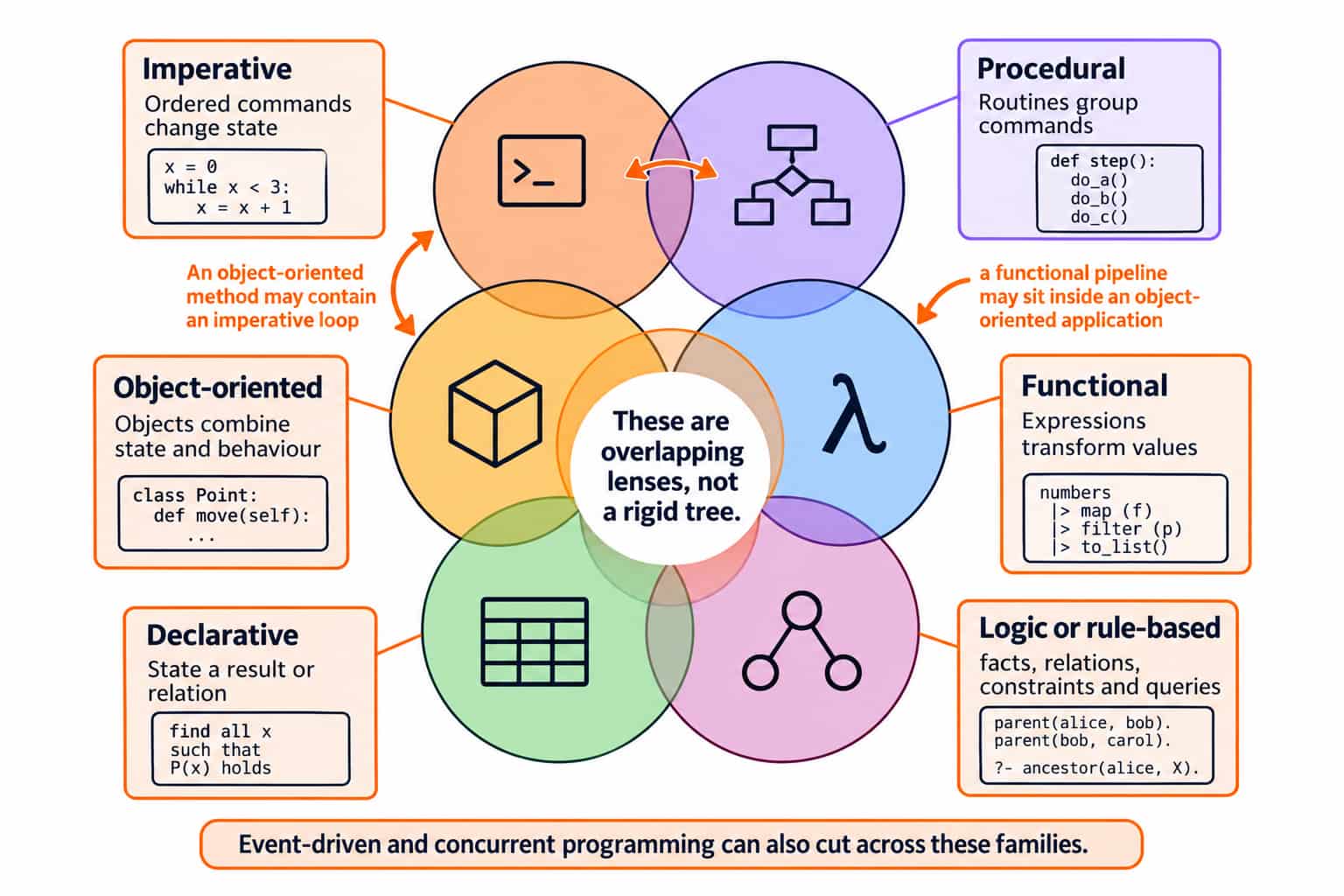
Imperative programming uses ordered commands to change state. In a common teaching classification, procedural programming groups those commands into procedures or functions. Structured programming controls them through sequence, selection and iteration.
Object-oriented programming organises state and behaviour around objects, which hold data and expose methods. Object Oriented Technology Explained: Four Pillars in Java owns encapsulation, abstraction, inheritance and polymorphism in a Java hierarchy; the comparison here asks how object-oriented organisation can overlap with imperative, functional and declarative code.
Declarative programming describes a required result rather than exact steps. Functional style uses expressions and value transformations. Logic or rule-based style uses facts, relations, constraints and queries.
These are overlapping lenses, not a rigid tree. An object-oriented method may contain an imperative loop, and a functional pipeline may sit inside an object-oriented application. Event-driven and concurrent programming can also cut across these families.
Lens | Central idea | Typical evidence in code | What it does not prove |
|---|---|---|---|
Imperative | Ordered commands change state | Assignment, loops, sequencing | Procedural or object-oriented organisation |
Procedural | Routines group commands | Procedures, calls, parameters | A procedures-only language |
Object-oriented | Objects combine state and behaviour | Fields, methods, dispatch | Non-imperative method bodies |
Functional | Expressions transform values | Composition, | Purity without checking side effects |
Declarative | State a result or relation | Queries, rules, constraints | A particular execution plan |
One ledger calculation, four paradigm views
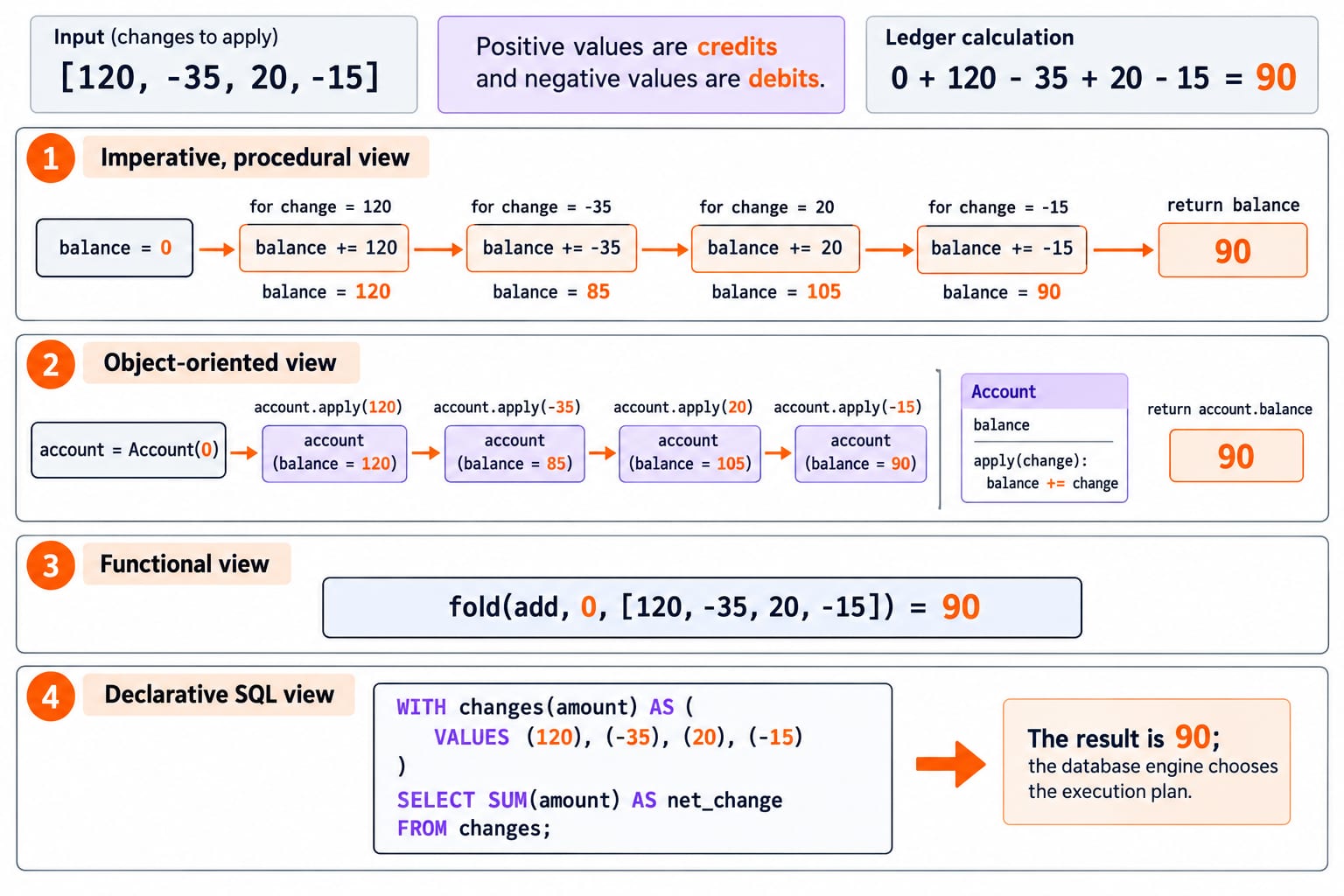
A ledger records four signed changes: [120, -35, 20, -15]. Positive values are credits and negative values are debits. Starting from zero, the balance becomes 0 + 120 - 35 + 20 - 15 = 90.
In an imperative, procedural view, initialise an accumulator and update it for each change:
balance = 0
for change in [120, -35, 20, -15]:
    balance = balance + change
return balance
The accumulator trace is 0 -> 120 -> 85 -> 105 -> 90: the two credits add 140, the two debits subtract 50, and the net change is 90.
In an object-oriented view, an account owns the balance and exposes the update operation:
account = Account(0)
for change in [120, -35, 20, -15]:
    account.apply(change)
return account.balance
The object encapsulates its balance and the rule for applying a change. Its method may still contain imperative assignment, and the final balance is 90.
In a functional view, a fold combines the signed values without exposing a changing accumulator:
fold(add, 0, [120, -35, 20, -15]) = 90The declarative SQL view states the rows and required aggregate:
WITH changes(amount) AS (VALUES (120), (-35), (20), (-15))
SELECT SUM(amount) AS net_change FROM changes;
The result is 90; the database engine chooses the execution plan.
How to classify real code without guessing from the language
Start with visible evidence: sequencing and mutation, object-owned state and behaviour, expression pipelines, then facts, rules, constraints or queries. Allow multiple labels when the evidence supports them, but name the level being classified.
The loop is imperative because balance mutates, and procedural when a named routine groups those steps. Account.apply adds object-oriented organisation. The fold expression is functional. SQL is declarative because it states the rows and result while the engine plans execution.
Language versus construct: C supports procedural imperative code. Java supports object-oriented and imperative code. Python supports procedural, object-oriented and functional-style constructs. These are supported styles, not permanent labels for every program.
Common programming-paradigm classification traps
“Written in Java” does not prove that a snippet is object-oriented. Replace the language-name shortcut with evidence such as object-owned state, method dispatch, mutation or an expression pipeline.
Do not equate all declarative code with functional code. SQL is declarative, but not functional like a filter-map-fold pipeline. Functions alone do not prove purity; purity requires no observable side effects.
Procedural and object-oriented programming are not opposites. Account.apply organises behaviour around an object while its method may remain imperative. Event-driven and concurrent styles can coexist with either.
How exams turn paradigms into questions
An identification question may show balance = balance + change inside a loop. It is imperative, and procedural if a routine groups the steps. A matching question may pair SELECT SUM(amount) with declarative programming. 'Java code is automatically object-oriented' is false because the construct supplies the evidence.
For a 20-second elimination check, use this order:
Mutable variable plus ordered steps suggests imperative programming.
A named routine grouping commands suggests procedural programming.
Object-owned state plus methods suggests object-oriented programming.
Function composition and value transformation suggest functional style.
Facts, rules, constraints or result-only queries suggest logic or declarative style.
Practise by naming the evidence in each snippet before choosing a label. This prevents a familiar language name from replacing the actual control-flow, state and abstraction test.
Programming paradigms: revision and next step
A paradigm is a way to express and organise computation. Classify code by control, state and abstraction, expect overlap, and justify labels from visible evidence. In all four ledger versions, credits total 140, debits total 50, and the net change is 90.
Use the Coding & Skills category to choose a language path. Build procedural fundamentals with the C Language Course, then study object-oriented organisation with the Java Course. Finally, rewrite the [120, -35, 20, -15] -> 90 ledger in two styles and explain the classification evidence.
Keep learning
Data Abstraction Explained: Hide Implementation Details with a Worked Java Example
See how a stable Account contract protects its invariant while the Java implementation changes from a running balance to a transaction ledger.
Updated 16 Nov 20265 min readProgramming Languages Survey
Introduction to Visual Basic (VB): Concepts, Worked Code and Exam Patterns
Learn how a VB.NET form turns text-box input and a button click into a traced result. Then practise operators, loops, procedures, scope and debugging.
Updated 14 Nov 20266 min readProgramming Languages Survey
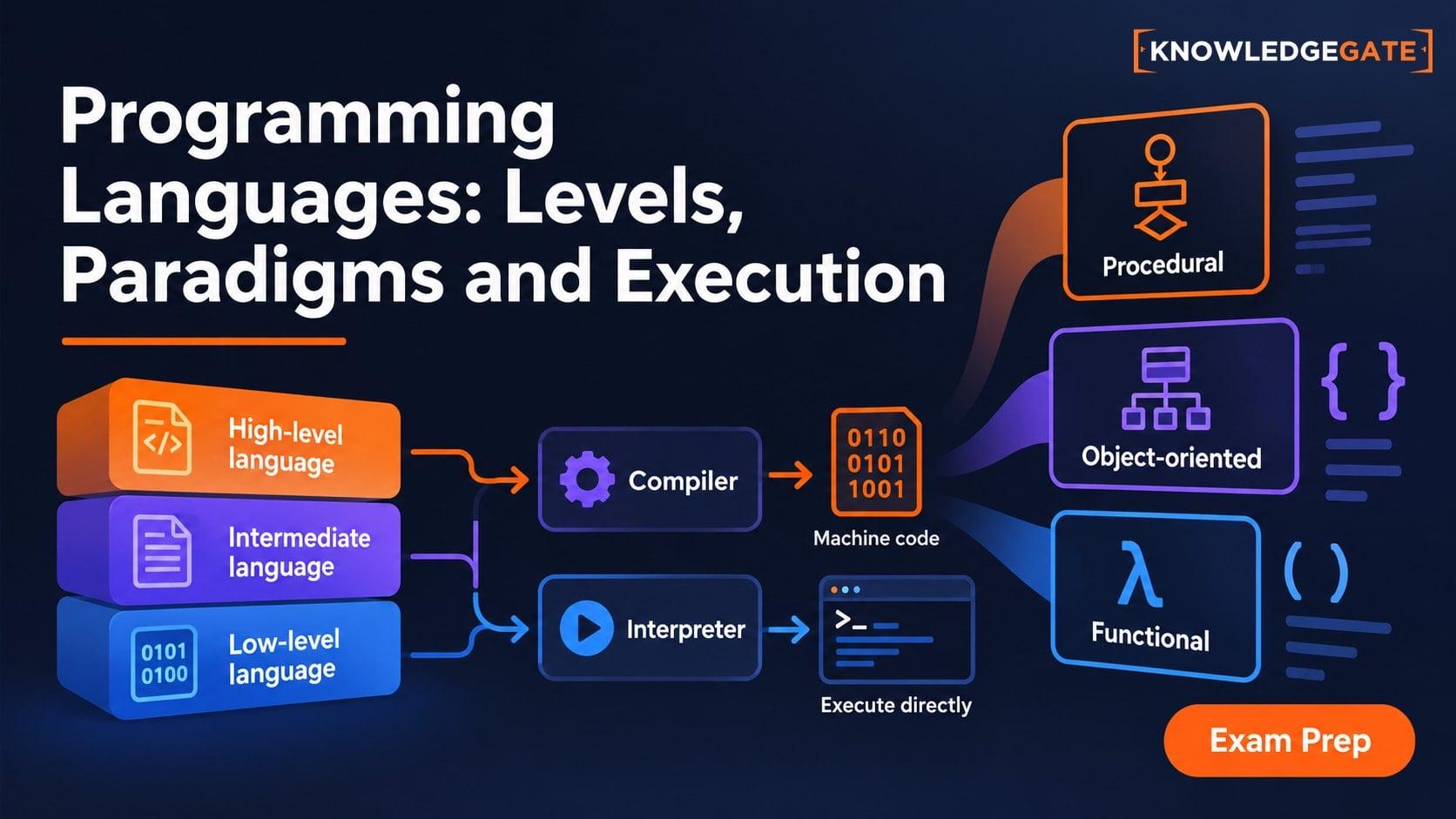
Types of Programming Languages: Levels, Paradigms and Execution Models
Learn why low-level, object-oriented, compiled and dynamically typed describe different axes. Build a clear classification map through one result expressed three ways.
Updated 13 Nov 20266 min readProgramming Languages Survey
Programming Language Syntax Explained: Grammar, Tokens and Semantics
Follow one assignment from its source characters to tokens, an AST, type checks and runtime evaluation. Learn exactly where syntax ends and semantics begins.
Updated 12 Nov 20265 min readProgramming Languages Survey