Go and Python can both serve the same HTTP workload, yet long-lived services, short scripts and multi-year team ownership reward different trade-offs. For a three-worker summary API, cancellation, boundary validation and deployment shape matter; for a short automation script, edit speed and library fit carry more weight. Start with the workload and team evidence before choosing a language. The Coding & Skills catalogue provides the wider learning path.
Start with the workload, not a language slogan
Judge three axes before comparing syntax. Service shape asks whether the program stays up, handles concurrent I/O and gets deployed repeatedly. Script shape asks how quickly a learner can transform data and use an existing library. Team speed covers implementation, review, onboarding, debugging and the next six changes, not just lines typed on day one.
The Go path here uses its standard HTTP, JSON, context and synchronisation packages. The Python path uses CPython with FastAPI, Pydantic, httpx and asyncio. Framework choice is therefore part of the comparison. Go deserves more weight when a durable service and compact deployment unit dominate. Python deserves more weight when iteration, library access and existing team fluency dominate.
Go vs Rust for Backend Systems: Choose Simplicity or Stronger Guarantees handles the systems-language choice between Go's simpler service construction and Rust's ownership-driven guarantees. That comparison owns the systems-language trade-off; this one owns the services, scripts and team-speed choice between Go and Python.
Worked example: compare the same three-worker summary API
Both implementations accept this unchanged POST /summary request:
{
  "jobs": [
    {"id": "alpha", "records": 1200, "delay_ms": 80},
    {"id": "beta", "records": 800, "delay_ms": 120},
    {"id": "gamma", "records": 2000, "delay_ms": 200}
  ],
  "timeout_ms": 250
}
The delays are deterministic teaching values for mocked upstream workers, not measured production latency. The total is 1200 + 800 + 2000 = 4000. gamma is the slowest scheduled worker at 200 ms, and ideal headroom is 250 - 200 = 50 ms, excluding network and scheduling overhead. Both versions return exactly {"job_count":3,"total_records":4000,"slowest_job":"gamma","ideal_headroom_ms":50}.
The comparable core has two paths:
Go: typed
Job,RequestandSummarystructs, withJobs []JobandTimeoutMS intin the request; decode JSON; startfetch(ctx, job)goroutines; receive channel results; addresult.Records; encode the summary.Python: equivalent Pydantic models, with
jobs: list[Job]andtimeout_ms: StrictIntinRequest; use a FastAPI route; awaitasyncio.gather; calculatesum(result.records for result in results); return the same fields.
Identical inputs and outputs make comparisons fairer than unrelated examples, a principle also useful with classic programs in C, Java and Python.
Concurrency: work the timing trace before discussing speed
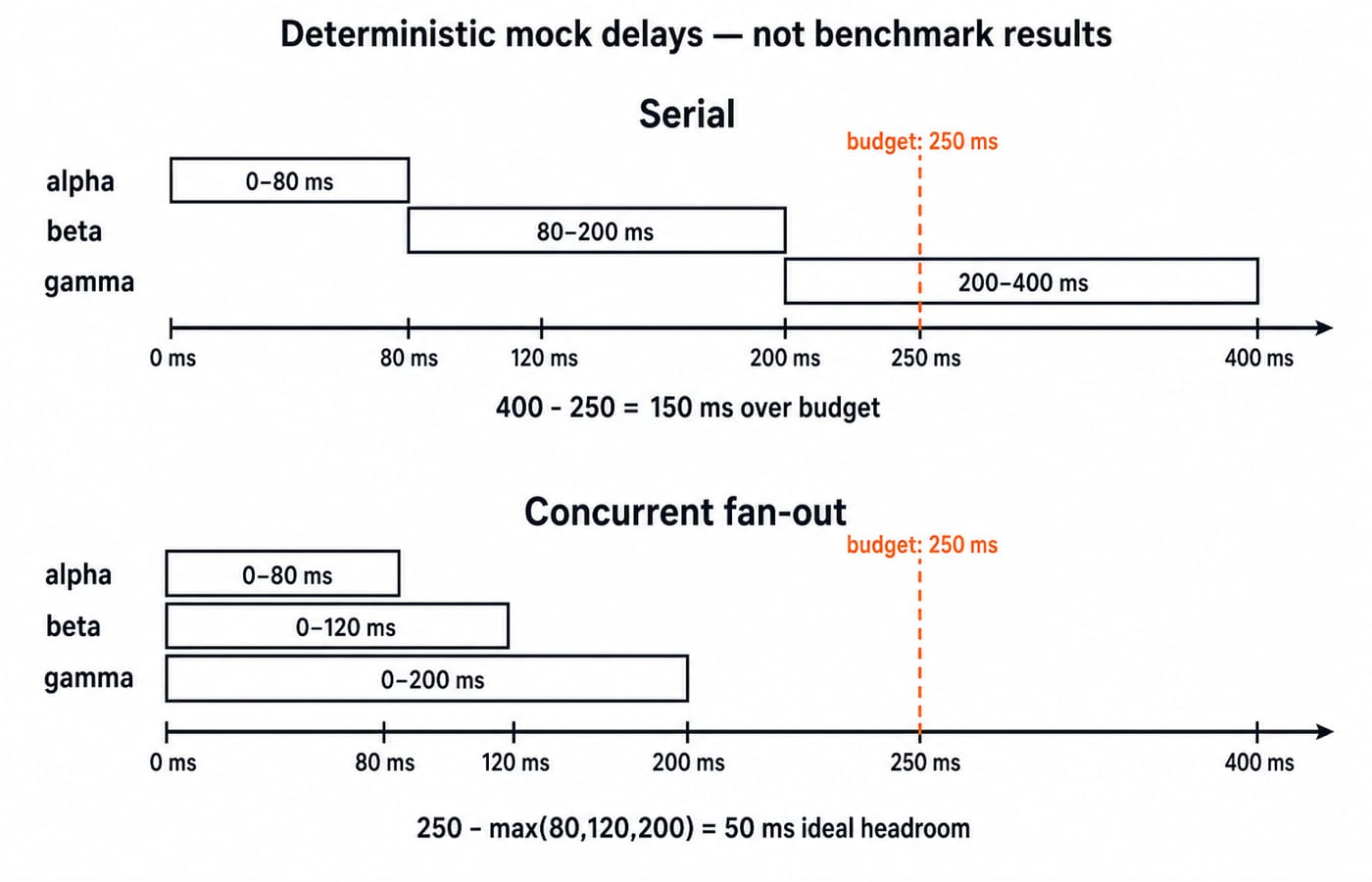
Run serially, alpha occupies 0-80 ms, beta occupies 80-200 ms, and gamma occupies 200-400 ms. The ideal total is 80 + 120 + 200 = 400 ms, which exceeds the 250 ms request budget by 400 - 250 = 150 ms.
With concurrent fan-out, all three start at 0 ms. They finish at 80, 120 and 200 ms. The ideal floor is max(80,120,200) = 200 ms, leaving 250 - 200 = 50 ms arithmetic headroom. Go can launch three goroutines, collect channel results and propagate a 250 ms context deadline. Python can create three coroutines, await asyncio.gather and enforce the same 0.250 s limit. If gamma changes to 300 ms, both paths should cancel at the deadline and return a controlled timeout, not a partial total.
This trace models I/O fan-out only. It proves nothing about relative CPU throughput, memory use or production tail latency.
Typing and validation fail at different moments
Now change alpha's value from "records": 1200 to "records": "1200". A Go decoder targeting an int must report an error, and the handler must check it. The Python model should declare a strict integer such as Pydantic's StrictInt; an ordinary annotation alone is not runtime boundary validation. Both routes should reject the value instead of silently adding it.
Three layers must stay separate. Go's compiler catches a source assignment such as Records: "1200". A Python type checker can flag the analogous source. Incoming JSON is runtime data, so both paths still need validation and tests.
Rename records to record_count, and each implementation must update the request model, aggregation line, JSON fixture and response test. The useful question is how quickly the team discovers missed call sites, not how short the first edit looks. Concise Python still demands deliberate practice with runtime values, slicing and mutability. The Python Programming course is the structured language-foundation route.
Deployment and library ergonomics: count moving parts honestly
The minimal Go project has go.mod and main.go; go build -o summary-service . produces an executable for the chosen target. Python has app.py and a pinned requirements.txt; create a virtual environment and start with uvicorn app:app. Configuration and certificates remain separate, so one binary does not mean no operations work.
Go owns explicit decoding, error branches, channels and response encoding. The Python stack supplies concise route and validation declarations, but adds framework and package lifecycle decisions. That is an ergonomics trade-off, not a moral ranking.
For ten identical replicas, ask what must be built, scanned, patched, started and observed on each path. Image size, cold-start time and memory use need a reproducible benchmark in the team's own base image and environment. For a local CSV containing the same three jobs, Python can calculate 4000 and print gamma,200; Go can too. Existing libraries and operational constraints decide which version is cheaper to own.
Team speed: use hard gates before a tie-break
Weighted totals can hide a disqualifier by averaging it against strengths elsewhere. Use three yes-or-no gates in order. A failed gate ends the comparison for that workload.
Library gate: Confirm that every required SDK, data format, security control and licence is supportable. If only one language has a maintained fit for a required dependency, choose it.
Operations gate: Build one vertical slice in the real runtime. Prove deadline cancellation, useful logs, startup and the actual deployment path. Reject a stack that fails the service-readiness check.
Ownership gate: Name the people who can review, debug and take operational ownership. If only one language has credible owners for the next year, choose it unless the team funds that capability gap.
If both languages pass, run the same change in each slice: rename records to record_count, update boundary validation, trigger the timeout test and package the deployable artifact. Record review-ready time, defects found before runtime and deployment steps. When the evidence is close, keep the current stack; a second language must repay training and parallel tooling.
The gates overrule any attractive score. A concurrency rating cannot rescue a missing required library, failed cancellation test or absent ownership. Python's faster first edit does not win if its service slice fails operations, and Go's compact artifact does not win a script task that lacks the required library. Recheck the decision after the first vertical slice and after 30 days of use.
How interviews test the choice, and the traps to avoid
For 50 independent upstream I/O calls with strict cancellation and a small operations team, Go enters the operations gate with a plausible fit, but it still has to prove the deadline path. For a one-off 3,000-row CSV cleanup due in 2 hours, Python likely clears the library and change-speed test first when the team knows a suitable package. For a low-traffic API owned by 8 Python developers across 6 services, Go must prove enough operational benefit to justify a second stack.
A strong answer states assumptions, failure modes, team evidence, a prototype and a measurement plan. The Coding Round Strategy for Placements helps with timed problem solving. Interviewers use such scenarios to test whether you can connect workload constraints to a defensible language choice.
Avoid five traps: equating concise code with delivery speed, treating an I/O trace as a CPU benchmark, saying Python cannot do concurrent I/O, assuming compilation validates JSON, and choosing two languages when the team can maintain only one. Change the recommendation for a failed library fit, unreliable cancellation, unacceptable measured operations cost, or a prototype that overturns the scores.
The short version and the next step
Prefer Go when a long-lived service, cancellation, explicit contracts and repeatable deployment dominate. Prefer Python when scripting speed, library leverage and current team fluency dominate. Keep the current stack when the projected gain cannot repay second-language maintenance.
If Go passes those gates, Go Learning Roadmap: From Syntax to a Tested HTTP Service provides the staged learning path from syntax through cancellation and service readiness. That roadmap owns the learning sequence; this comparison owns the services, scripts and team-speed decision.
Concurrency changes the simulated schedule from 400 ms serial to a 200 ms ideal floor, but both languages can express that fan-out. For the next Python problem-solving track, continue with DSA Using Python.