Process Synchronization and Semaphores: race conditions, Peterson's solution, wait and signal
Process synchronization explained: the race condition, critical-section problem, Peterson's solution, binary and counting semaphores, and a worked trace.
KnowledgeGate Team
Exam prep & CS education
Updated 14 Jul 20266 min read149 views
Process synchronization is where Operating Systems stops being descriptive and starts being logical. Aspirants who can trace a semaphore value through a sequence of wait and signal calls answer these questions with certainty. Those who memorise "semaphore is a variable" freeze the moment two processes interleave. The gap between the two is a single skill: reading an interleaving step by step and knowing what the semaphore value means at each instant.
The race condition
A race condition is when two or more processes access shared data concurrently and the final result depends on the exact order in which their operations interleave. Consider two processes both running count = count + 1 on a shared variable that starts at 5. That single line is really three machine steps: load count into a register, add one, store the register back.
If process A loads 5, then process B loads 5 before A stores, both compute 6, both store 6, and one increment is lost. The correct answer was 7. Nothing is broken in either process; the bug is the uncontrolled interleaving. Preventing exactly this is what synchronization is for.
The critical-section problem
The shared code that must not be interleaved is the critical section. A correct solution to the critical-section problem must satisfy three requirements:
Mutual exclusion: at most one process is in its critical section at any time.
Progress: if no process is in its critical section, one of the processes wanting to enter must be allowed to, and the decision cannot be postponed indefinitely by a process not interested in entering.
Bounded waiting: there is a limit on how many times other processes can enter their critical sections after a process has requested entry and before it is granted, so no process starves.
Any synchronization mechanism is judged against these three, and examiners ask which one a flawed solution violates.
Peterson's solution
Peterson's solution is the classic software solution for two processes, and it satisfies all three requirements. It uses a shared boolean array flag[2] and a shared turn variable. For process i (with the other being j):
Set
flag[i] = true(I want to enter).Set
turn = j(but I politely give the other the turn first).Wait while
flag[j]is true andturn == j.Enter the critical section.
On exit, set
flag[i] = false.
Mutual exclusion holds because a process enters only when the other has not raised its flag or has yielded the turn. Bounded waiting holds because whichever process writes turn last loses the tie, so the other enters first and a waiting process waits at most one critical-section pass. Progress holds because a process that does not want to enter keeps its flag down and therefore cannot block anyone. Peterson's is beautiful for two processes but does not scale cleanly to many, which is why real systems use semaphores.
Semaphores: binary vs counting, wait and signal
A semaphore is an integer variable accessed only through two atomic operations, wait (also called P or down) and signal (also called V or up):
wait(S): decrement S; if S becomes negative, block the calling process on S's queue.signal(S): increment S; if a process is blocked on S, wake one of them.
Because wait and signal are atomic, no race can occur inside them. Two flavours exist:
Binary semaphore takes only 0 or 1 and acts as a lock (a mutex) for mutual exclusion.
Counting semaphore is initialised to the number of identical units in a resource pool, such as five available printer slots, so it is not restricted to 0 and 1. In the classic Dijkstra formulation, wait decrements before testing, so the value may go negative. A negative value is not an error: its magnitude is exactly the number of processes blocked on that semaphore, and 0 means no unit is free and nobody is waiting.
Producer-consumer and readers-writers
Two standard patterns show semaphores at work.
Producer-consumer uses a bounded buffer with three semaphores: mutex (binary, protects the buffer), empty (counting, counts free slots), and full (counting, counts filled slots). A producer does wait(empty), wait(mutex), add item, signal(mutex), signal(full). A consumer mirrors it with wait(full) and signal(empty). The counting semaphores block the producer on a full buffer and the consumer on an empty one, automatically.
Readers-writers allows many concurrent readers but gives a writer exclusive access. A mutex protects a reader count, and a write semaphore is held by the first reader in and released by the last reader out, so writers wait while any reader is active. These two patterns appear again and again in exams.
A worked semaphore trace
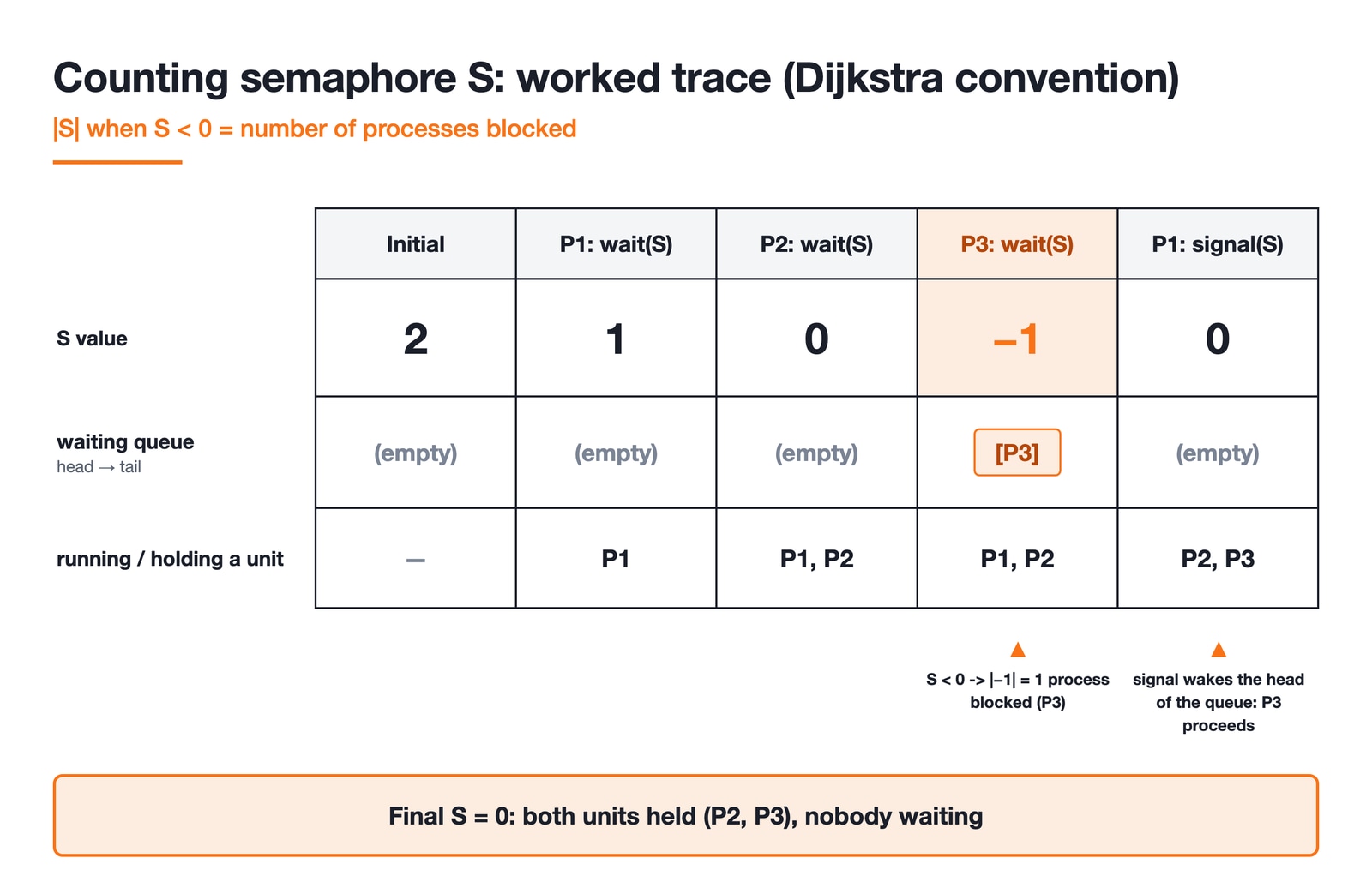
Take a counting semaphore S initialised to 2 (two identical resource units) and three processes P1, P2, P3, each calling wait(S) to acquire a unit, using the model where wait decrements first and blocks if the value goes negative.
S = 2 initially.
P1 calls
wait(S): S becomes 1, not negative, so P1 proceeds.P2 calls
wait(S): S becomes 0, not negative, so P2 proceeds.P3 calls
wait(S): S becomes −1, negative, so P3 blocks. The magnitude 1 tells you exactly one process is waiting.P1 finishes and calls
signal(S): S becomes 0, and because a process is blocked, P3 is woken and proceeds.
The final value 0 means both units are in use (held by P2 and P3) and no process is waiting, which is exactly what a value of 0 encodes. In the alternative model, where the value never goes negative and a process blocks when S is already 0, S would sit at 0 while P3 waits and stay at 0 when P1's signal hands the freed unit straight to P3; either way at most two processes hold a unit at any instant and the third waits. Tracing this value change is the exact skill the exam tests.
How process synchronization is tested in GATE, NET and placements
GATE CS hands you a semaphore initialised to some value with an interleaving of wait and signal calls and asks for the final value, the maximum number of processes in the critical section, or whether a given solution deadlocks. It also asks which requirement (mutual exclusion, progress, bounded waiting) a flawed solution breaks. Work the full topic with solved traces on the Operating System learn module. Then test the same trace skill against a set of solved process synchronization MCQs.
UGC NET Computer Science stays conceptual: define a race condition, state the three critical-section requirements, and distinguish binary from counting semaphores. Placement interviews ask you to solve producer-consumer or readers-writers with semaphores in code, and often connect synchronization to the memory hierarchy and virtual memory whose shared frames these very locks protect.
The short version
Start from the race condition: uncontrolled interleaving of shared data. The critical-section problem demands mutual exclusion, progress, and bounded waiting; Peterson's solution meets all three for two processes, and semaphores generalise it with atomic wait and signal. Trace a counting semaphore's value through a sequence by hand until it is automatic, and learn producer-consumer and readers-writers as templates. For a GATE-depth OS sequence with hundreds of solved synchronization problems, GATE Guidance by Sanchit Sir is built for it, and the GATE CS exam category covers the rest of the paper.
Keep learning
Critical Section in Process Synchronization: Race Conditions and Correctness Worked Step by Step
See how two sensible updates to x can finish at 6, 7, or 8. The worked trace connects race conditions to mutual exclusion, progress, bounded waiting, and safe synchronization choices.
Updated 21 Oct 20266 min readOperating Systems
System Calls and Dual Mode in OS: Mode-Bit Trace, Worked Example and Exam Traps
Follow one read() call across the user-kernel boundary, calculate its stated overhead, and learn the distinctions that make system-call questions easier.
Updated 17 Oct 20265 min readOperating Systems
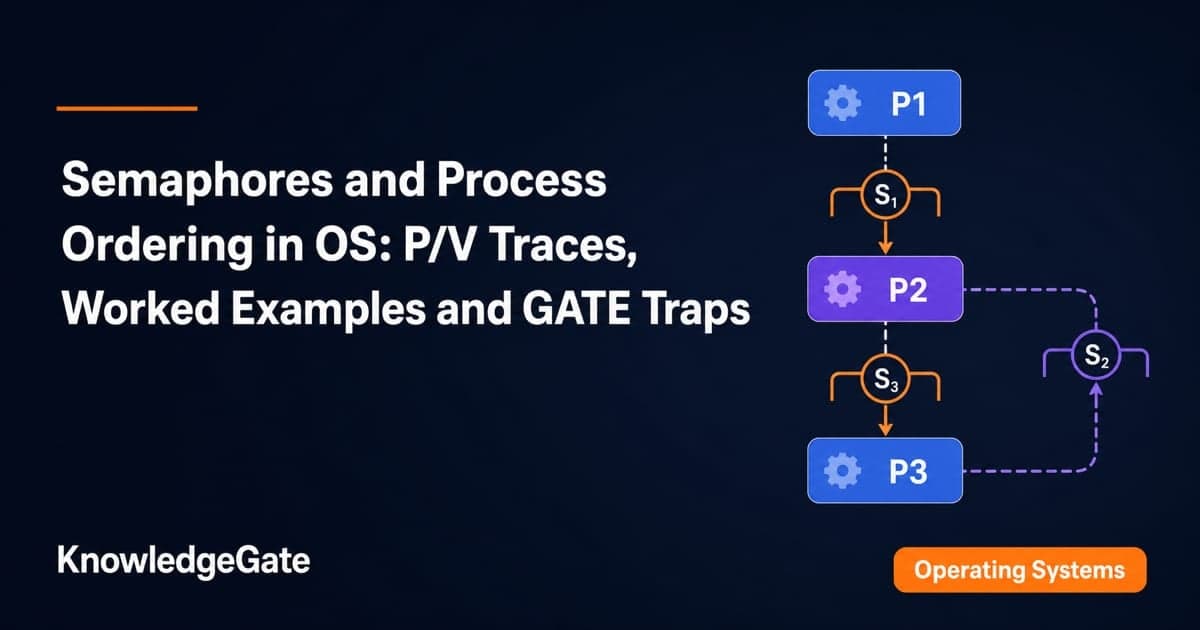
Semaphores and Process Ordering in OS: P/V Traces, Worked Examples and GATE Traps
Learn one consistent semaphore convention, then trace ordering constraints, shared-variable updates, bounded-buffer permits, rendezvous, and deadlock step by step.
Updated 13 Oct 20265 min readOperating Systems
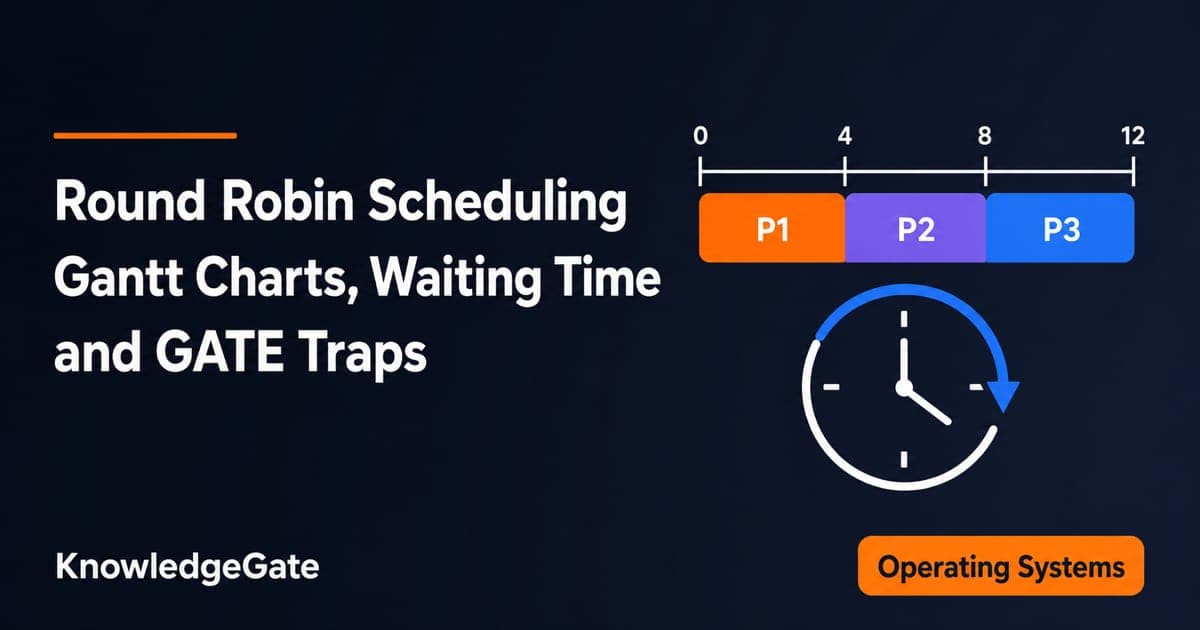
Round Robin Scheduling Explained: Gantt Charts, Waiting Time and GATE Traps
Learn a fixed Round Robin queue convention, trace staggered arrivals, calculate CT, TAT, WT and RT, and see how quantum size and context-switch cost change results.
Updated 9 Oct 20265 min read65 viewsOperating Systems