A learner can build the same CRUD backend in PHP or Node.js, but syntax is the least important difference. Request execution, blocking work, validation, hosting, team familiarity and deployment ownership decide which choice remains practical after the first demo. One BookStock API, its PostgreSQL rows, routes, concurrency assumptions and failures stay constant while the runtime changes. The timings are a teaching model, not a benchmark; the wider Coding & Skill Development Courses category offers focused routes once the runtime decision is clear.
PHP vs Node.js starts with the runtime model, not a winner
PHP commonly uses a web server and worker pool. Node.js commonly uses long-lived processes whose main JavaScript thread runs an event loop for non-blocking I/O. Both have alternatives, including other PHP runtimes and multi-process Node deployments.
Compare PHP + framework/router + driver + PHP-FPM or another runtime with Node.js + framework/router + driver + process/container strategy. Test I/O, CPU work, validation, conventions, hosting, operations and team knowledge. Ignore popularity, vague scalability and unmatched benchmarks.
Hold the CRUD contract constant in both implementations
PostgreSQL is the teaching choice, not a runtime requirement:
books(id INTEGER PRIMARY KEY, title VARCHAR(120) NOT NULL,
      copies INTEGER NOT NULL CHECK (copies BETWEEN 0 AND 99),
      version INTEGER NOT NULL DEFAULT 1)
Start with 41 | Operating Systems | 3 | 1. Both versions use this contract. Web Technologies for Teaching Exams: HTML and HTTP explains method, path, body and status.
Request | Response |
|---|---|
|
|
|
|
|
|
|
|
The five stages stay paired:
PHP:  match route -> parse JSON -> validate ->
      query("INSERT ... VALUES ($1, $2) RETURNING ...", values) ->
      map row to 201 JSON

Node: match route -> parse JSON -> validate ->
      await query("INSERT ... VALUES ($1, $2) RETURNING ...", values) ->
      map row to 201 JSON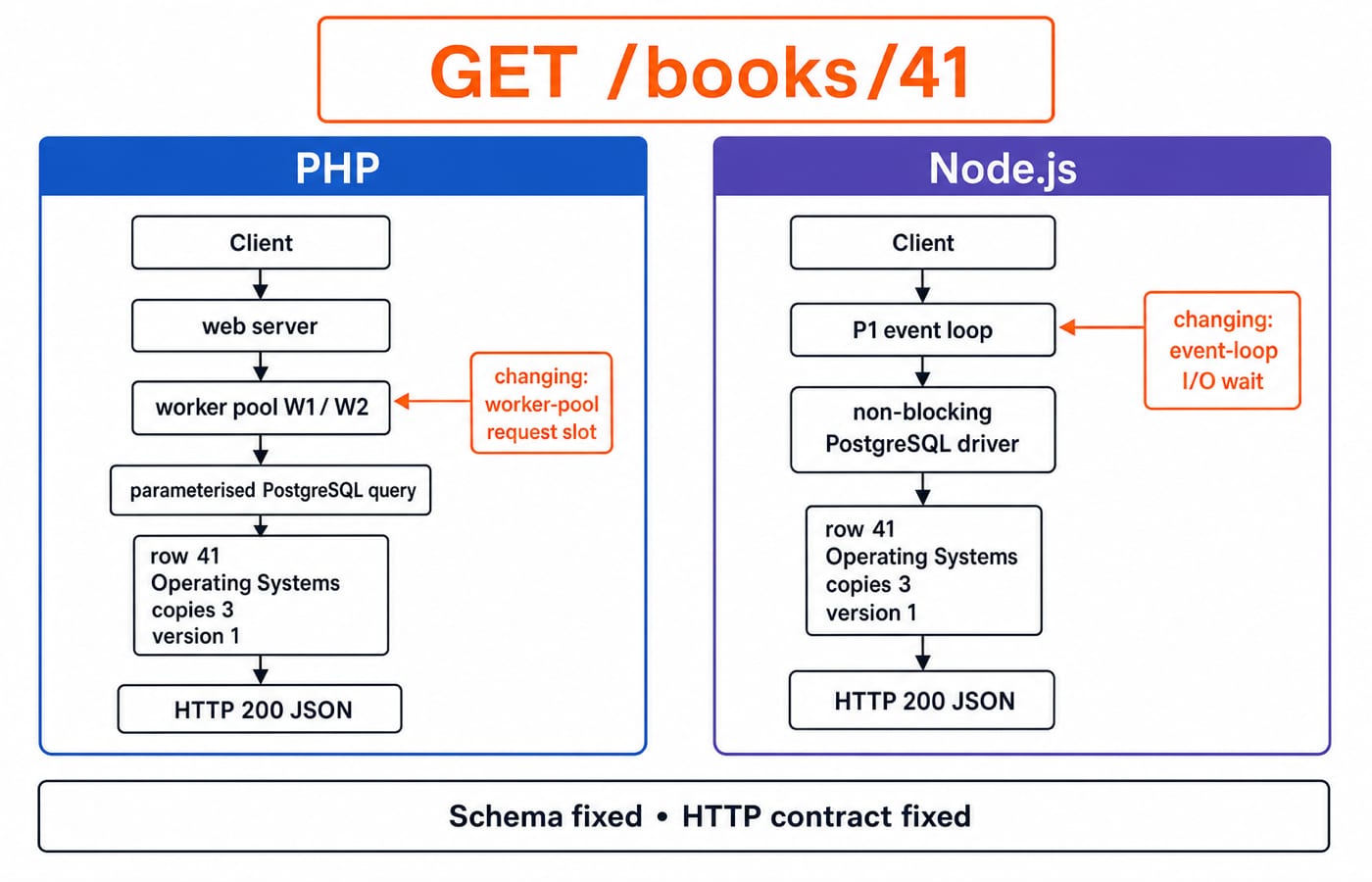
Trace I/O concurrency with actual times, then change the workload
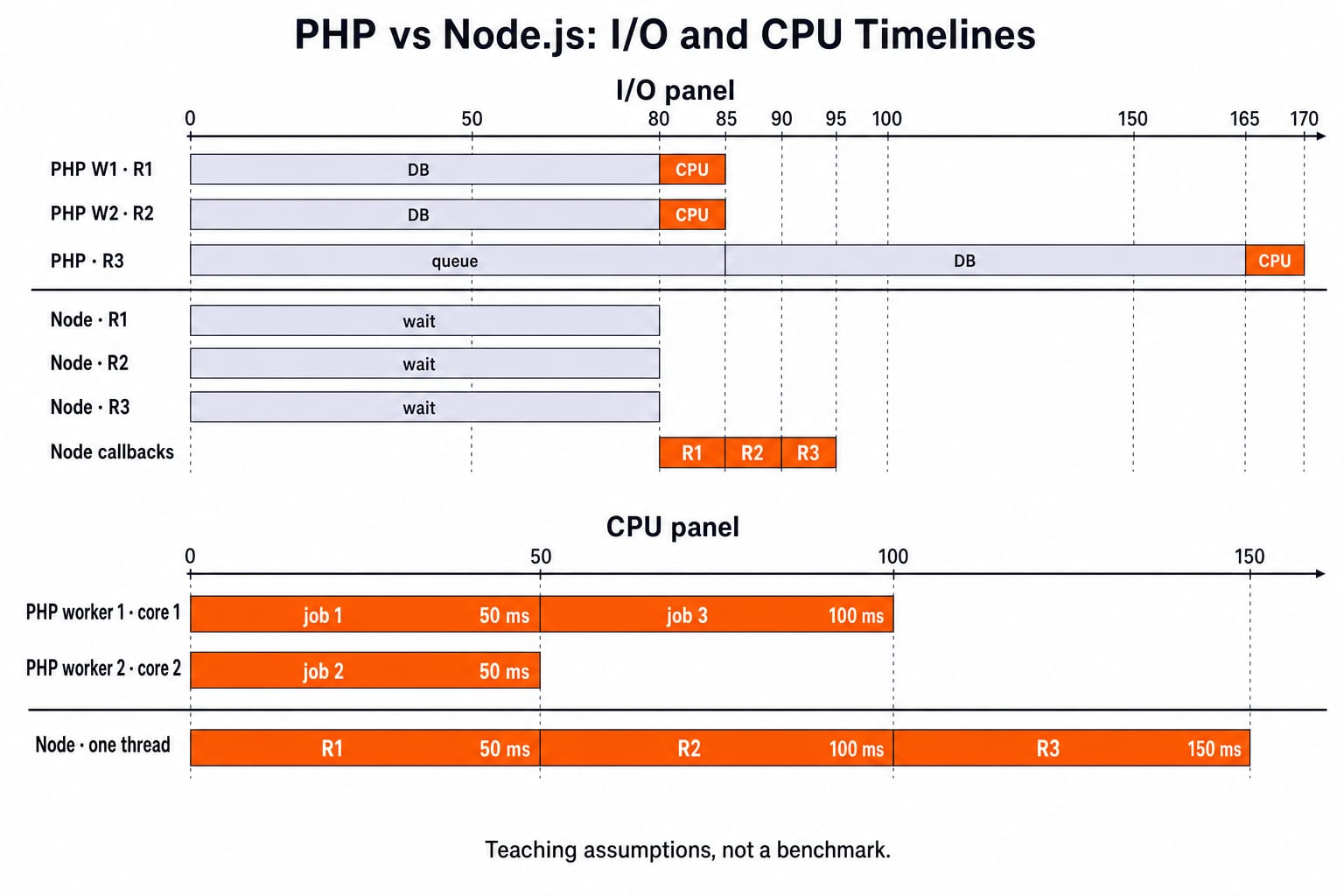
R1, R2 and R3 arrive together. Each database call waits 80 ms; mapping uses 5 ms of CPU.
With two PHP workers, R1 and R2 use 0-80 for I/O and 80-85 for mapping. R3 waits until 85, uses I/O until 165 and maps until 170. Results: 85, 85, 170 ms.
In one Node process, all calls start at 0 and become ready at 80 ms. Serial 5 ms callbacks finish at 85, 90, 95 ms. These fixed-assumption schedules are teaching numbers, not measurements.
For three CPU-only POST /reports jobs of 50 ms, two PHP workers on two cores produce 50, 50, 100 ms. One JavaScript thread produces 50, 100, 150 ms. Again, this is a teaching model, not a benchmark. Node needs threads, processes or a queue for CPU work. PHP needs enough workers and cannot block every slot on slow dependencies.
Type declarations do not replace boundary validation
Send {"title":"Operating Systems","copies":"3"}. Both APIs must reject, not coerce, it with 422 and {"error":"copies must be an integer from 0 to 99"}.
Bad input | Expected boundary error |
|---|---|
|
|
missing |
|
PHP declarations clarify internals, and strict typing can reduce applicable coercion. Requests remain untrusted. TypeScript catches development-time mismatches, but its types disappear at runtime. Both stacks need runtime validation, database constraints and consistent errors.
The contract is adjustCopies(current: integer 0..99, delta: integer) -> integer 0..99. PHP declares function adjustCopies(int $current, int $delta): int; TypeScript declares function adjustCopies(current: number, delta: number): number. Both enforce the range.
The database decides correctness when requests overlap
At copies=3, version=1, borrows A and B both read 3, calculate 2 and write 2. The final 2 is wrong because two borrows should leave 1. Switching runtimes cannot repair this race.
Use one optimistic update in both:
UPDATE books SET copies = copies - 1, version = version + 1
WHERE id = 41 AND copies > 0 AND version = 1;
A changes one row and produces copies=2, version=2. Stale B changes zero rows and receives 409, {"error":"book changed; reload and retry"}. B reloads version 2, retries and produces copies=1, version=3.
Both need parameterised queries, transactions for multi-statement invariants, bounded pools and identical errors. Mongoose Schemas and Models covers a later MongoDB path, not this PostgreSQL example.
Compare frameworks, hosting and deployment as one operating choice
Options include opinionated Laravel/Symfony, or Express/Fastify/NestJS.
Constraint | Practical PHP route | Practical Node.js route | Question to ask |
|---|---|---|---|
Server-rendered CRUD | Laravel or Symfony | Framework plus templates | Which workflow is established? |
JSON API | Laravel or Symfony | Express, Fastify or NestJS | Which policy is clearer? |
Long-lived connections | Confirm runtime support | Event-driven prototype | Can operations run it? |
CPU-heavy jobs | Queue workers | Queue or worker threads | Where will CPU work run? |
Shared hosting | Use supported PHP | Requires long-running process support | What can the host run? |
Containers | Package runtime and workers | Package processes and workers | Who owns health? |
JavaScript team | Accept language boundary | Reuse team language | Does reuse reduce friction? |
PHP: reverse proxy, release directory, 8 workers, PostgreSQL limit 8, /health. Node: reverse proxy, P1/P2, pool 4 each, total 2 x 4 = 8, /health. Replicas multiply either budget.
Project A has managed PHP hosting but no long-running Node process, so choose PHP. Project B has three JavaScript developers, 2,000 mostly idle WebSockets and container operations, so load-test Node first. Project C spends 250 ms CPU per uploaded-image resize, so queue it in either stack.
Node.js, Express.js & MongoDB is the focused route when Project B's JavaScript-team and long-lived-process constraints apply. That fit supports the learning path; it does not prove a universal speed ranking.
PHP vs Node.js traps that produce bad decisions
Trap | What goes wrong | Better check |
|---|---|---|
Node never blocks | CPU and synchronous calls block its main thread | Trace CPU time |
PHP cannot handle concurrency | Pools serve simultaneous requests, but slots can fill | Size and observe workers |
Types validate JSON | Neither TypeScript nor PHP types remove boundary checks | Test malformed payloads |
Benchmark X settles it | Database, cache, payload or process settings differ | Match the complete workload |
One process equals one pool | Replicas multiply connections | Calculate the total budget |
Two review failures matter. String "3" destabilises the contract, so return 422. Read-then-write on row 41 loses a borrow, so use the versioned update and 409. Ignore unsupported market-share, jobs, cost, salary, longevity or security claims. Either runtime can ship the API. Workload and operations decide risk.
How interviews and project reviews test the choice
Use four answerable prompts:
Derive
PHP 85/85/170 msandNode 85/90/95 msfor the stated I/O model.Explain the CPU-only results,
50/50/100 msversus50/100/150 ms.Show why two naive borrows leave
copies=2, then repair the race withversion.Choose Project A, B or C and name the deciding constraint.
The short version
Choose PHP when its deployment and conventions reduce friction. Choose Node when the team and an I/O-heavy, long-lived application fit its runtime. Isolate CPU jobs. Validate every request. Keep concurrency correctness in the data layer.
Implement POST, GET, PATCH and DELETE for rows 41 and 42. Run the two-borrow race and explain it before adding a framework. For a wider path, continue with MERN Stack.