

Types of Programming Languages: Levels, Paradigms and Execution Models
Learn why low-level, object-oriented, compiled and dynamically typed describe different axes. Build a clear classification map through one result expressed three ways.
KnowledgeGate Team
Exam prep & CS education
Updated 13 Nov 20266 min read
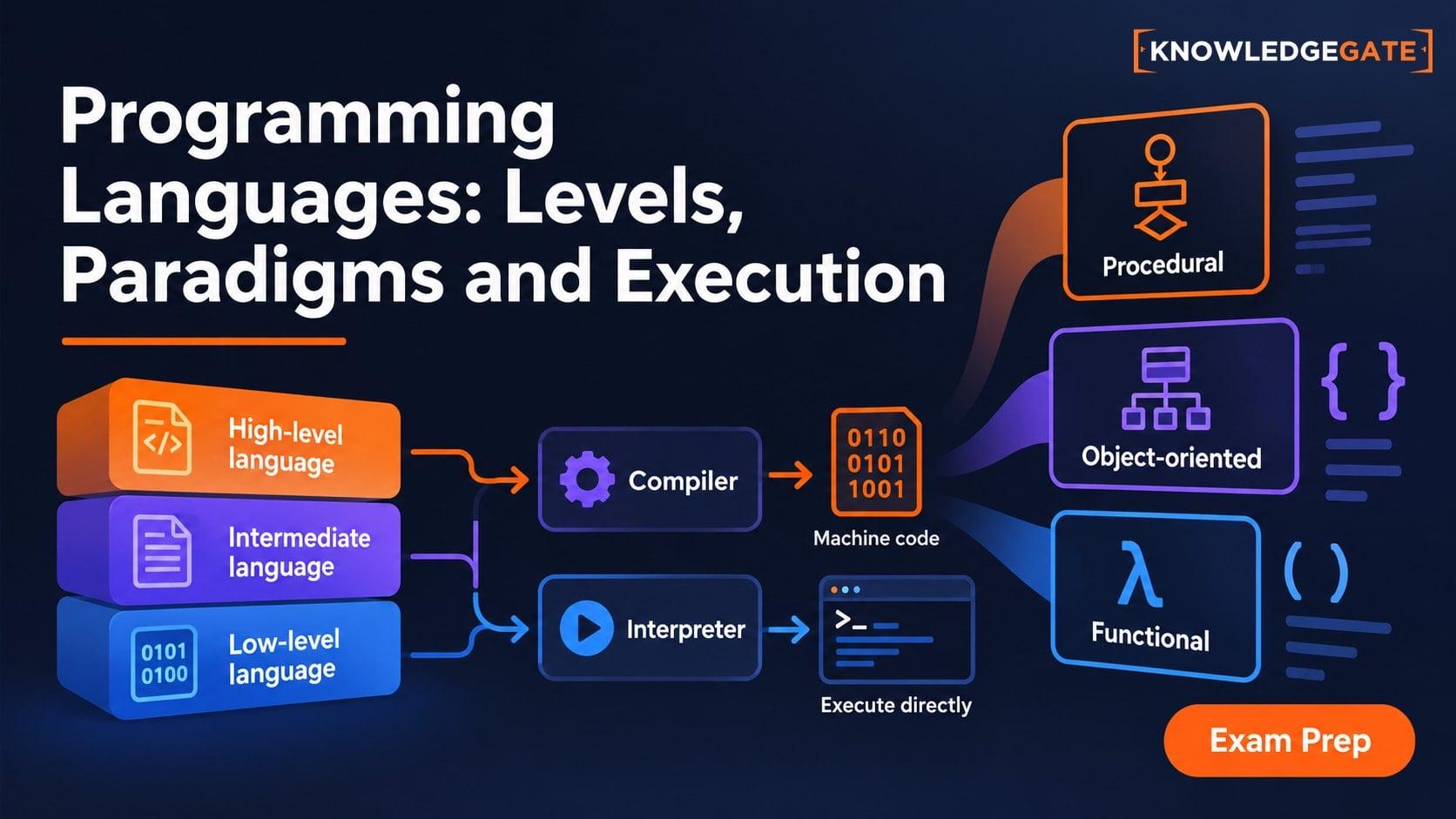
Labels such as low-level, object-oriented, compiled, declarative and dynamically typed are often taught as one list. That makes simple classification questions confusing because one language can belong in several boxes. The useful rule is to classify four things separately: abstraction level, paradigm, execution path and type system. Languages can be compared along all four axes, and one computation can be expressed in three different styles.
1. What does a programming-language "type" describe?
Four independent axes answer four different questions:
Axis | What it describes |
|---|---|
Abstraction level | How close the notation is to hardware details |
Paradigm | How the program expresses computation |
Execution model | How a particular implementation turns source into work |
Type system | When and how value-type rules are checked |
These axes overlap rather than forming one exclusive ladder. A Python program may be imperative, object-oriented or functional, while common CPython first produces bytecode and runs it on a virtual machine. Therefore, object-oriented and interpreted answer different questions. A language offers paradigm facilities; an individual program chooses among them. You can compare language-learning paths without forcing each language into one box.
2. Classification by abstraction level and the textbook generation model
Machine language contains processor instructions encoded for a specific instruction set. Assembly gives those instructions symbolic names and needs an assembler. High-level languages hide many hardware details behind variables, expressions, functions, objects, queries or rules.
A common teaching convention calls machine language 1GL, assembly 2GL and general high-level languages 3GL. It may call more domain-oriented or declarative notation 4GL, with SQL as a frequent example, and constraint or logic-oriented systems 5GL. The boundaries of 4GL and 5GL are not universal standards, so use the definition given in the question.
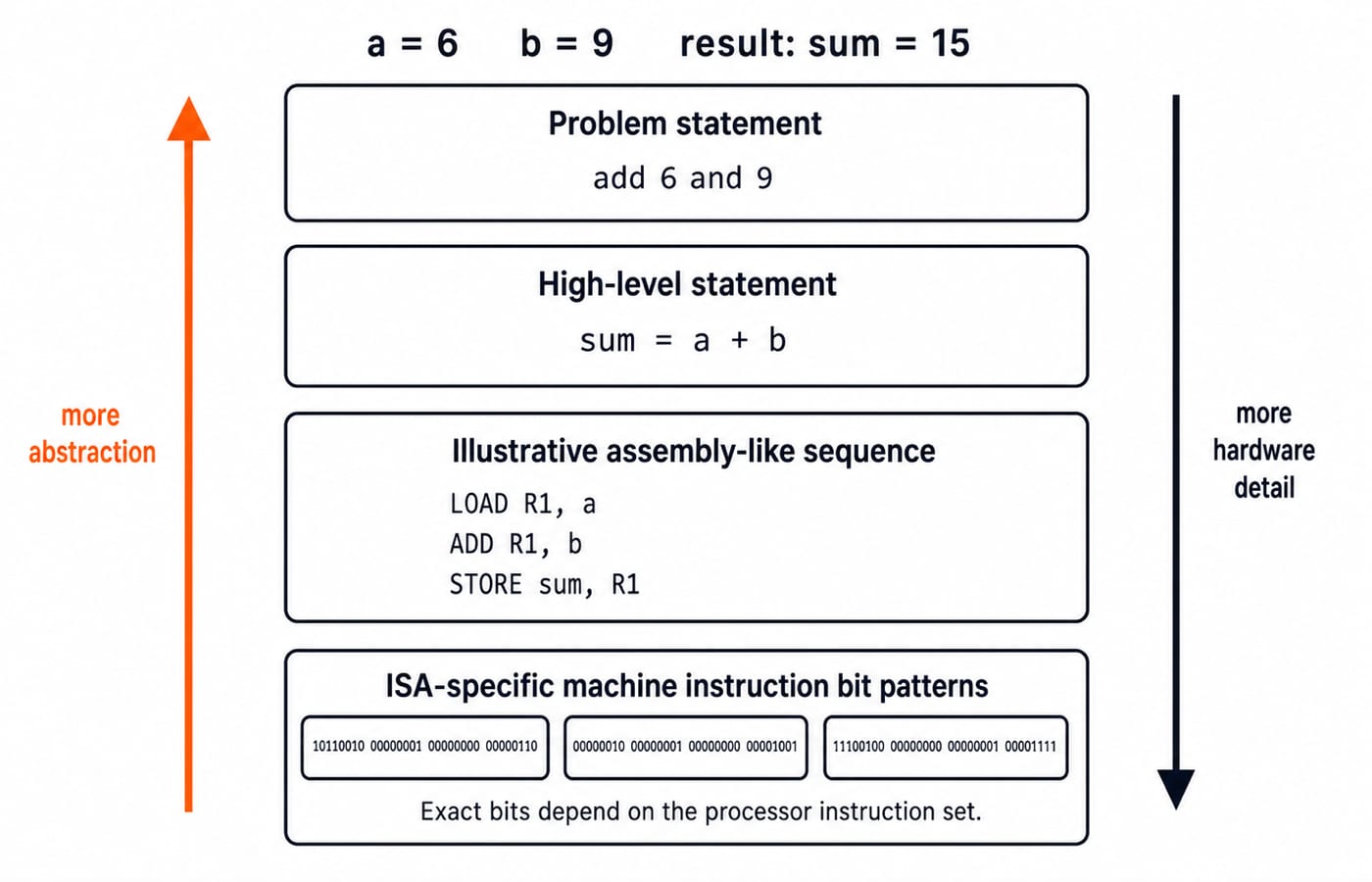
For a = 6 and b = 9, the high-level statement is sum = a + b, producing 15. An illustrative assembly-like sequence is:
LOAD R1, a
ADD R1, b
STORE sum, R1
The figure's bottom row uses generic bit groups to represent the machine-code layer. Executable opcodes depend on the processor instruction set and addressing mode.
3. Classification by programming paradigm
Imperative programming changes state through commands. Procedural programming organises those commands into procedures. Object-oriented programming groups state and behaviour around objects and classes. Functional programming emphasises expressions, function composition and controlled mutation. Declarative programming states the desired result, while logic programming gives facts and rules from which answers are derived. Event-driven and concurrent styles provide further overlapping classifications.
A representative map is useful if it is not treated as absolute:
C is mainly imperative and procedural.
Java is class-based object-oriented, with imperative and functional features.
Python is multiparadigm.
SQL is a declarative query language.
Prolog is logic-oriented and declarative.
Representative use does not mean "only supports". A Java loop is imperative even though Java is commonly classified as object-oriented. A Python generator pipeline can be functional in style without making Python a purely functional language. Always separate a language's capabilities from the style chosen for one solution.
4. Compiled, interpreted, bytecode and JIT are execution paths
An ahead-of-time compiler translates code before execution. An interpreter executes it through another program. Bytecode is an intermediate instruction format. Just-in-time compilation translates hot code during execution. One toolchain can combine these mechanisms.
Typical implementation paths make the overlap clear:
C source goes through an ahead-of-time compiler to native machine code.
Java source goes through
javacto bytecode, then a JVM may interpret and/or JIT-compile it.Python source in common CPython becomes bytecode for the Python virtual machine.
SQL text goes through a database parser and optimiser to an execution plan.
Asking whether Java or Python is "compiled or interpreted" without naming an implementation creates an artificial choice. The defensible answer describes the stages. A one-word label alone does not establish performance, portability or memory safety.
Compiled vs Interpreted vs JIT Languages: How Code Actually Runs traces those stages and their startup, warm-up and throughput costs. In the four-axis map, execution path remains separate from paradigm, abstraction level and typing.
5. Worked example in imperative, functional and declarative styles
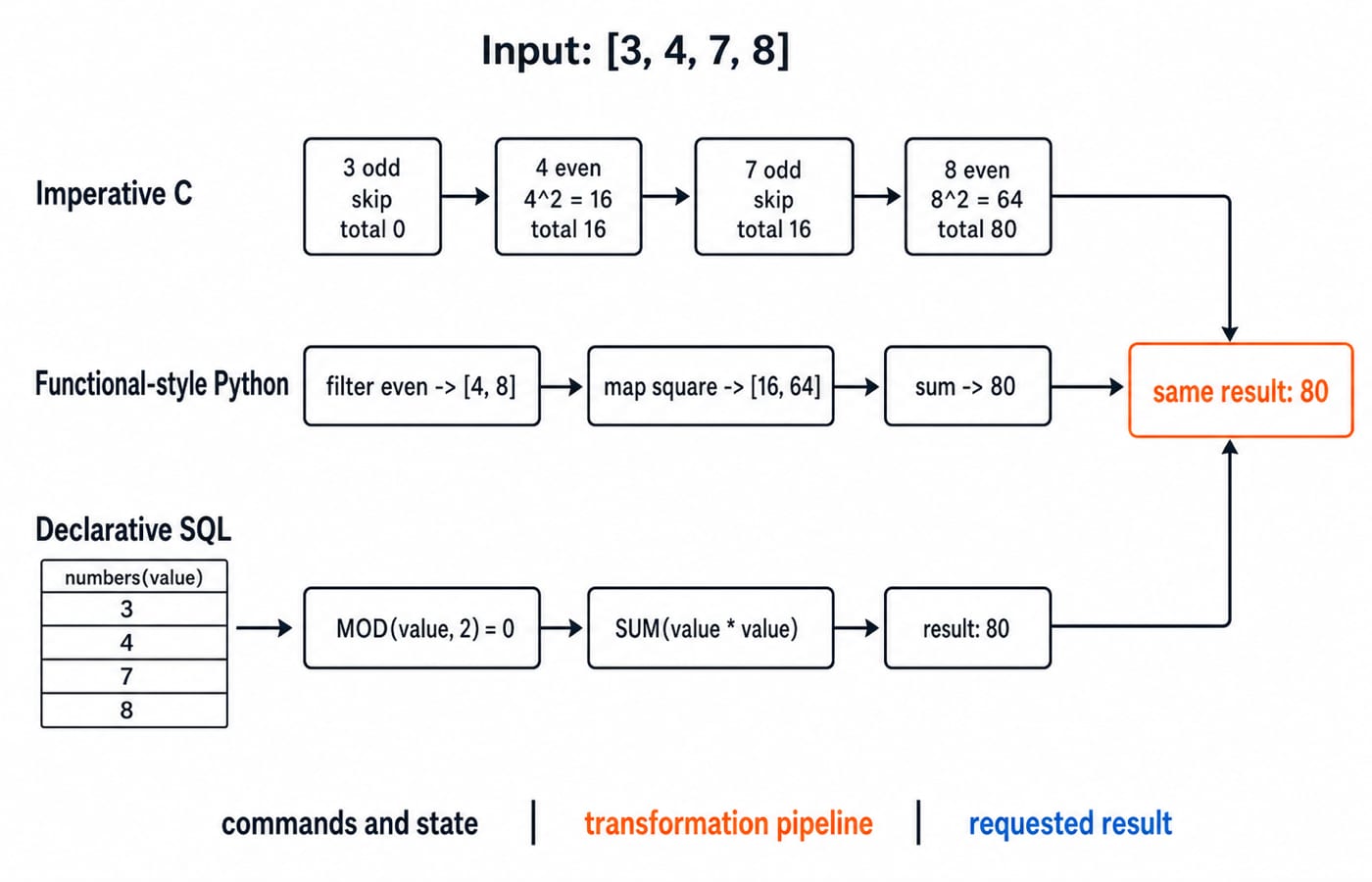
Take the integers [3, 4, 7, 8]. Keep the even values, square them and add the squares:
Evens:
[4, 8]Squares:
[4 * 4, 8 * 8] = [16, 64]Total:
16 + 64 = 80
An imperative C solution changes total as it scans the array:
int values[4] = {3, 4, 7, 8};
int total = 0;

for (int i = 0; i < 4; i++) {
    if (values[i] % 2 == 0) {
        total += values[i] * values[i];
    }
}
The four states are exact: 3 is skipped, so total = 0; 4 contributes 16, so total = 16; 7 is skipped, so total = 16; 8 contributes 64, so total = 80. The C Language course is the direct next step for practising this trace.
A functional-style Python expression states a transformation pipeline:
sum(map(lambda x: x * x,
        filter(lambda x: x % 2 == 0, [3, 4, 7, 8])))
Conceptually, it performs [4, 8] -> [16, 64] -> 80.
For a table numbers(value) containing the rows 3, 4, 7 and 8, this SQL query requests the result:
SELECT SUM(value * value) AS answer
FROM numbers
WHERE MOD(value, 2) = 0;
The result is 80. C, Python and SQL have not become three mutually exclusive language types. The comparison is mainly about how each solution states the computation.
6. Type systems form another independent classification axis
Static and dynamic checking concern when type rules are enforced. In Java, this is rejected by the type checker because count is declared as an integer:
int count = 3;
count = "three";
Python permits the name to be rebound:
count = 3
count = "three"
count + 1
The last expression raises a runtime TypeError. This does not mean Python has no types. Also, static typing may include type inference, so missing annotations do not prove dynamic typing. Labels such as "strongly typed" and "weakly typed" vary across authors. A precise answer names the conversion that is permitted or the operation that is rejected. SQL expressions and columns are typed too, although coercion and checking details differ across database dialects. None of these facts decides whether an implementation compiles or interprets code.
7. How exams turn the classification map into traps
Questions may match a language to a paradigm, identify an abstraction level, order a translation pipeline, or test words such as only, always and directly.
Consider this check:
I. SQL is usually classified as declarative.
II. Java source is always translated directly to native machine code before execution.
III. Python is restricted to one paradigm.
IV. Compiled and interpreted are properties only of languages, never implementations.
Only I is defensible. II ignores the common bytecode and JVM path. III ignores Python's multiparadigm use. IV ignores the choices made by particular implementations.
Use three correction rules:
Identify the classification axis before choosing.
Treat absolute wording with suspicion.
Prefer a staged execution explanation over a one-word binary.
Use the four-axis map above to learn the concepts. Types of Programming Languages MCQs: 12 Solved Classification Questions provides the practice set on levels, runtimes, typing, memory and notation. For each question, name the axis before looking at the options.
8. Short version and the next study step
Ask four questions: How close is the notation to hardware? How is computation expressed? How does this implementation execute it? When are type rules checked? Java, for example, is high-level, commonly object-oriented and imperative with functional features, statically typed, and typically compiled to bytecode for JVM interpretation and/or JIT compilation.
Now find the maximum of [12, 5, 19, 7] once with a state-changing loop and once as a result-oriented expression. The answer is 19. Coding For Placements is the multi-language next step. Classifications are lenses, not exclusive boxes.
Keep learning
Data Abstraction Explained: Hide Implementation Details with a Worked Java Example
See how a stable Account contract protects its invariant while the Java implementation changes from a running balance to a transaction ledger.
Updated 16 Nov 20265 min readProgramming Languages Survey
Programming Paradigms Explained: Concepts, Classifications and Worked Examples
Learn how imperative, procedural, object-oriented, functional and declarative styles organise the same computation, and how to classify code from visible evidence.
Updated 15 Nov 20265 min readProgramming Languages Survey
Introduction to Visual Basic (VB): Concepts, Worked Code and Exam Patterns
Learn how a VB.NET form turns text-box input and a button click into a traced result. Then practise operators, loops, procedures, scope and debugging.
Updated 14 Nov 20266 min readProgramming Languages Survey
Programming Language Syntax Explained: Grammar, Tokens and Semantics
Follow one assignment from its source characters to tokens, an AST, type checks and runtime evaluation. Learn exactly where syntax ends and semantics begins.
Updated 12 Nov 20265 min readProgramming Languages Survey