

Data Abstraction Explained: Hide Implementation Details with a Worked Java Example
See how a stable Account contract protects its invariant while the Java implementation changes from a running balance to a transaction ledger.
KnowledgeGate Team
Exam prep & CS education
Updated 16 Nov 20265 min read
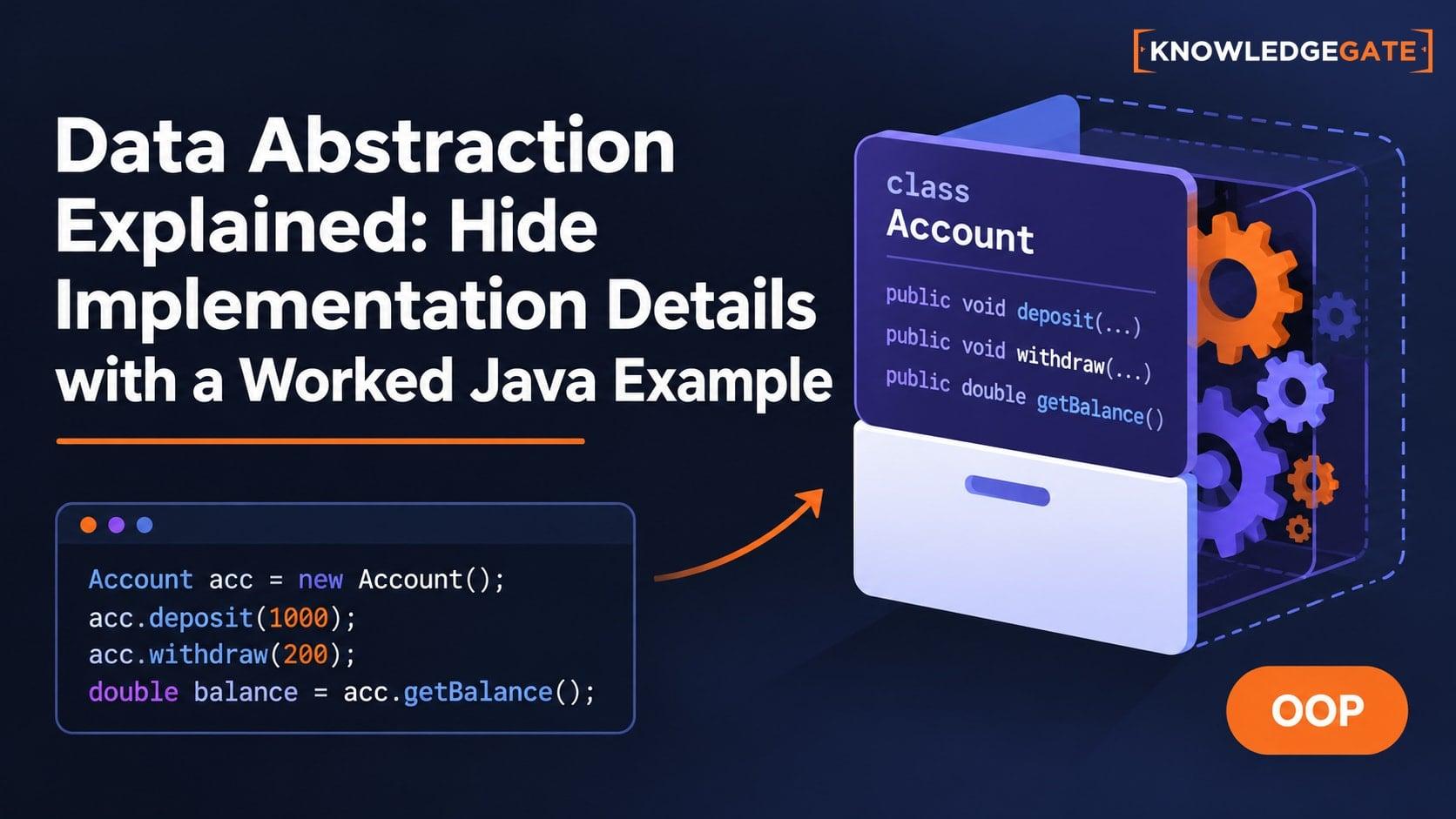
You may have memorised that abstraction means "hiding details" but still be unsure what is hidden, from whom, and why one private field is not enough. One bank account can keep the same public behaviour while its internal representation changes. Abstraction, information hiding, encapsulation and access control have distinct roles in output and design questions.
1. Data abstraction defines what clients may observe
Data abstraction presents meaningful operations and observable results while keeping representation and algorithm choices behind a boundary. As an abstract data type, a bank account is understood through deposit, withdraw and balance queries, not through its fields.
The nearby terms have different jobs:
Abstraction chooses the essential public contract.
Information hiding conceals choices that may change.
Encapsulation bundles state and behaviour behind a boundary.
Access control uses Java modifiers such as
privateto help enforce that boundary.
A private field helps, but privacy alone does not create a useful abstraction. Public methods that expose every representation detail still leak the implementation. For the wider OOP context, see Object Oriented Technology Explained. For constructor syntax, private fields, inheritance and JavaScript-specific output traces, use Classes in JavaScript: A Practical Tutorial with Runnable Examples. The Java Account below answers a different question: can one invariant survive a complete representation swap?
Abstraction is not limited to Java or OOP. Functions and modules can also expose stable contracts while hiding representations.
2. Fix the public contract and invariant before writing fields
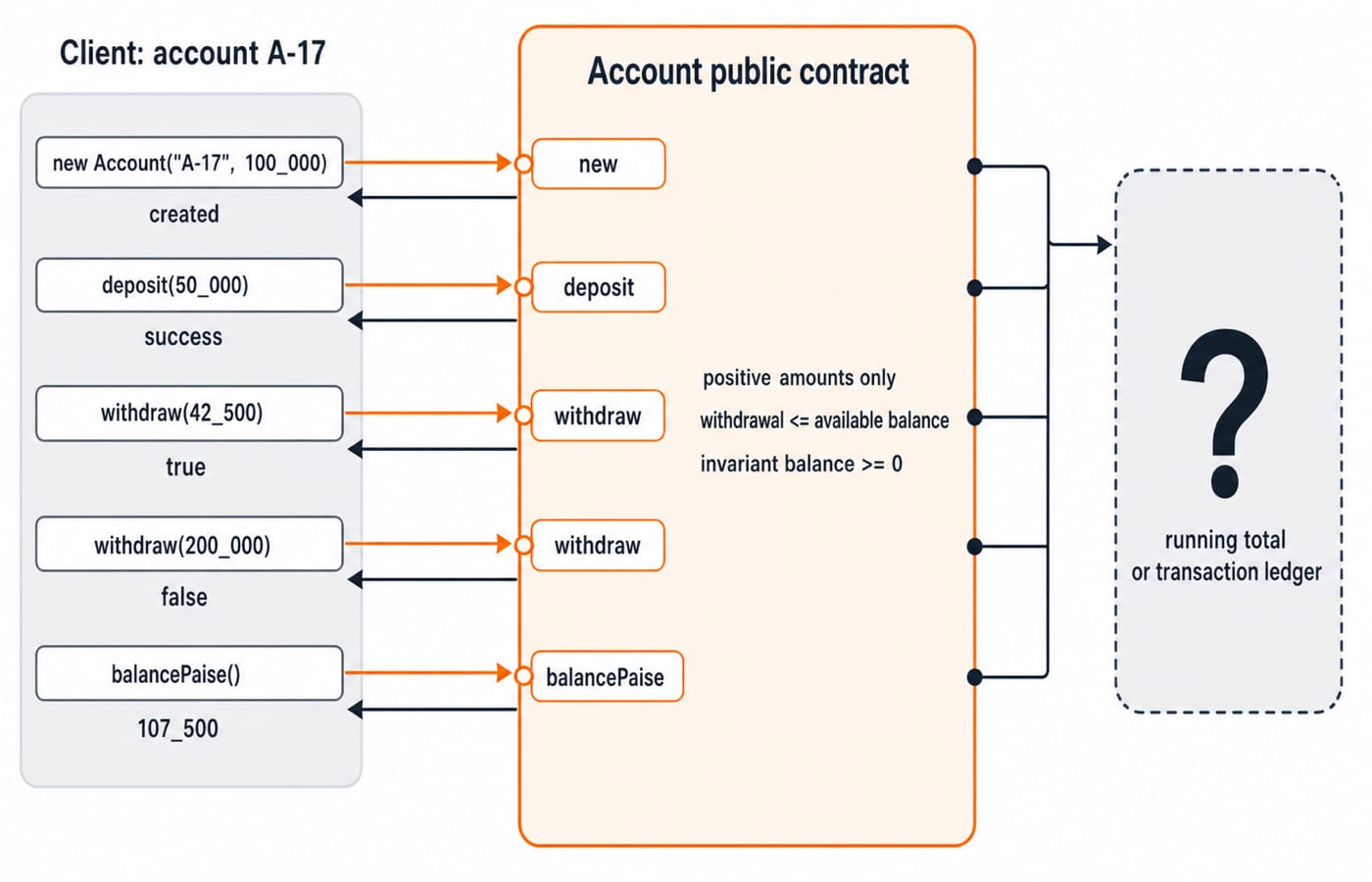
new Account("A-17", 100_000) creates our only account with 100_000 paise. deposit(long amountPaise) accepts only a positive amount. withdraw(long amountPaise) returns true only for a positive amount no greater than the available balance. balancePaise() returns the balance. There are no setters.
Before choosing fields, fix the rules: a successful deposit or withdrawal changes the balance by that amount, while rejection changes nothing. After every public call, balancePaise >= 0. The ID A-17, paise unit and rejection behaviour are contractual.
Hidden choices include a running total versus a transaction list, balance computation and invalid-transition prevention. Hidden representation is not secret data: abstraction improves separation and changeability, not authentication or encryption.
3. Worked example: trace every call and preserve the invariant
Version 1 uses private long balancePaise;. Its core methods can be written like this:
void deposit(long amountPaise) {
    if (amountPaise <= 0) throw new IllegalArgumentException();
    balancePaise = Math.addExact(balancePaise, amountPaise);
}

boolean withdraw(long amountPaise) {
    if (amountPaise <= 0 || amountPaise > balancePaise) return false;
    balancePaise -= amountPaise;
    return true;
}

long balancePaise() { return balancePaise; }
The constructor validates and stores 100_000. The deposit calculates 100_000 + 50_000 = 150_000. The first withdrawal checks 42_500 <= 150_000, calculates 150_000 - 42_500 = 107_500, and returns true.
Next, 200_000 <= 107_500 is false. No subtraction occurs, false is returned, and the final balance is 107_500 paise. The invariant holds.
step | call | check | return | balance after call |
|---|---|---|---|---|
construct |
| no withdrawal check | account object |
|
deposit |
|
| success |
|
first withdrawal |
|
|
|
|
second withdrawal |
|
|
|
|
query |
| no mutation |
|
|
4. Change the representation without changing client code
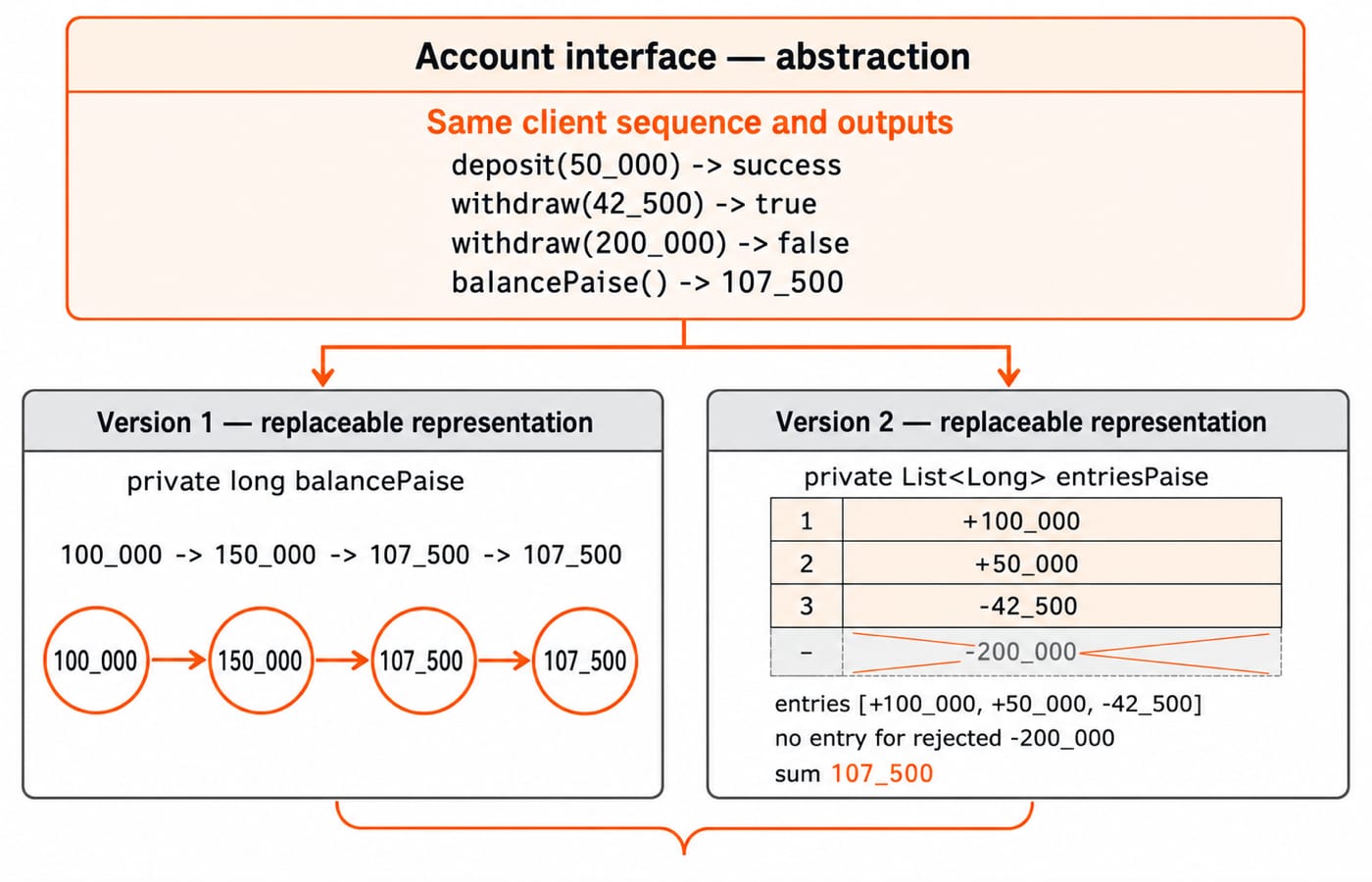
Version 2 replaces the running total with a hidden List<Long> entriesPaise. It starts as [+100_000]. The deposit appends +50_000, the accepted withdrawal appends -42_500, and the rejected withdrawal appends nothing. Computing the balance gives 100_000 + 50_000 - 42_500 = 107_500.
The same calls produce the same results: deposit succeeds, the withdrawals return true then false, and balancePaise() returns 107_500. Client code depends on the contract, not the field or list, so the representation change requires no client source change. This is representation independence.
Performance may differ because summing a ledger can cost more than reading one field. A documented timing or complexity guarantee would be observable. Only the stated functional contract remains unchanged here.
5. Representation leaks and common abstraction traps
If version 1 makes balancePaise public, client code can run account.balancePaise -= 200_000 after the trace and produce -92_500. That bypasses validation and breaks the invariant. Keep mutation behind validated domain operations.
Version 2 can leak too. Returning the live entriesPaise list lets a client call .clear(), changing 107_500 to 0 without a domain operation. If clients must see the entries, return an immutable list or a defensive copy.
Three traps follow. "Private means abstract" ignores a leaky public API. "Abstraction means the user knows nothing" ignores the documented contract. "A getter and setter for every field is encapsulation" may expose the complete representation behind method syntax. Good hiding makes operation names, units, validation and failure behaviour clearer, not vaguer.
6. How exams and interviews test data abstraction
Questions may ask you to choose a public member, spot a leak, distinguish abstraction from encapsulation, judge whether a representation change affects clients, trace an invariant, or compare an abstract data type with one implementation. The ideas cross language and module systems, as the Coding & Skill Development Courses explains.
Changing the field to a ledger, handling a failed withdrawal, and returning the live ledger test representation independence, invariant preservation, and information hiding. Changing the field to a ledger needs no client source change when clients use only stated methods. At 107_500, withdraw(200_000) returns false and leaves 107_500, not -92_500. Returning the live ledger leaks representation even if its field is private.
In 60 seconds, underline public operations and results, circle hidden structures, write the invariant, test whether clients can bypass it, then replace the representation mentally.
7. The short version and next step
Remember: abstraction defines the useful view; information hiding conceals replaceable choices; encapsulation draws the boundary; access control helps enforce it; representation independence permits implementation change while client behaviour remains stable.
The trace starts with 100_000, includes a 50_000 deposit, an accepted 42_500 withdrawal, and a rejected 200_000 withdrawal, and ends with a 107_500 balance while preserving the invariant in both implementations. Redraw both representations and explain why the failed withdrawal creates no ledger entry.
Use the Java course for structured Java learning, or DSA using Java for data-structure and interview practice.
Keep learning
Programming Paradigms Explained: Concepts, Classifications and Worked Examples
Learn how imperative, procedural, object-oriented, functional and declarative styles organise the same computation, and how to classify code from visible evidence.
Updated 15 Nov 20265 min readProgramming Languages Survey
Introduction to Visual Basic (VB): Concepts, Worked Code and Exam Patterns
Learn how a VB.NET form turns text-box input and a button click into a traced result. Then practise operators, loops, procedures, scope and debugging.
Updated 14 Nov 20266 min readProgramming Languages Survey
Types of Programming Languages: Levels, Paradigms and Execution Models
Learn why low-level, object-oriented, compiled and dynamically typed describe different axes. Build a clear classification map through one result expressed three ways.
Updated 13 Nov 20266 min readProgramming Languages Survey
Programming Language Syntax Explained: Grammar, Tokens and Semantics
Follow one assignment from its source characters to tokens, an AST, type checks and runtime evaluation. Learn exactly where syntax ends and semantics begins.
Updated 12 Nov 20265 min readProgramming Languages Survey