

GATE CS Self-Study Plan: Prepare Without Classroom Coaching
Build a GATE CS routine that converts lessons, practice, PYQs, tests, and mistakes into the next week's plan, even when a study day gets missed.
KnowledgeGate Team
Exam prep & CS education
Updated 22 Nov 20265 min read

A self-study aspirant rarely lacks lectures. The gap is a feedback loop that decides what to learn, solve, revisit, and test. A usable loop also needs a missed-day recovery rule. Treat the hour splits and thresholds as planning heuristics, not official GATE rules.
Replace the classroom with a six-step feedback loop
For every topic, use learn -> recall -> graded practice -> PYQs -> timed check -> error-led repair. A lecture completes only stage one.
Attempt 30 mixed questions in 45 minutes without notes. Label each K if known and solved, S if known but slow, or U if unknown or misapplied. A result of 11 K, 8 S, and 11 U puts 19 items on the repair list, not a label on your ability.
Use the GATE and PSU preparation pathway to build your sequence.
Map your weekly capacity across four phases
Use a 24-week model at 14 hours per week.
Phase | Weekly allocation | Total |
|---|---|---|
Weeks 1 to 12 | 8 h concepts, 4 h graded practice, 2 h recall and error repair | 14 h |
Weeks 13 to 18 | 4 h concept repair, 6 h PYQs, 4 h revision and timed checks | 14 h |
Weeks 19 to 22 | 2 h concept repair, 4 h PYQs, 6 h tests and analysis, 2 h recall | 14 h |
Weeks 23 to 24 | 3 h short-note recall, 3 h error repair, 6 h tests and analysis, 2 h weak-area practice | 14 h |
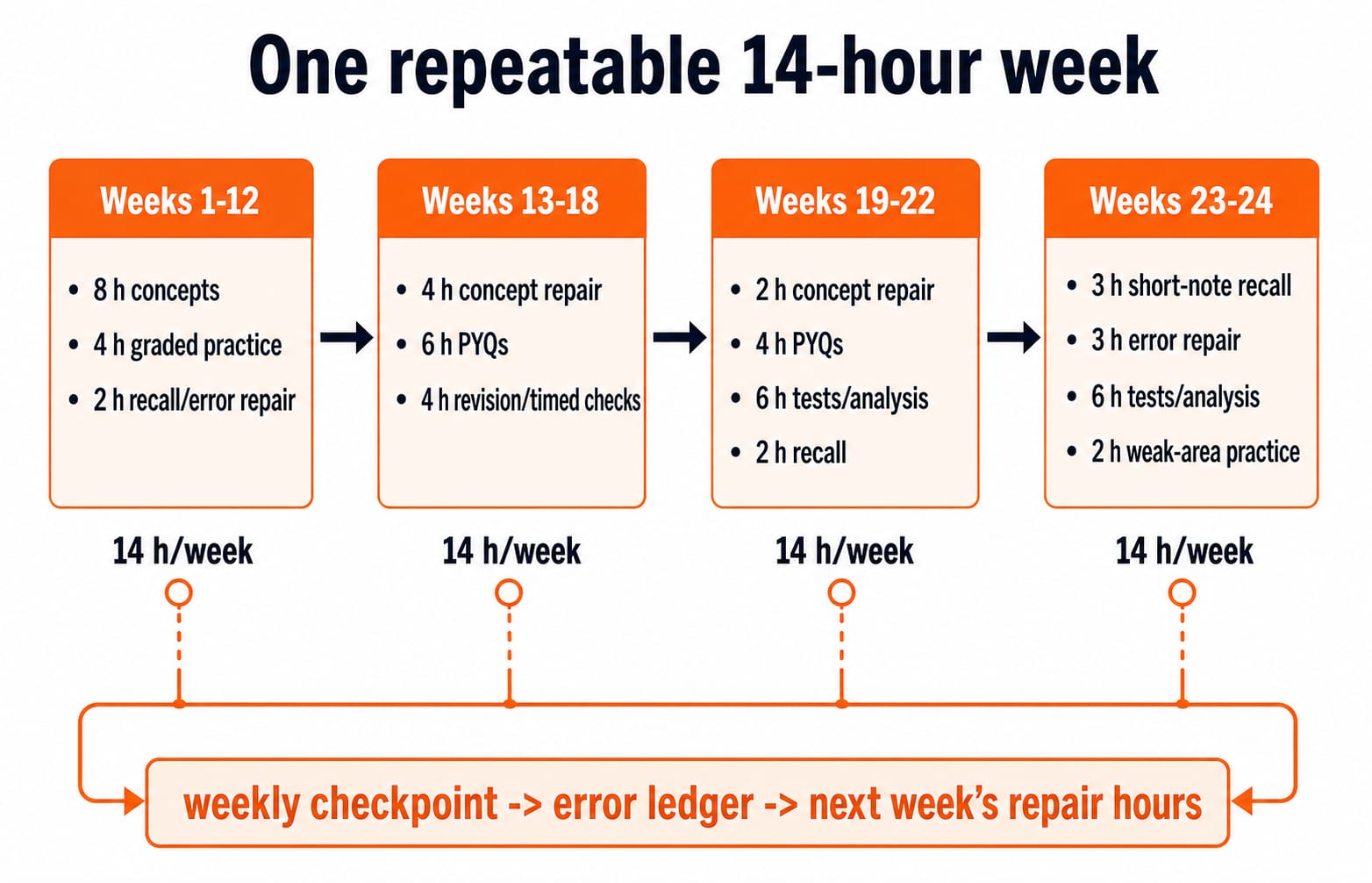
For a 10-hour week, scale each bucket by 10/14 = 0.714 and extend the calendar. Phase one becomes about 8 x 0.714 = 5.7 hours of concepts, 4 x 0.714 = 2.9 of practice, and 2 x 0.714 = 1.4 of recall and repair. The rounded total is 10 hours. Avoid tired late-night sessions.
Software Engineering for GATE: Syllabus and Priority shows how to order one subject. Do not transfer its priorities to others.
Run each topic through a 100-minute session
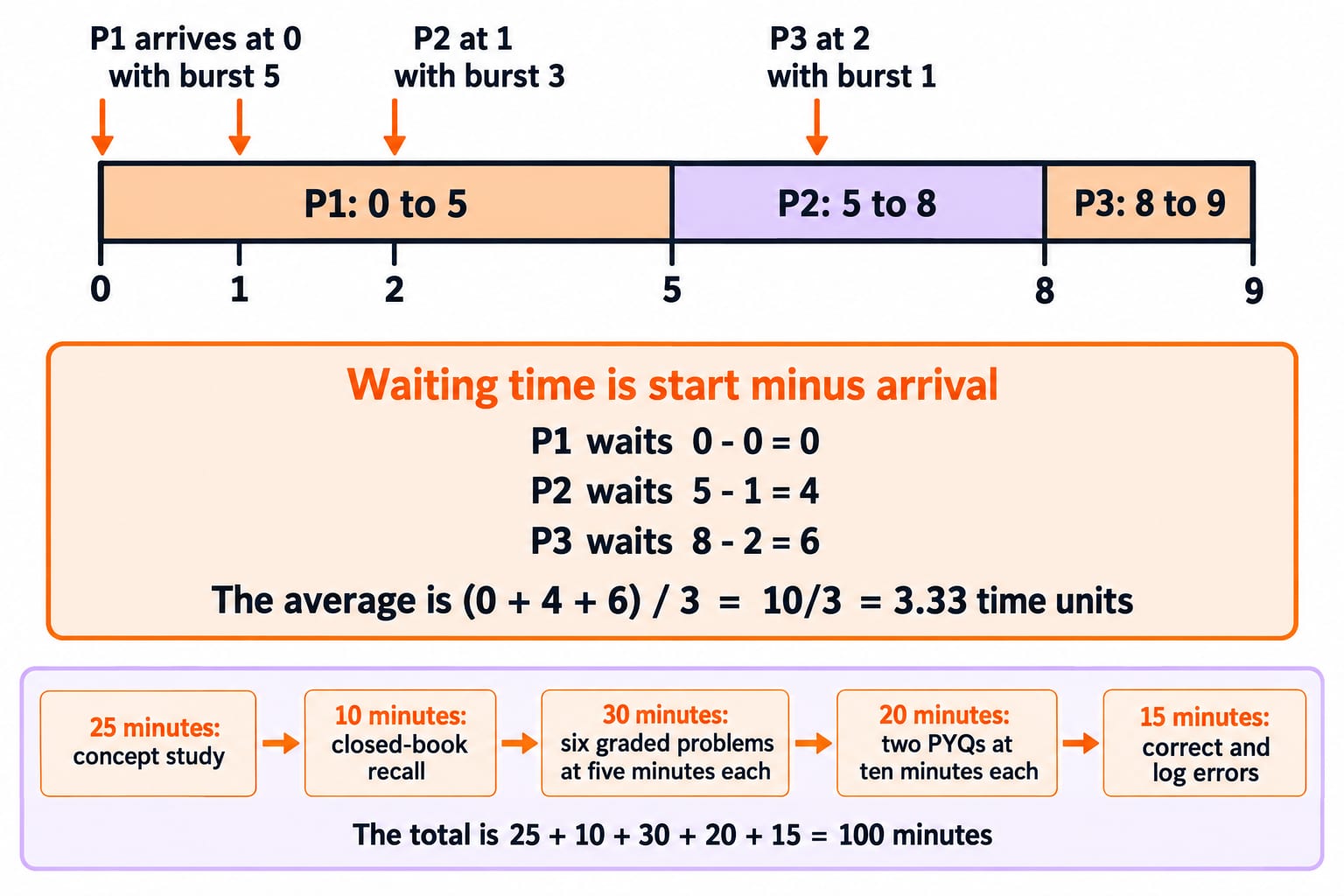
Use this learn-to-recall clock:
25 minutes: concept study
10 minutes: closed-book recall
30 minutes: six graded problems at five minutes each
20 minutes: two PYQs at ten minutes each
15 minutes: correct and log errors
The total is 25 + 10 + 30 + 20 + 15 = 100 minutes.
Apply it to FCFS scheduling: P1 arrives at 0 with burst 5, P2 at 1 with burst 3, and P3 at 2 with burst 1. FCFS runs P1 from 0 to 5, P2 from 5 to 8, and P3 from 8 to 9.
Waiting time is start minus arrival. P1 waits 0 - 0 = 0, P2 waits 5 - 1 = 4, and P3 waits 8 - 2 = 6. The average is (0 + 4 + 6) / 3 = 10/3 = 3.33 time units. Close the notes and prompt yourself: "Rebuild the timeline and all three waiting times."
Operating Systems for GATE places FCFS in context. The closing course offers optional lessons and PYQs.
Build a week that survives a missed day
Use this timetable:
Day | Planned work |
|---|---|
Monday | 2 h concept study |
Tuesday | 2 h graded problems |
Wednesday | 2 h concept study |
Thursday | 2 h PYQs |
Friday | 2 h recall and error repair |
Saturday | 4 h mixed revision and checkpoint |
Sunday | 0 h scheduled study |
The plan totals 2 + 2 + 2 + 2 + 2 + 4 = 14 h. If Wednesday is missed, recover it without creating a 16-hour week: add 0.5 h Thursday, 0.5 h Friday, and 1 h Saturday. Actual study is 2 + 2 + 2.5 + 2.5 + 5 = 14 h.
If recovery would cut sleep or spill into two weeks, move the topic forward but keep the checkpoint. Limit active core subjects to Operating Systems and DBMS. Add aptitude or mathematics only within the same 14 hours.
Measure retention, not completed hours
Use four adjustable checkpoints: 5-minute blank-page recall at session end, 10 questions after 48 hours, 20 mixed questions after 7 days, and 50 cumulative questions after 4 weeks. These are not official exam rules.
A 20-question check gives 14 correct, 3 wrong, and 3 unattempted. Attempted accuracy is 14/17 x 100 = 82.4%, coverage is 17/20 x 100 = 85%, but total-set mastery is 14/20 x 100 = 70%. Do not finish the topic on 82.4% alone. Turn all 6 wrong or unattempted items into repair prompts.
Below 60% mastery, relearn the concept. From 60% to 79%, keep it in weekly repair. At 80% or above, move it to spaced review. These thresholds are adjustable. Keep error notes after promotion.
Let test analysis design the next week
Use a 90-minute mixed set and 90 minutes of analysis. For 40 questions, record 26 correct, 8 wrong, and 6 unattempted. Classify the 14 misses as 5 concept gaps, 4 method gaps, 3 careless errors, and 2 time-pressure misses. Check: 5 + 4 + 3 + 2 = 14.
Next week gets 3 h concept repair, 2 h re-solving method gaps, 1 h accuracy drills, 1 h timed practice, and 7 h planned subjects: 3 + 2 + 1 + 1 + 7 = 14 h.
The GATE Test Series offers optional subject-wise and mock tests; your analysis still shapes the next week.
Keep resources narrow and escalate doubts deliberately
Use one primary explanation, one graded-problem source, PYQs, and one test source. Add another explanation only for a logged concept gap. Five playlists fragment continuity and trap you at the learning stage.
When a question blocks you, follow a fixed ladder:
Attempt it independently for 15 minutes.
Spend 10 minutes checking the relevant concept, not the answer.
Retry once without notes.
Record the precise blocker in one sentence.
Revisit it the next day.
After a second failed attempt, seek a worked explanation or community help.
Solve one transfer problem with changed values.
Self-study means owning decisions, not avoiding feedback. A weekly check-in needs only hours completed, checkpoint result, and next repair priority.
Audit every four weeks
Over four weeks, planned time is 14 x 4 = 56 h and logged time is 49 h. Adherence is 49/56 x 100 = 87.5%. Across 180 questions, 126 correct, 36 wrong, and 18 unattempted sum to 180. Total-set mastery is 126/180 x 100 = 70%.
The habit works, but extra resources are not earned. Keep the capacity and reserve the next week's first 3.5 h for the 36 + 18 = 54 misses. Change one variable at a time. If adherence is below 80% for two audits, resize weekly hours before changing books, teachers, or subjects.
The short version
Choose repeatable hours, close every topic loop, and let errors set next week's work. Recover missed days without punishment. For an optional structured path, use GATE Guidance by Sanchit Sir; otherwise, return to the GATE CS pathway and keep the loop under your control.
Keep learning

Java Tutorial: The Complete Learning Path for Self-Study
Learn Java in the right order, from your first compiled program to OOP, collections, and DSA. Each stage includes a practical target and an honest exit check.
Updated 30 Oct 20266 min read56 viewsJava

Python Tutorial: The Complete Learning Path, Ordered for Self-Study
Follow Python in a practical order, from your first program to functions, collections, files, OOP, libraries, and the point where DSA should begin.
Updated 9 Aug 20267 min read54 viewsPython

GATE CS Study Plan for Working Professionals
A practical GATE CS plan for working professionals: a 12-hour weekly timetable, flexible subject roadmap, PYQ practice, revision and mock analysis.
Updated 30 Oct 20265 min read130 viewsGATE CS Preparation
UGC NET CS and GATE CS Study Plan: A 16-Week Integrated Schedule
Prepare the shared CS core once, then protect separate lanes for Paper 1, NET-only topics and GATE problem solving. This plan shows exactly how to allocate, review and recover 18 study hours each week.
Updated 30 Oct 20265 min readNET Strategy & Updates