Python Tutorial: The Complete Learning Path, Ordered for Self-Study
Follow Python in a practical order, from your first program to functions, collections, files, OOP, libraries, and the point where DSA should begin.
KnowledgeGate Team
Exam prep & CS education
Updated 9 Aug 20267 min read
Most beginners learn Python by jumping between random videos. They can write a loop in isolation, then freeze when a problem needs a function and a dictionary together. The cure is a fixed order: syntax first, then loops and functions, then strings and collections, then files, classes and libraries, and only after that data structures. That ladder runs from print("Hello, world") to your first binary search tree.
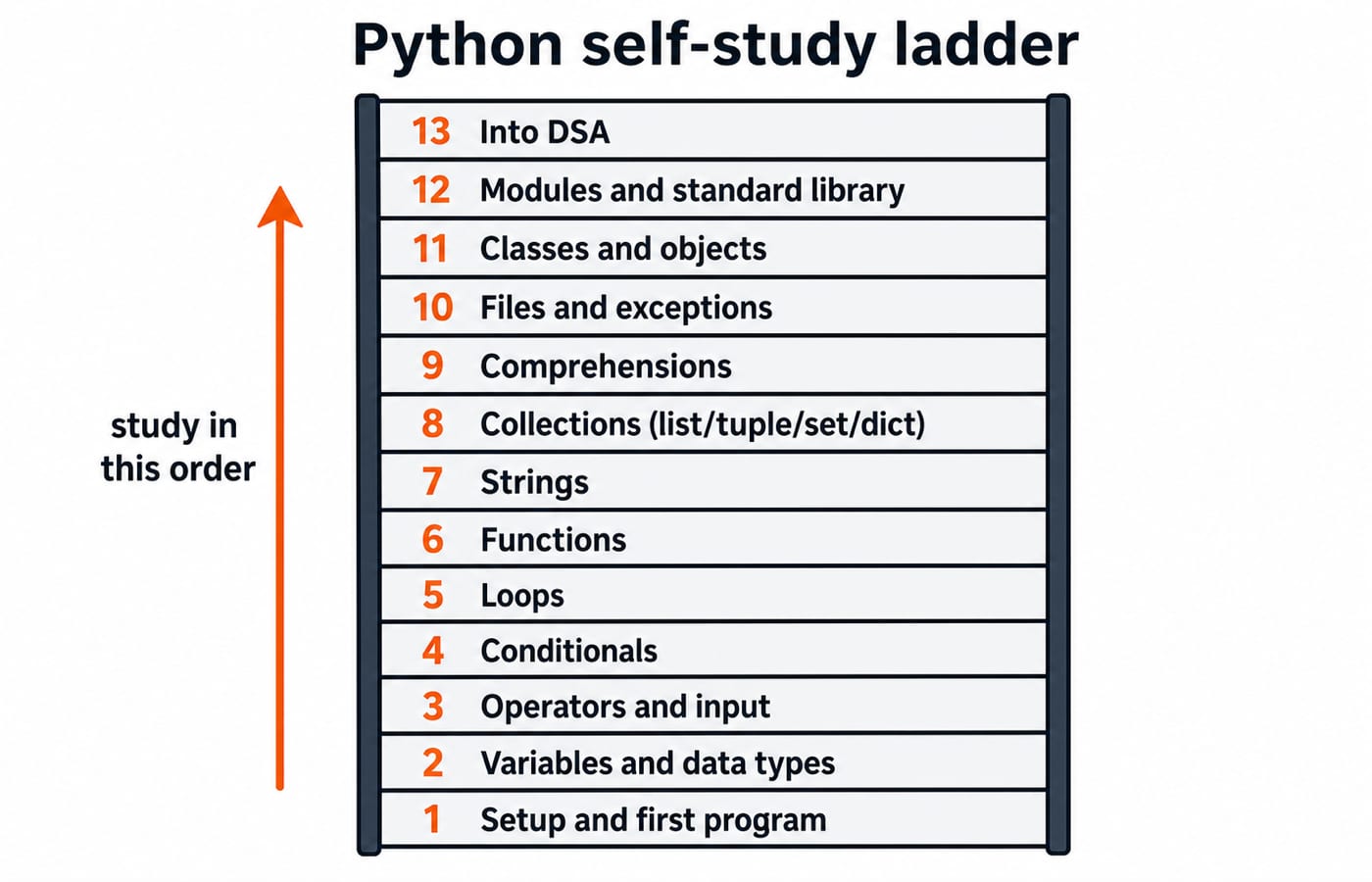
1. The 13-rung Python study order
Climb one rung at a time, and type every example into your own editor before moving up. Running, changing, and debugging code is how you learn Python.
Use this order:
Setup and first program
Variables and data types
Operators and input
Conditionals
Loops
Functions
Strings
Core collections: list, tuple, set, and dict
Comprehensions
Files and exceptions
Classes and objects
Modules and the standard library
The bridge into data structures and algorithms
Aim to clear one or two rungs per sitting, and before starting a new rung, recreate the previous rung's example from memory. At one focused hour a day, rungs 1 to 5 take roughly two weeks, rungs 6 to 9 another two, and rungs 10 to 12 about ten days, which puts a beginner at rung 13 in six to eight weeks. Missed days stretch that, and stretching is fine. Restarting at rung 1 every month is not.
2. Stage 1: setup and language basics
Install Python from the official source, open its beginner tutorial, and save this one-line program in hello.py:
print("Hello, world")Run it with python hello.py. A file ending in .py is a Python source file.
Next, learn variables and data types. Python is dynamically typed: x = 5 binds x to an int, while x = "five" later binds the same name to a str. The four everyday types are int, float, str, and bool; type(x) tells you the current type.
Operators let you calculate and compare. Learn arithmetic + - * / // % **, comparisons == != < >, and logic with and, or, and not. Remember that input() always returns a string. Convert numeric input explicitly, as in age = int(input("Age: ")).
Conditionals choose a path with if, elif, and else. Indentation, not braces, defines each block:
if marks >= 40:
    print("Pass")
else:
    print("Fail")
3. Stage 2: loops and functions, with a worked example
A for loop processes a known sequence. range(1, n + 1) produces the integers from 1 through n. A while loop repeats while its condition remains true; break exits a loop and continue skips to its next iteration. Many loop problems use an accumulator, a variable such as total that is updated on each useful iteration.
A function packages a task: def name(parameters): starts its definition, and return sends a value back to the caller. A function that reaches the end without return produces None.
Here is one program that combines operators, a conditional, a loop, and a function:
def sum_even(n):
    total = 0
    for i in range(1, n + 1):
        if i % 2 == 0:
            total += i
    return total

print(sum_even(10))
For n = 10, range(1, 11) yields 1 through 10. The test i % 2 == 0 is true only for 2, 4, 6, 8, and 10. Starting from 0, total changes as 0 -> 2 -> 6 -> 12 -> 20 -> 30. The additions are 0 + 2 = 2, 2 + 4 = 6, 6 + 6 = 12, 12 + 8 = 20, and 20 + 10 = 30. Therefore, sum_even(10) is 30, and the program prints 30.
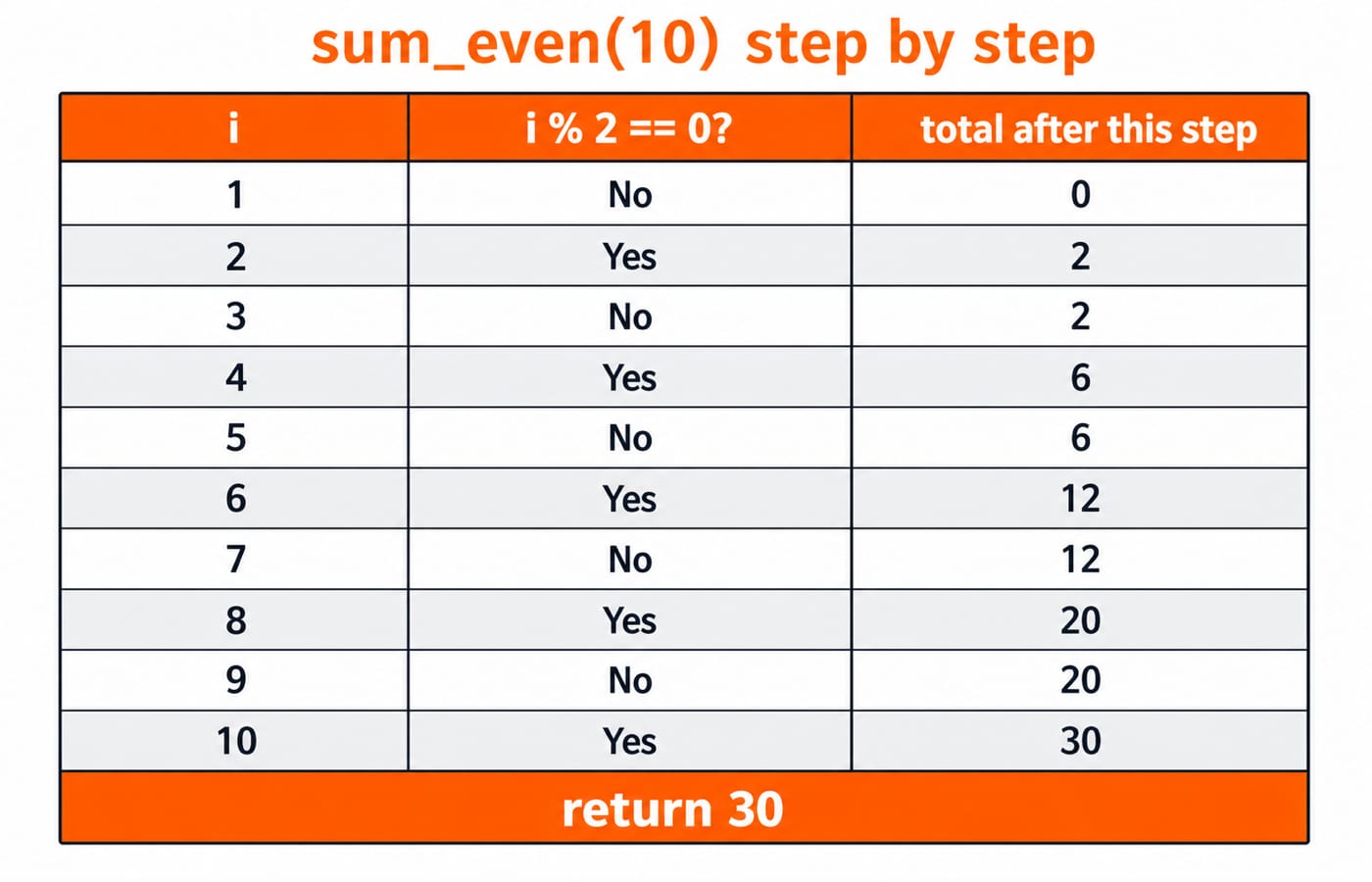
This example exercises def, return, range, for, %, if, and the += augmented assignment.
4. Stage 3: strings, collections, and comprehensions
Strings use zero-based indexing, so s[0] is the first character. A slice such as s[0:3] takes positions 0, 1, and 2. Strings are immutable, which means s[0] = "X" is invalid. Useful operations include .upper(), .split(), and f-strings such as f"Hello {name}".
Choose a collection by the job it must do:
List:
nums = [3, 1, 2]is ordered and mutable, and it allows duplicates. Afternums.append(4), it is[3, 1, 2, 4].Tuple:
point = (4, 5)is ordered but immutable. Use a tuple for a fixed record.Set:
{1, 2, 2, 3}becomes{1, 2, 3}. A set stores unique values and suits deduplication and fast membership checks.Dictionary:
marks = {"amit": 90, "riya": 85}maps keys to values.marks["amit"]returns90.
A comprehension builds a collection compactly. [x * x for x in range(1, 6)] squares 1, 2, 3, 4, and 5, producing [1, 4, 9, 16, 25]. For what each of these four collections costs per operation, and when a dictionary beats a list, work through Python Data Structures: Lists, Tuples, Sets, Dictionaries.
5. Stage 4: files, errors, classes, and libraries
Use a context manager for files: with open("data.txt") as f: text = f.read() closes the file automatically. Put risky operations inside try and except; use finally for cleanup that must happen whether the operation succeeds or fails.
A class bundles data and behaviour. This example stores a student's name:
class Student:
    def __init__(self, name):
        self.name = name

s = Student("Amit")
__init__ runs when the object is created, and self refers to that current object.
Modules provide reusable code. After import math, math.sqrt(16) returns 4.0; import random adds randomisation tools. Install extra libraries with pip, and use a virtual environment to keep each project's packages separate.
6. Common Python traps that stall beginners
Treating input as a number.
input()returns a string, soage + 1fails ifagecame straight from it. Convert withint(...)orfloat(...).Confusing
/and//.7 / 2is3.5, while7 // 2is3. Use//when you need the whole-number floor quotient.Using a mutable default. In
def add(x, box=[]), the same list is reused across calls and appears to remember old values. DefaultboxtoNone, then create a new list inside the function.Using
isfor values.==compares values;isasks whether two references point to the same object. Use==for value checks.Mixing tabs and spaces. One stray tab can produce
IndentationErrororTabError. Configure the editor for four spaces and stay consistent.Removing list items while iterating. Mutating the same list can skip elements. Iterate over a copy with
for x in nums[:], or build a new list.
The mutable default is the trap that survives longest, because the code looks correct on the first call and only misbehaves on the second. It and the scope rules behind it are worked out in Python Functions Deep Dive: the mutable default trap and LEGB scope.
7. Python for placements: the bridge into DSA
When loops, functions, and collections stop needing thought, Python is no longer the obstacle and the algorithm is the whole problem. That is the moment to start data structures, and the crossing is short, because Python already hands you most of the primitives:
Array, stack, and queue. A
listis your array.append()andpop()turn it into a stack, andcollections.dequewithappend()andpopleft()gives you a queue that removes from the front cheaply.Hash map. A
dictis a hash map, so frequency counts, seen-before checks, and the classic pair-sum scan all finish in a single pass instead of a nested loop.Fast membership. A
setanswersx in swithout walking the collection, which collapses many search loops into one scan.Ordering.
sorted(items, key=...)plus tuple comparison covers almost every ordering step an interview question needs, so you rarely write a sort by hand.Nodes and recursion. A class holding
self.leftandself.rightis an entire binary tree node, and recursion is only a function calling itself, which you already met on rung 6.
Take the DSA rungs in this order: arrays and strings, then stacks and queues, then hashing, then recursion, then trees, then graphs, then sorting and searching, and finally dynamic programming. Most first-round screening questions live in the first four, and trees, graphs and dynamic programming are what separate the harder shortlists.
The natural next thread is Binary Trees and Binary Search Trees, which picks up exactly where rung 13 leaves off and builds on the same two-child node described above.
Company coding rounds and aptitude-plus-coding drives, the TCS NQT among them, ask you to combine these building blocks under time pressure rather than at leisure, which is why the order matters more than the total hours. If you would rather have the crossing taught than self-assembled, DSA Using Python takes these same primitives into the standard problem patterns, and the Coding & DSA Courses for Placements category shows the wider set of routes.
For precise current syntax, version-specific behaviour, installation guidance, and the beginner tutorial, use the official Python documentation. Treat it as the language reference whenever a detail may vary by Python release.
8. The short version and your next rung
Learn the language basics first, then loops and functions, followed by strings and collections. Add files, exceptions, OOP, modules, and libraries before moving straight into data structures.
Pick the lowest rung you cannot complete from memory and code its example without looking. That, not another random video, is your next step. The Python course gives you this ladder already sequenced with exercises attached, while the Mera Placement Hoga - Complete Placement Preparation Course is the broader guided path for placement-focused learners.
Keep learning
Pandas Basics in Python: Build, Clean and Analyse a DataFrame Step by Step
Follow one student dataset from its first DataFrame to a clean city summary, while learning how selection, missing values and vectorised calculations really work.
Updated 24 Sep 20265 min readPython
Python Operators and Expressions: Precedence, Types and Worked Output Traces
Trace Python expressions without guessing. This guide connects operator families, precedence, types, short-circuiting and exact output through worked examples.
Updated 23 Sep 20266 min readPython
CSV Files Explained: Parsing Rules, Worked Records and Exam Traps
Learn why commas and newlines are not always boundaries, trace a quote-aware parser, validate text fields with a schema, and calculate processing costs.
Updated 22 Sep 20265 min readPython
Polymorphism and Dunder Methods in Python: Runnable Examples and Exercises
See how one Python operation supports different types, then build a Vector2D class with readable output, addition, magnitude and equality. Includes runnable code, protocol failures and exercises.
Updated 21 Sep 20265 min readPython