Java Tutorial: The Complete Learning Path for Self-Study
Learn Java in the right order, from your first compiled program to OOP, collections, and DSA. Each stage includes a practical target and an honest exit check.
KnowledgeGate Team
Exam prep & CS education
Updated 23 Aug 20266 min read
You have decided to learn Java, but scattered videos and half-finished playlists keep pulling you in different directions. The problem is usually not a shortage of material. It is the absence of a clear order. Learn the concepts in five stages, build a project at each stage, and complete an exit check before moving on.
How this Java learning path works
Order matters in Java. Classes and inheritance remain abstract if methods and control flow are not yet automatic. Data structures practice also becomes frustrating when arrays and collections are shaky. Many self-study plans stall because they ask the learner to use ideas before building their prerequisites.
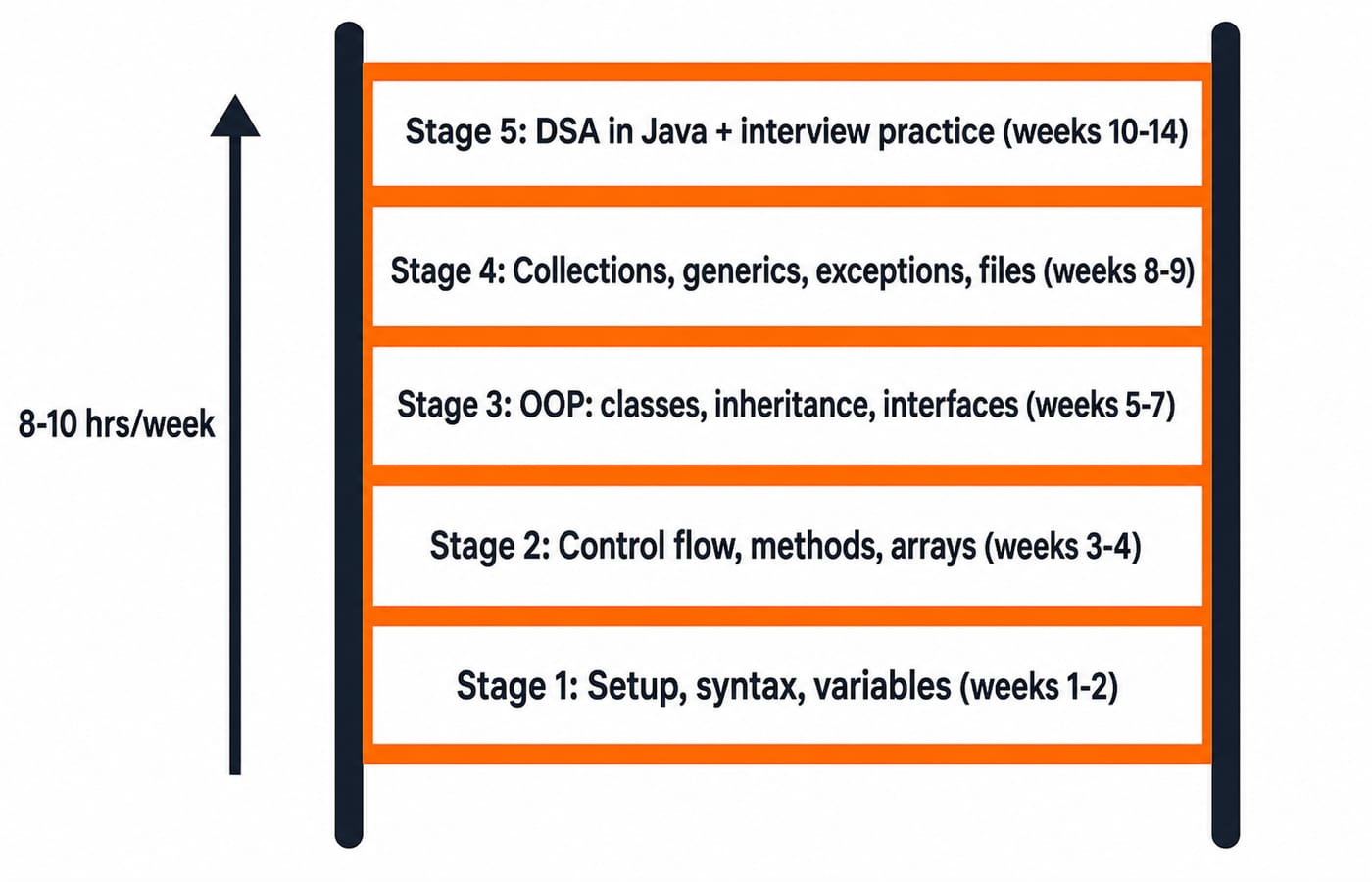
Follow these stages in sequence:
Stage 1: Setup, syntax and variables (weeks 1-2)
Stage 2: Control flow, methods and arrays (weeks 3-4)
Stage 3: Object-oriented programming (weeks 5-7)
Stage 4: Collections, generics, exceptions and files (weeks 8-9)
Stage 5: DSA in Java and interview practice (weeks 10-14)
These week bands assume roughly 8-10 hours of study a week. More time can compress the plan. Missing a week simply shifts the ladder forward, so nothing breaks.
Stage 1: Setup, syntax and variables (weeks 1-2)
Install the JDK and learn the basic journey of a Java program: javac compiles source code into bytecode, then the JVM runs that bytecode. Study the anatomy of the main method, primitive types such as int, double, char, and boolean, variables, operators, and input through Scanner.
Use a simple-interest program to connect syntax with arithmetic:
public class SimpleInterest {
    public static void main(String[] args) {
        double p = 12000;
        double r = 7.5;
        double t = 3;
        double si = (p * r * t) / 100;
        System.out.println("Simple interest = " + si);
    }
}
Trace it before running it:
12000 * 7.5 = 9000090000 * 3 = 270000270000 / 100 = 2700.0
The exact output is Simple interest = 2700.0. The variables take part in double arithmetic, so Java represents and prints the result as a decimal value rather than the integer-looking 2700.
Exit check: Write, compile, and run a small program that accepts three inputs and prints a computed result, without copying code.
Stage 2: Control flow, methods and arrays (weeks 3-4)
Now learn if and else, switch, for and while loops, static methods, one-dimensional arrays, and basic String operations. These tools let you turn a formula into a process that can make decisions and repeat work.
For example, find the digit sum of 4728 using n % 10 to take the last digit and integer n / 10 to remove it:
Current | Current | Digit taken | New | New |
|---|---|---|---|---|
4728 | 0 | 8 | 8 | 472 |
472 | 8 | 2 | 10 | 47 |
47 | 10 | 7 | 17 | 4 |
4 | 17 | 4 | 21 | 0 |
When n becomes 0, the loop ends and the answer is 21. You will reuse this remainder-and-division pattern in many later problems.
Exit check: From a blank file, reverse a number, find the largest element in an array, and print a multiplication table.
Stage 3: Object-oriented programming (weeks 5-7)
Learn OOP in a deliberate order: classes and objects, constructors, this, encapsulation through private fields and getters, static versus instance members, inheritance and super, overriding versus overloading, abstract classes, and interfaces. The four pillars are encapsulation, inheritance, polymorphism, and abstraction, but they become useful only when applied to one running example.
Build a Student class with name and int[] marks, plus an average() method. For Asha's marks {78, 92, 85}, the trace is 78 + 92 = 170, then 170 + 85 = 255, then 255 / 3 = 85.0. The expression new Student("Asha", new int[]{78, 92, 85}).average() should therefore return 85.0. In the method, divide the total by (double) marks.length so the return value uses decimal division.
Then create a HostelStudent subclass and override a summary() method. Calling summary() through a Student reference should select the subclass implementation while using the same name and marks. That small extension makes inheritance and runtime polymorphism concrete.
This stage gets three weeks because it needs daily writing, not repeated watching. Build several small class hierarchies until constructors, private state, and overridden methods feel ordinary.
Stage 4: Collections, generics, exceptions and files (weeks 8-9)
Learn when each common collection fits. Use ArrayList for an ordered, resizable sequence, HashSet for unique values, and HashMap for key-value lookup. Understand them through the List, Set, and Map interfaces. Use generics such as ArrayList<String> for type safety instead of raw lists.
Add try, catch, and finally, the difference between checked and unchecked exceptions, and basic text-file reading. Then combine the topics in a word-frequency counter: read a line, split it on spaces, and update a HashMap<String, Integer>. For the input to be or not to be, the required mappings are to=2, be=2, or=1, and not=1. A HashMap does not guarantee the order in which those mappings appear when printed.
Exit check: Explain why a HashMap suits counting problems, then write that counter without help.
Stage 5: DSA in Java and interview practice (weeks 10-14)
Start with time and space complexity, then study arrays and strings, recursion, linked lists, stacks and queues, trees, sorting, and searching. When you reach trees, use the Binary Trees and Binary Search Trees deep-dive as a model for the depth each topic deserves.
Solve two or three problems a day. Before attempting new ones, re-solve yesterday's hardest problem from a blank editor. A problem solved once with hints is not yet a problem learned.
Structure matters most at this rung. The DSA Using Java placement course sequences this work with practice sets. The wider Coding & Skills catalog also shows neighbouring tracks when you are still deciding which language or skill to pursue.
How exams and interviews test Java
Campus placement online rounds commonly use Stage 2 and Stage 3 ideas in predict-the-output, control-flow, OOP, and complexity questions. Interviews draw more from Stages 3 to 5, asking you to write code such as a linked-list reversal or a HashMap-based counter in an editor. University examinations often combine definitions with short programs from Stages 1 to 4.
For exact language and API behaviour, including integer division and String immutability, use Oracle's Java documentation. It is the authoritative reference for the language and standard APIs.
After every stage, reserve one session for predict-the-output questions on the topics you just completed. That habit turns passive reading into active recall and exposes gaps before the next stage depends on them.
The short version and your next step
Stage 1, weeks 1-2: Run a small input-based calculation without copying.
Stage 2, weeks 3-4: Solve loop, number, and array exercises from blank files.
Stage 3, weeks 5-7: Build and extend a small class hierarchy confidently.
Stage 4, weeks 8-9: Write a file-backed collection program with safe error handling.
Stage 5, weeks 10-14: Re-solve DSA problems independently and explain their complexity.
If you want the complete ladder taught in this order, the Complete Java Course follows the same stage discipline. If you are already at Stage 5, go directly to the DSA course above. For a focused check of Stage 3 and Stage 4 fundamentals, use Java Interview Questions for Freshers: Answers & Traps.
Keep one rule throughout self-study: never climb a rung until you have honestly completed the previous stage's exit check.
Keep learning
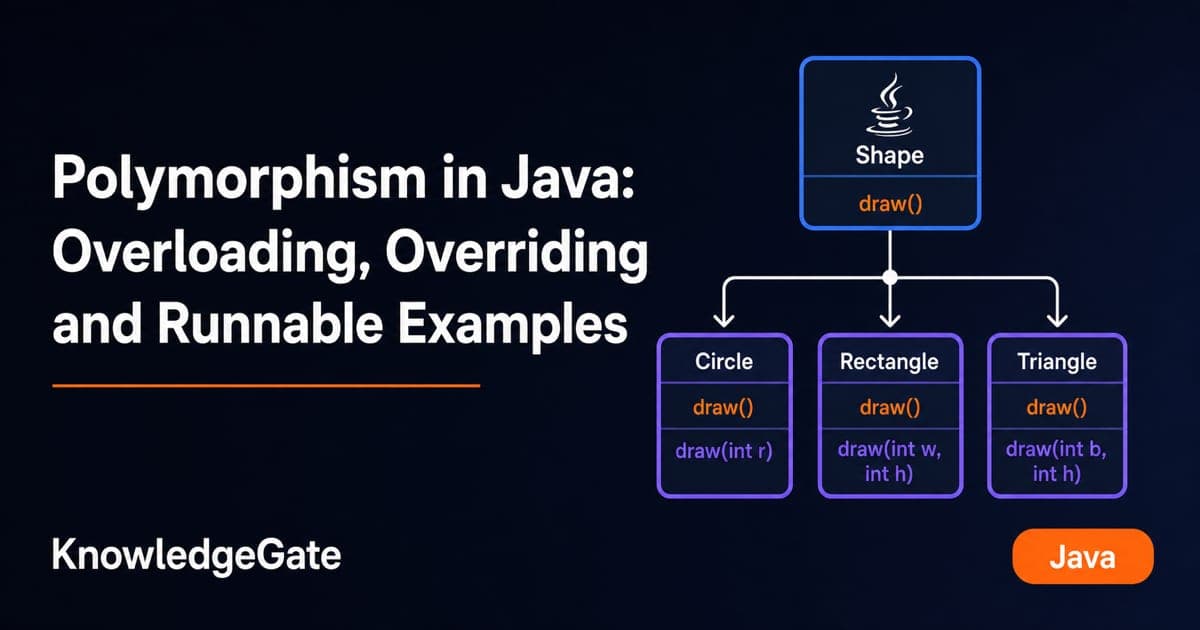
Polymorphism in Java: Overloading, Overriding and Runnable Examples
Learn how Java chooses overloaded methods at compile time and overridden methods at runtime. Trace two complete programs, common traps and practice targets.
Updated 22 Oct 20266 min readJava
Packages and Access Modifiers in Java: Visibility Rules with Runnable Examples
Learn how Java package boundaries change member visibility. Compile a complete example covering public, protected, package-private and private access.
Updated 18 Oct 20265 min readJava
OOP Basics in Java: Classes, Objects and the Four Pillars with Runnable Examples
Connect Java's OOP syntax to design decisions with a complete Account example. Trace two objects through validation, overriding and runtime dispatch to exact output.
Updated 14 Oct 20265 min readJava
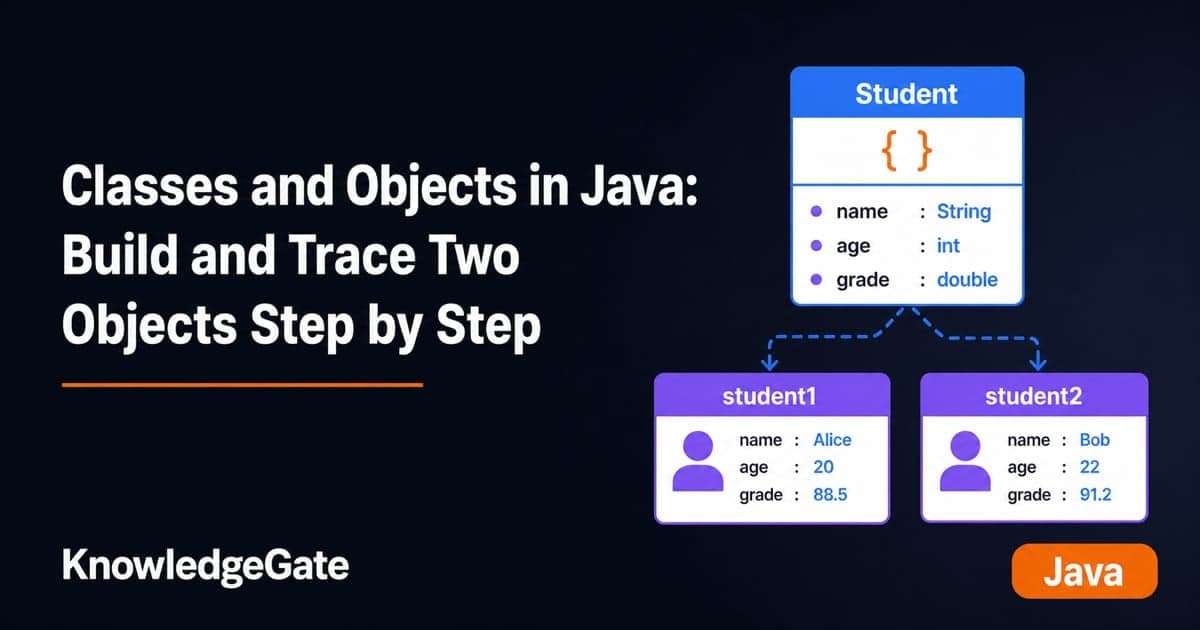
Classes and Objects in Java: Build and Trace Two Objects Step by Step
Build a Java Student class, create two independent objects, and trace fields, methods, aliases, null references, output, and common errors step by step.
Updated 10 Oct 20266 min readJava