

Physical Security Assets and Risk Factors: Worked Audit, Controls and Exam Traps
Follow a fictional college server-room audit from asset inventory to residual risk. Calculate four priorities, test power continuity, and avoid common exam traps.
KnowledgeGate Team
Exam prep & CS education
Updated 6 Nov 20266 min read
Physical security is often reduced to locks and guards, but exam scenarios mix people, rooms, servers, removable media, power, cooling, fire, water and operating procedures in one stem. A reusable method is to identify the asset, locate its physical dependency, separate threat from vulnerability, choose each control by purpose, and then assess the remaining risk. A fictional college examination server room supplies four risk scores and a UPS-generator timing gap. Its 1-to-5 scales are illustrative internal priorities, not an official formula or universal threshold. The topic sits within the broader UGC NET CS exam preparation.
Start with the asset, not with the lock
An asset is anything whose loss, damage, disclosure, alteration or unavailability causes harm. Inventory people; facilities and zones; equipment and media; information and credentials; and services, utilities and operations. Intangibles still depend on people, power, cooling, rooms, cables and devices.
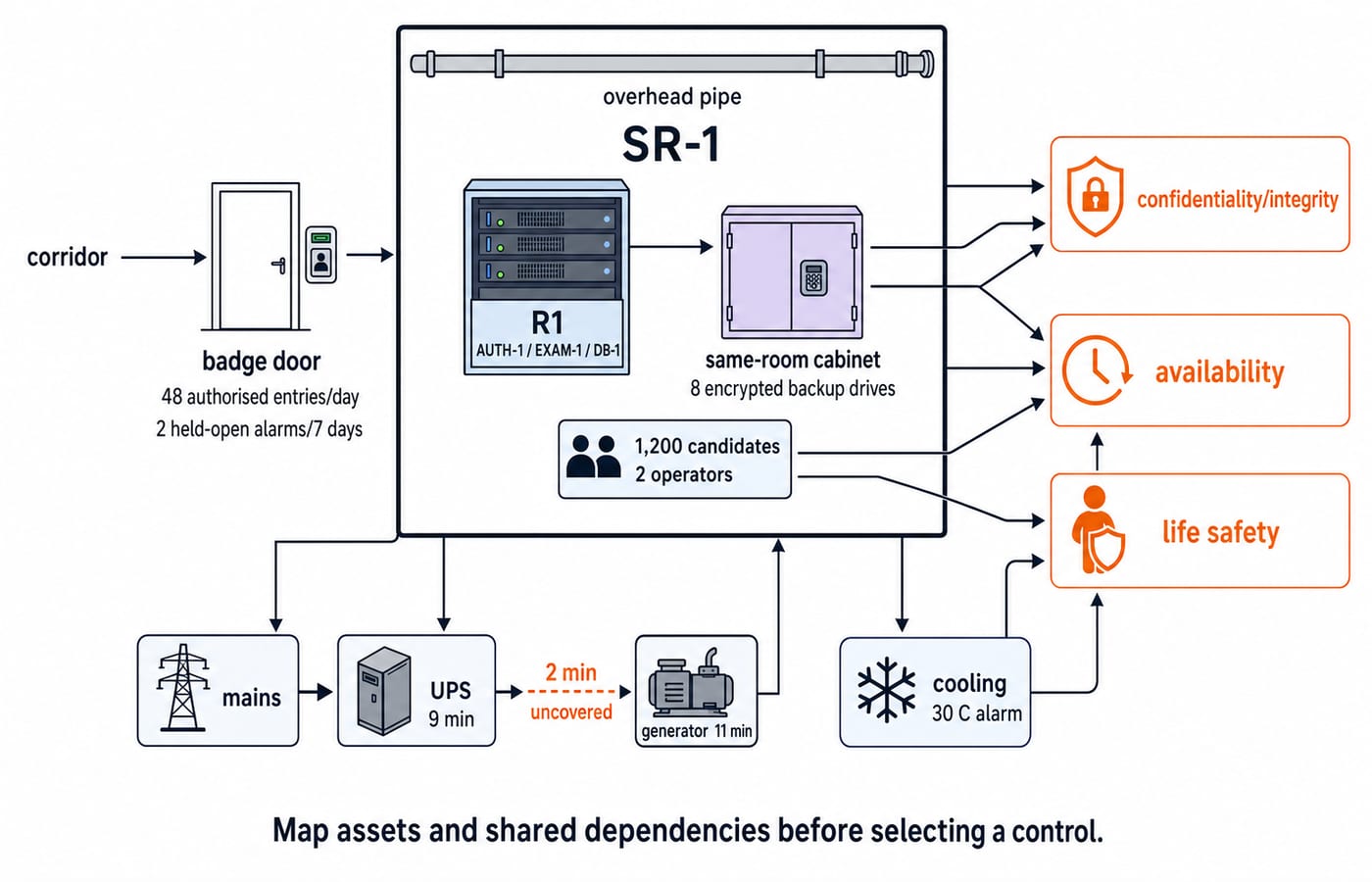
The service uses 2 operators, SR-1, AUTH-1, EXAM-1, DB-1, 8 encrypted backup drives, one uplink, UPS, generator and cooling. Its database and 1,200-candidate service are assets. Drive theft affects confidentiality, an unauthorised device integrity, and lost power availability. Life safety comes before equipment scores. UGC NET Computer Science Syllabus Areas gives broader navigation.
Separate threat, vulnerability, exposure, factor, control and risk
Use each term to answer a different question:
Term | Question it answers | SR-1 example |
|---|---|---|
Asset | What needs protection? |
|
Threat | What can happen? | Pipe water escapes |
Vulnerability | What weakness helps? | Pipe above rack; no sensor |
Exposure | What shares harm? |
|
Factor | What changes design? | Basement; slow response |
Control | What reduces risk? | Reroute, raise, sense, respond |
Impact | What follows? | Loss, tampering concern, interruption |
Risk | How prioritised? | Stated likelihood-impact combination |
Factors include location, crime or protest exposure, layout, visitors, hours, criticality, utilities, climate, accessibility, maintenance and response. A basement is a factor, rising water a threat, and an unsealed cable opening a vulnerability. A camera is a control, flood is not a vulnerability, high value is not a threat, and controls do not guarantee safety.
Group the factors before choosing controls
Factor group | What to inspect | Concrete SR-1 meaning |
|---|---|---|
Site and surroundings | Flood path, neighbours, emergency access, approach | Public corridor affects approach and response |
Building and zoning | Perimeter, walls, doors, windows, roof, loading, movement | One badge door with held-open events creates an access path |
Environment | Fire, smoke, water, dust, temperature, humidity | Pipe above |
Utilities and dependencies | Mains, UPS, generator, cooling, network, fuel | One cooling unit fails singly; tested power gap weakens continuity |
People and operations | Staff, contractors, visitors, handover, badges, evacuation | Unowned alarm means detection without response |
Lifecycle and assurance | Maintenance, tests, log review, revocation, recovery |
|
Ask what one event disables together. Three servers and eight backups are not independent if one hazard reaches all. Redundancy needs separate failure paths.
Use layered controls and give each layer one job
Build deter -> prevent or restrict -> detect -> delay -> respond -> recover. A sign deters, badge reader restricts, held-open alarm detects, locked rack delays, desk responds, and separated backups recover. No device completes the chain.
Physical controls include barriers, locks and raised racks; technical controls, badges, sensors and logs; administrative controls, escorts, maintenance and procedures. Access covers identity, authorisation, entry, logging, exit and revocation. The IBPS SO IT Officer networking guide covers the adjacent layer: a firewall cannot stop drive removal, door misuse or overheating.
Worked example: audit SR-1 and calculate the initial priorities
Snapshot item | Observed value |
|---|---|
Service and people |
|
Compute and media |
|
Access | Badge door; |
Environment | Chilled-water pipe above |
Power test | UPS |
The college assigns 1 to 5: risk score = likelihood x impact. Inputs are teaching priorities, not probabilities or published thresholds.
Scenario | Assigned inputs | Calculation |
|---|---|---|
Tailgating or door misuse |
|
|
Pipe leak over |
|
|
Power transition failure |
|
|
Cooling failure |
|
|
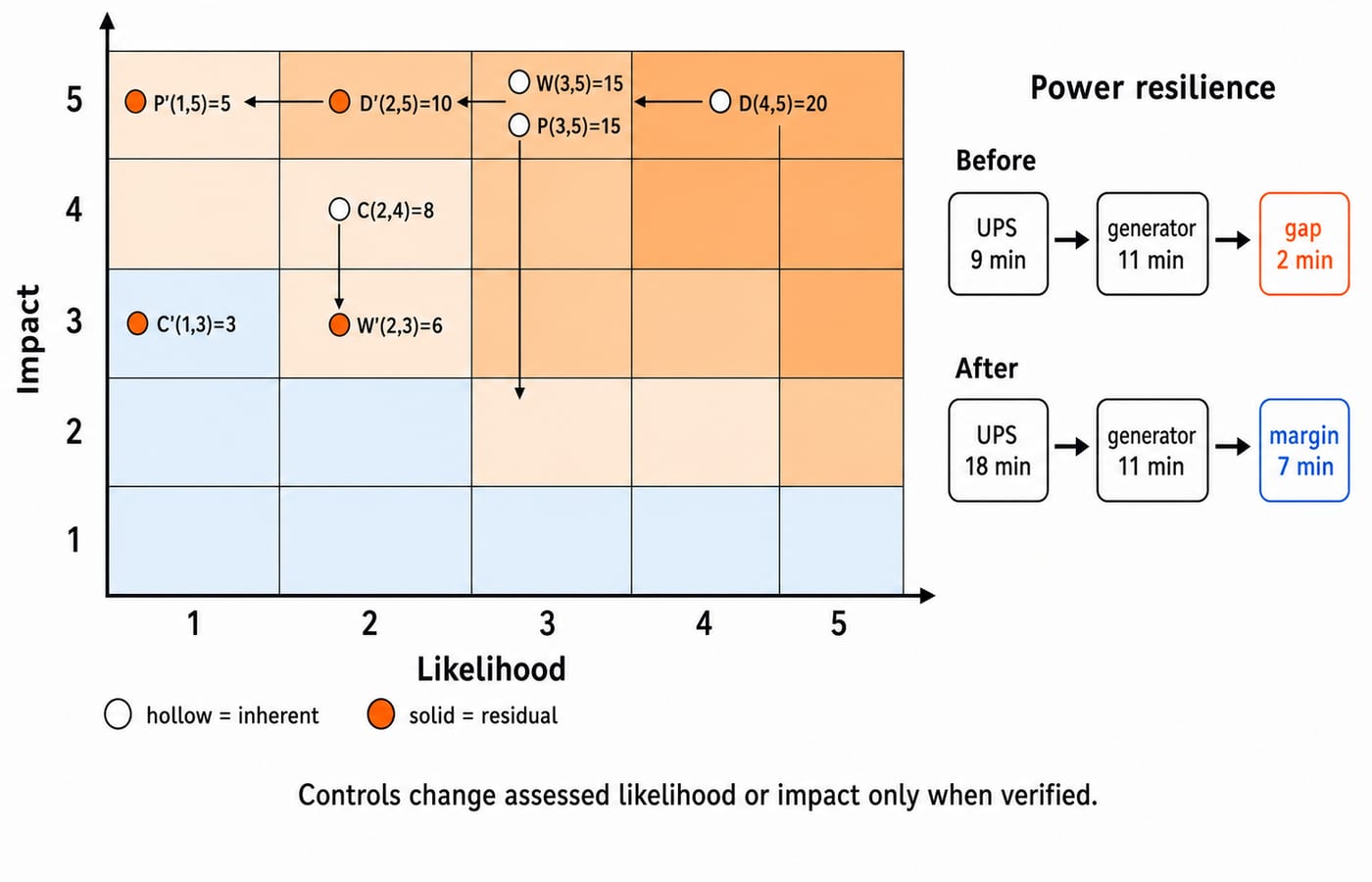
Order: 20, 15, 15, 8. Resolve the 15 tie through safety, shared exposure, detection and recovery, not decimals. Power margin is 9 - 11 = -2 minutes, a tested 2-minute uncovered interval, not a guarantee.
Apply controls, recalculate residual risk and inspect the assumptions
Scenario | Control plan | Residual calculation |
|---|---|---|
Door | Escort, anti-passback, immediate desk alert, named responder |
|
Water | Move pipe, raise |
|
Power | Replace battery; verify |
|
Cooling | Add independent unit; test alert |
|
Residual order: 10, 6, 5, 3. Power margin: 18 - 11 = 7 minutes. Impact stays 5 because both paths can still fail severely.
Products are ordinal priorities, not monetary loss, probability or proof of safety. Never add them or claim percentage improvement without an aggregation rule. Controls need owners, tests, alarm handling and fallback. Confirm door alerts reach staff and record response time; test power under documented load; simulate temperature or leak alarms safely; move one recoverable backup to a separate approved failure zone.
Common traps and exam-style checks
Assets means hardware only: ignores people, media, credentials, services, utilities. Inventory dependencies.
Physical security affects availability only: theft and tampering also affect confidentiality and integrity.
Camera means prevention: without monitoring and response, it deters or detects.
Encryption prevents theft: it reduces disclosure impact, not loss or downtime. Add custody and recovery.
Same-room backup means resilience: one hazard reaches both. Separate failure zones.
High score means probability: 1-5 values are assigned priorities. Record assumptions.
Answers: (1) pipe above R1 without sensor is a vulnerability within an environmental factor; (2) door: 4 x 5 = 20; (3) initial power margin: 9 - 11 = -2, a 2-minute gap; (4) residual: 18 - 11 = 7 minutes margin.
For a removed encrypted drive, the drive is asset, theft threat, and unauthorised access vulnerability or control failure. Encryption reduces disclosure impact, but replacement and restoration still affect availability and recovery.
How exams test physical security reasoning
Stable questions classify terms, match control purposes, find shared dependencies, trace security or safety effects, calculate L x I, compare scores, or solve a UPS-generator gap.
Use: circle asset -> underline event -> mark weakness -> identify objective -> use supplied scale -> choose control by purpose -> check residual risk and dependencies. Power moves 3 x 5 = 15 to 1 x 5 = 5; coverage, 2-minute gap to 7-minute margin.
The short version and next step
Inventory people, place, equipment, media, information, services and utilities. Group factors, layer and test controls, and never call residual risk zero. Redraw SR-1; reproduce 20, 15, 15, 8, then 10, 6, 5, 3.
For optional next steps, concept learners can use the NTA-UGC-NET Paper 2 complete course, while practice-ready learners can use the NTA UGC NET Paper 2 Test Series.
Go deeper with the full courseUGC NET Computer Science (Paper 1 + Paper 2)
Keep learning
Physical Security Controls and Access Management: Three-Zone Worked Example and Exam Notes
Learn how layered physical controls work with authentication, authorization and audit. Then test four requests against a complete three-zone access policy.
Updated 20 Nov 20266 min readGATE Strategy & Roadmap
Physical Security and Disaster Control: Layered Controls, RPO and RTO Worked Example
Learn how physical controls, disaster planning and recovery targets work together. Follow an exact incident timeline to test RPO, RTO and a warm standby.
Updated 6 Nov 20266 min readTeaching Recruitment (Computer Science)
Physical Security and Cryptography Basics: Controls, Ciphers and Worked Examples
Connect physical and logical security through Lab L-07. Learn layered controls, calculate residual risk, trace XOR, compare SHA-256 outputs and choose the right primitive.
Updated 25 Oct 20265 min readDSA & Algorithms
Physical Security and Cryptography Basics: Controls, Keys and Worked Examples
Learn how physical and cryptographic controls work together, then apply them in a four-asset server-room model and a step-by-step toy RSA example.
Updated 13 Oct 20265 min read50 viewsDSA & Algorithms