

EVS for CTET: Environmental Studies vs Environmental Education with Worked Examples
Learn how primary-stage EVS differs from Environmental Education, how six themes integrate around a child's life, and how to solve evidence-led CTET choices.
KnowledgeGate Team
Exam prep & CS education
Updated 11 Nov 20265 min read
CTET names both Environmental Studies and Environmental Education, but treating them as synonyms can lead you towards the wrong pedagogy option. At the primary stage, Environmental Studies integrates natural, social and cultural inquiry, while Environmental Education develops informed concern, decision-making and responsible participation.
EVS for CTET: Environmental Studies and Environmental Education are related, not identical
For primary-stage EVS in CTET, Environmental Studies (EVS) is the broad, integrated curricular area through which children investigate their natural, social and cultural environment. They ask what exists, how parts relate, how people live and what evidence they can gather locally.
Environmental Education (EE) is a process or orientation that develops awareness, understanding, concern, decision-making and responsible participation. It can run through an EVS lesson, but EVS is wider than conservation. It also examines family, food, shelter, travel, work and how things are made.
Point | Environmental Studies | Environmental Education |
|---|---|---|
Object of study | The child's natural, social and cultural surroundings | Environmental issues and people's relationship with them |
Main aim | Integrated understanding through inquiry | Informed concern, judgement and responsible participation |
Typical classroom move | Observe a water source, interview people and compare findings | Use the evidence to choose and evaluate a feasible response |
Visible outcome | A reasoned explanation based on connected evidence | An evidence-led decision or action, followed by reflection |
The CTET EVS pedagogy guide develops the activity-based and child-centred teaching logic behind this distinction.
Integrated EVS connects subjects through one lived situation
Integration does not mean putting unrelated subjects on one worksheet. It starts with one meaningful situation and connected questions. In a water lesson, source and quality involve science; access, labour and sharing involve social understanding; bucket counts create mathematics; interviews use language.
A fragmented lesson copies a groundwater definition, solves an unrelated sum and adds a slogan. An integrated lesson observes one source, measures use, asks who collects water and interprets the evidence.
Remember: shared situation + connected questions + learner evidence + reflection or action = integrated EVS. Action is optional. When supported by context, responsible action becomes the Environmental Education dimension.
CTET EVS themes organise the child's environment
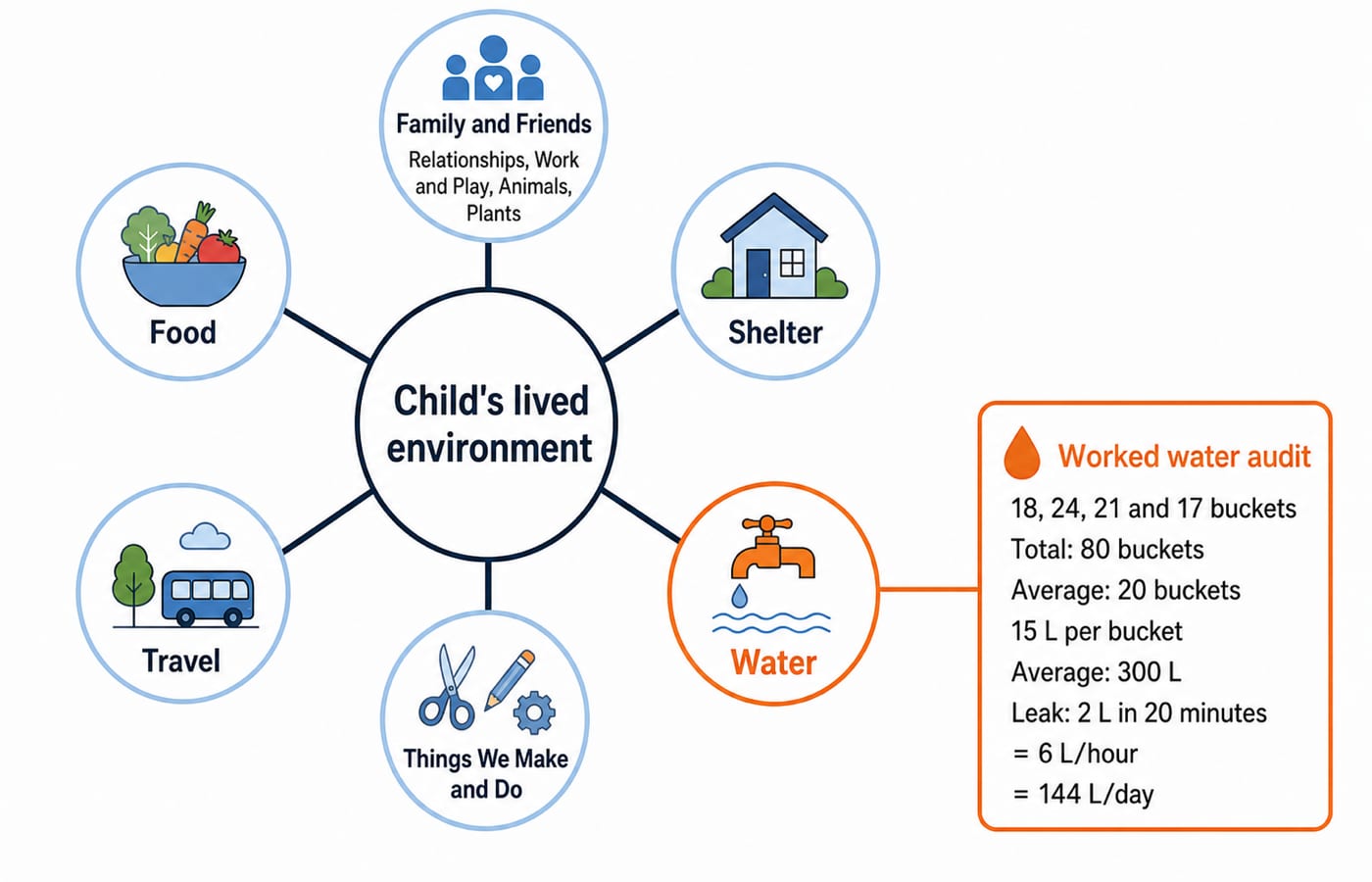
The February 2026 CTET Information Bulletin groups primary EVS content under six organisers: Family and Friends (Relationships, Work and Play, Animals, Plants), Food, Shelter, Water, Travel, and Things We Make and Do. They overlap rather than forming sealed textbook compartments.
For example:
Carrying water connects Water + Work and Play + Relationships.
Making a clay pot connects Things We Make and Do + Water + Work.
A bus journey to a weekly market connects Travel + Food + Work.
For the wider paper context, use the CTET syllabus guide for Paper 1 and Paper 2. The theme grouping itself comes from CTET's bulletin.
EVS worked example: a household water audit
Consider an illustrative classroom dataset, not a population statistic. Four groups report household use of 18, 24, 21 and 17 buckets per day, and each bucket holds 15 L.
Total use is
18 + 24 + 21 + 17 = 80 buckets.The sample average is
80 / 4 = 20 buckets per household.In litres, the average is
20 x 15 = 300 L per household per day.
Now a group observes that a continuously leaking tap fills a 2 L bottle in 20 minutes.
The measured rate is
2 / 20 = 0.1 L/minute.Per hour, that is
0.1 x 60 = 6 L/hour.Per day, that is
6 x 24 = 144 L/day.
The last result assumes that the observed flow continues unchanged for 24 hours.
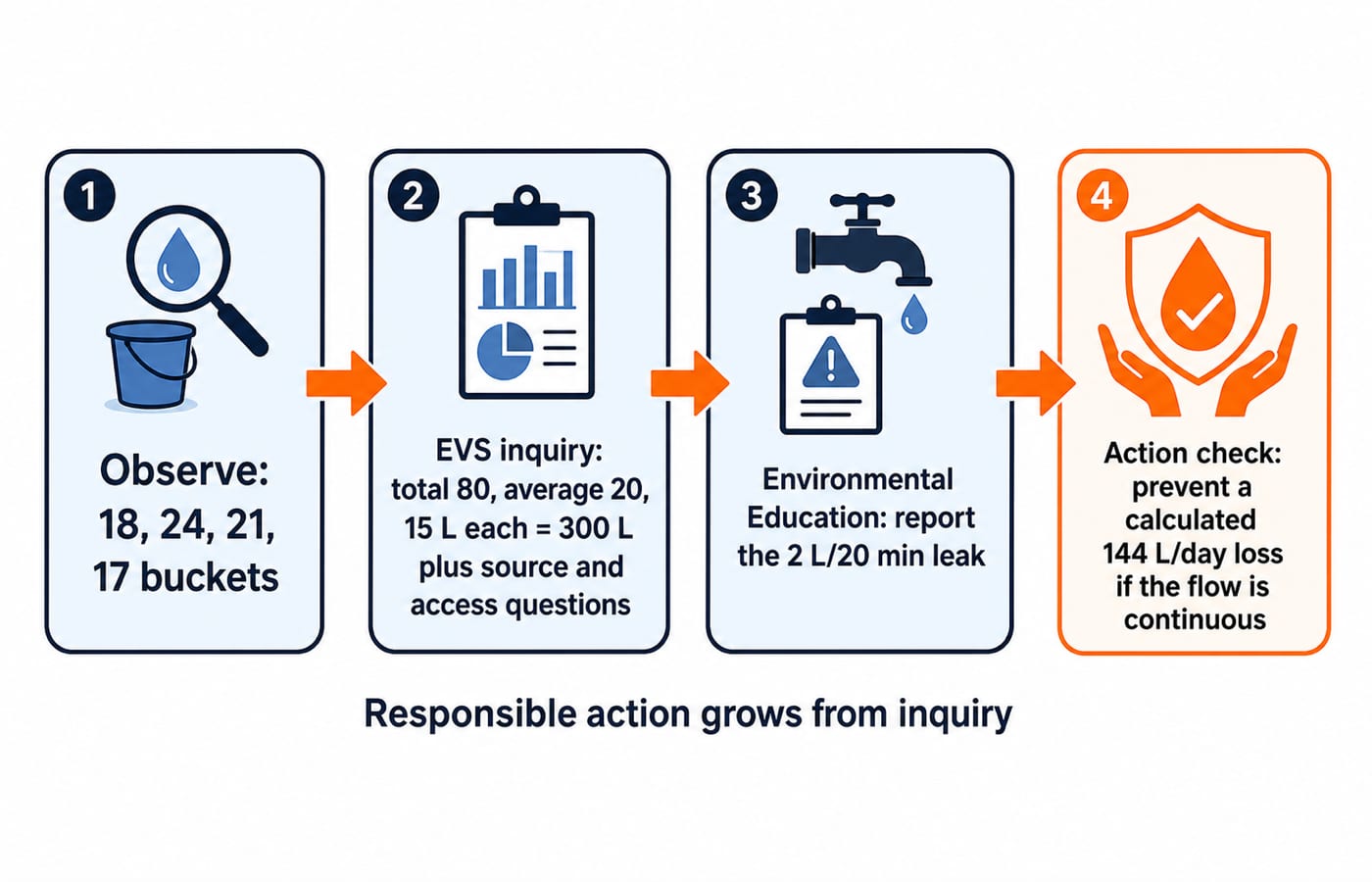
The EVS study includes calculating the average, identifying sources and storage, comparing who collects water and discussing safe handling. The Environmental Education layer uses the measured leak to report the fault, choose a feasible repair or shut-off, and measure again. The action grows from inquiry. A slogan alone is not evidence-led participation.
CTET-style examples: match the option to the learning aim
Question 1: integrated EVS
Which plan best represents integrated EVS while teaching water?
A. Dictate five definitions of water sources.
B. Show a water-cycle chart and ask learners to copy it.
C. Record 18, 24, 21 and 17 bucket counts, calculate the sample average, interview families about collection roles, inspect a leak and discuss a response.
D. Ask learners to memorise ten conservation slogans.
Answer: C. One situation connects evidence, calculation, social context and decision-making.
Question 2: study versus education
I. Calculating 80 / 4 = 20 buckets and comparing water sources is an EVS inquiry.
II. Using the measured 144 L/day leak estimate to report, repair and recheck the tap is an Environmental Education outcome.
A. I only
B. II only
C. Both I and II
D. Neither
Answer: C. The second statement extends the inquiry into participation. EE need not be a separate subject.
Question 3: best teacher response
A child says, "Water saved at school cannot matter because homes use more." What should the teacher do?
A. Correct the child immediately.
B. Ask the class to accept a conservation slogan.
C. Let groups measure the school leak for 20 minutes, extrapolate carefully, question the constant-flow assumption, then compare before and after repair.
D. Avoid the topic because the data are imperfect.
Answer: C. It treats the child as an investigator and establishes evidence before action.
EVS traps in CTET
Trap: EVS means environmental science only. Primary EVS also studies social and cultural relationships, including work, family and travel.
Trap: Environmental Education is a pollution chapter. It is a process that can run across themes and support informed participation.
Trap: any hands-on task is integrated EVS. A disconnected colouring exercise is activity, not necessarily inquiry. Check for a meaningful situation, connected ideas, evidence and learner reasoning.
A two-trial filter investigation can be traced through the Kolb cycle in Experiential Pedagogy for Teaching Exams: Complete Notes, Kolb Cycle and Classroom Examples. By contrast, the water-audit sequence separates EVS inquiry from the Environmental Education action that follows it.
How CTET tests EVS classroom logic
The February 2026 bulletin on the official CTET Information Bulletin page includes the concept and scope of EVS, integrated EVS, Environmental Studies and Environmental Education, links with Science and Social Science, activities, practical work, discussion, teaching material and classroom problems.
Use three passes to eliminate weak options:
Identify the aim: understanding, investigation, concern or participation.
Check whether the child gathers and interprets evidence.
Reject teacher-dominated, rote, decontextualised or slogan-only choices.
For the wider teaching-eligibility route, explore the CTET and UPTET preparation category.
EVS for CTET in the short version
EVS: integrated study of the lived environment.
EE: learning towards informed environmental responsibility.
Integrated EVS: one context examined through connected disciplinary lenses.
Strong CTET option: child-centred evidence, reasoning and feasible action.
If you want structured EVS lectures, practice and the other Paper 1 subjects together, use the CTET Paper 1 2026 course. If only this distinction is weak, revise the comparison table and solve the three examples again before taking a broader course.
Does the option help children investigate their environment, and if it asks for responsibility, does that action grow from evidence?
Go deeper with the full courseCTET Paper 1 2026 — प्राथमिक शिक्षक (कक्षा 1–5)
Keep learning
EVS in CTET: Scope and Relation to Science and Social Studies, with a Worked Example
Understand integrated EVS through its six themes, three contributing lenses and a four-household water inquiry that separates evidence from assumption.
Updated 14 Nov 20266 min readCTET & UPTET
Flood Control and Disaster Management EVS Notes: CTET and TET Concepts with a Worked Example
Learn how floods turn into disasters, match controls to causes, sort actions across four management phases, and check a fictional evacuation plan step by step.
Updated 13 Nov 20266 min readCTET & UPTET
CTET EVS pedagogy: the concepts, themes and testing pattern
A CTET Environmental Studies pedagogy guide for Paper 1: the six syllabus themes, the integrated approach, activities, and how EVS is actually tested.
Updated 30 Oct 20265 min read173 viewsCTET & UPTET
Communication General Knowledge and General Studies for Teaching Exams: Facts and Worked Examples
Build a reliable Communication GK revision map for teaching exams, then practise chronology, matching and statement questions with fully checked answers.
Updated 1 Aug 20265 min readCTET & UPTET