

CTET Eligibility for Engineering Graduates: B.Tech, B.Ed and D.El.Ed Rules
A B.Tech is only one part of a CTET qualification route. See how B.Ed, D.El.Ed, graduation and post-graduation marks affect Paper I and Paper II.
KnowledgeGate Team
Exam prep & CS education
Updated 12 Nov 20264 min read
“I have a B.Tech. Can I apply for CTET?” Not on the engineering degree alone. Your route depends on the teacher-education qualification paired with it and whether you target Paper I or Paper II. B.Tech with B.Ed or D.El.Ed must be matched against the listed route, and the appointing authority checks your documents and recruitment conditions before appointment.
CTET eligibility for B.Tech graduates: the short answer
A complete route has three tests: a degree leg, a teacher-training leg, and a target paper. B.Tech can supply the graduation leg, but it is not B.Ed, D.El.Ed, B.El.Ed or another listed professional qualification. B.Tech alone completes neither paper's route. The CTET Eligibility 2026: Routes and Official Checks guide maps the wider options for engineers.
This is a route screen, not an appointment decision. The current CTET eligibility page says that recruitment rules also apply, appearing in CTET does not prove eligibility, and the appointing authority conducts final verification.
CTET Paper I for engineering graduates: D.El.Ed matters, plain B.Ed does not
For classes I to V, the NCTE notification dated 29 July 2011 lists Graduation plus a two-year D.El.Ed. Other routes start from senior secondary and add elementary teacher training. An engineering degree cannot replace it.
NCTE added a graduation-with-at-least-50%-plus-B.Ed route in 2018, but the Supreme Court set that amendment aside on 11 August 2023. B.Tech plus plain B.Ed must therefore not be treated as a current Paper I route. Anyone relying on an older certificate or case should seek written clarification from the recruiting authority.
Once the documents support Paper I, the CTET Paper 1 Course 2026 provides structured coverage for the primary paper.
CTET Paper II for engineering graduates: when B.Ed or D.El.Ed can complete the route
For classes VI to VIII, NCTE lists two relevant routes: Graduation plus a two-year D.El.Ed, and, under the 2019 wording, at least 50% in graduation or post-graduation plus B.Ed. The professional qualification must be valid and NCTE-recognised. B.Tech cannot replace it.
CTET and a teaching vacancy apply different screens. A recruiter may require a concerned subject, teaching-method subject, accepted engineering branch or equivalence clause. Passing CTET does not settle that fit. If the official document check supports Paper II, the CTET Paper 2 Course 2026 is the matching preparation path.
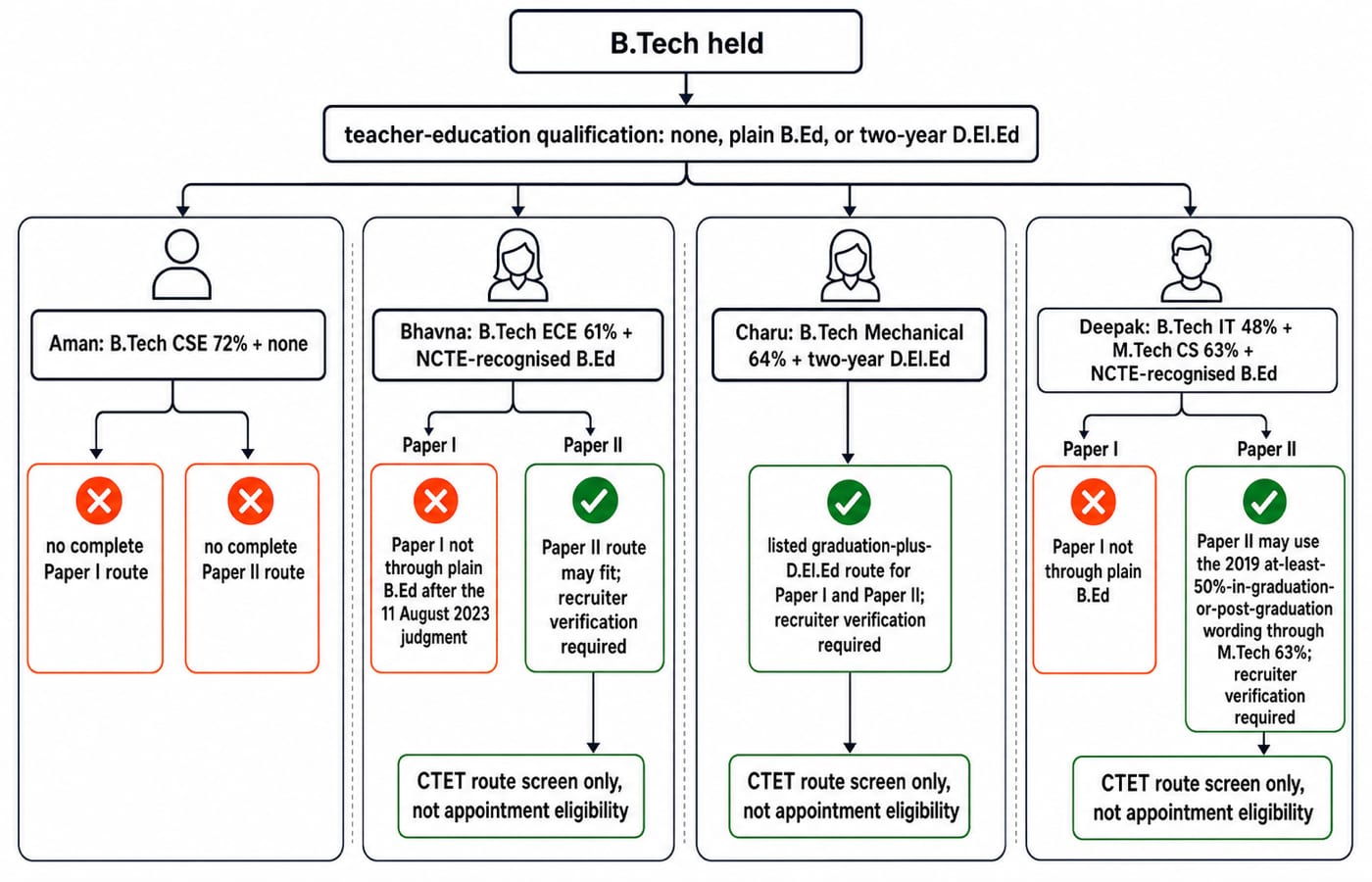
Four worked engineering-graduate profiles
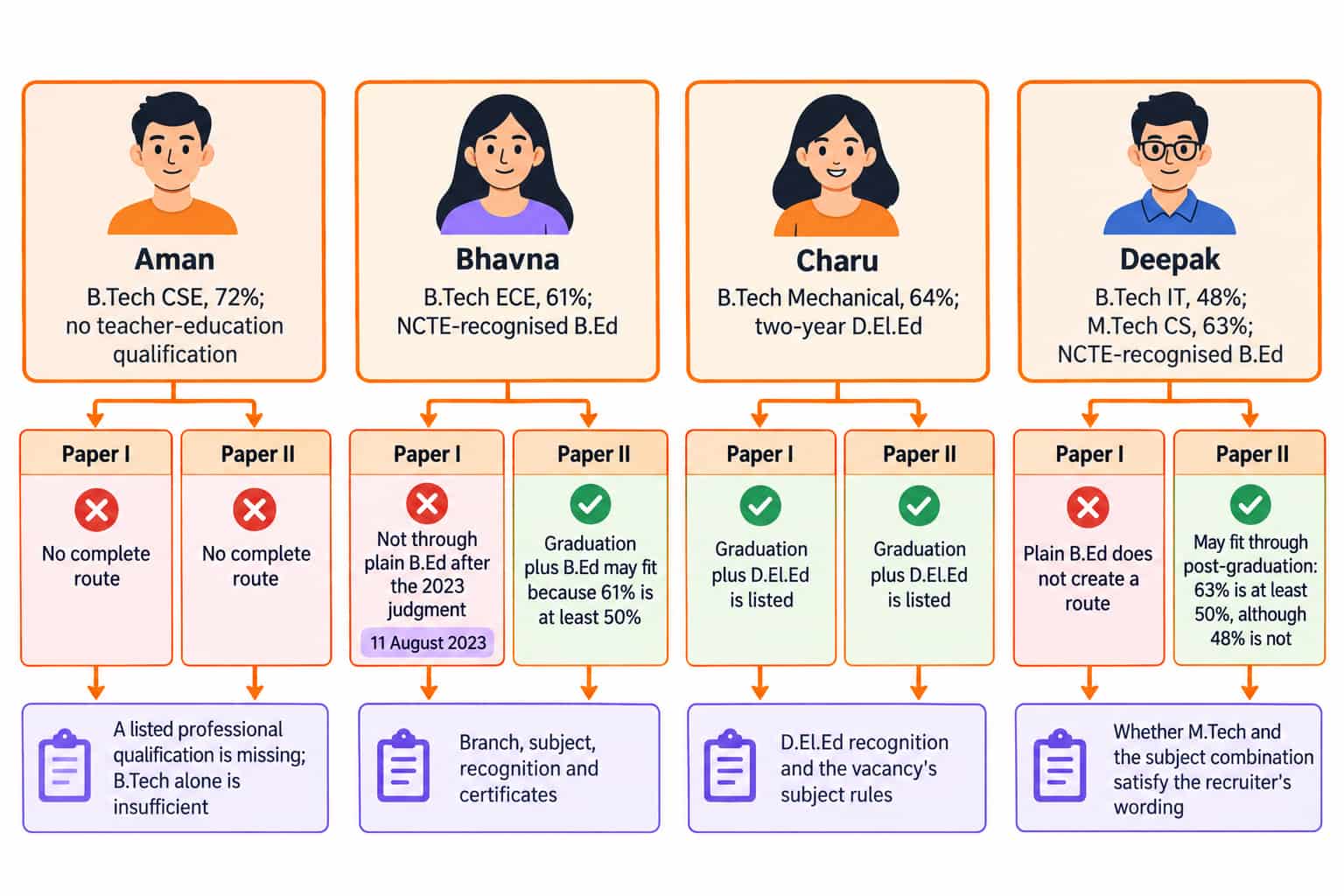
Profile | Documents | Paper I reading | Paper II reading | What must be verified |
|---|---|---|---|---|
Aman | B.Tech CSE, 72%; no teacher-education qualification | No complete route | No complete route | A listed professional qualification is missing; B.Tech alone is insufficient |
Bhavna | B.Tech ECE, 61%; NCTE-recognised B.Ed | Not through plain B.Ed after the 2023 judgment | Graduation plus B.Ed may fit because 61% is at least 50% | Branch, subject, recognition and certificates |
Charu | B.Tech Mechanical, 64%; two-year D.El.Ed | Graduation plus D.El.Ed is listed | Graduation plus D.El.Ed is listed | D.El.Ed recognition and the vacancy's subject rules |
Deepak | B.Tech IT, 48%; M.Tech CS, 63%; NCTE-recognised B.Ed | Plain B.Ed does not create a route | May fit through post-graduation: 63% is at least 50%, although 48% is not | Whether M.Tech and the subject combination satisfy the recruiter's wording |
Do not mix B.Ed admission rules with CTET Paper II rules
These are separate gates. The NCTE 2014 B.Ed admission norms state at least 55% for an Engineering or Technology bachelor's degree with specialisation in Science and Mathematics, subject to applicable university, state and amended rules. The NCTE Paper II wording amended in 2019 uses 50% in either graduation or post-graduation plus B.Ed. The first governs B.Ed admission; the second belongs to a teacher-qualification route.
Esha has B.Tech Civil at 54% and no B.Ed. For the stated engineering admission threshold, 54% < 55%, and 55 - 54 = 1 percentage point. She cannot round up or use the separate 50% Paper II clause to claim B.Ed admission. She should check the current prospectus and obtain written confirmation from the university, including whether her degree has the required specialisation.
Marks relaxation and document verification
The February 2026 CTET bulletin allows up to 5% relaxation in qualifying marks in the minimum educational qualification for SC, ST, OBC and differently-abled candidates. “Up to” is not one guaranteed reduced threshold across every route or recruiter. Keep this separate from the CTET passing score, explained in CTET Qualifying Marks: 60% Rule and Lifetime Validity.
Save these six items before applying:
B.Tech degree and all semester mark sheets.
M.Tech records if using the post-graduation marks limb.
B.Ed or D.El.Ed certificate and mark sheets.
NCTE recognition evidence for the institution and programme during the relevant session.
Category or disability certificate if claiming relaxation.
The target recruiter's exact subject or equivalence clause, plus any written response. Do not rely on a phone-call assurance.
CTET eligibility for engineers: final decision and next step
B.Tech only: no complete route.
B.Tech plus plain B.Ed: consider Paper II, not Paper I on that basis.
B.Tech plus two-year D.El.Ed: check the listed Paper I and Paper II routes.
Any positive route: still verify subject, recognition and document rules with the recruiter.
After that written check, use the CTET Exam Preparation, Paper 1 and Paper 2 hub to follow the study path for the supported paper. The current CTET eligibility page and your target recruitment notice remain the final authorities.
Go deeper with the full courseCTET Paper 1 2026 — प्राथमिक शिक्षक (कक्षा 1–5)
Keep learning
B.Ed Entrance Exam Syllabus and Pattern: An 8-Week Phased Plan
Build a B.Ed entrance plan around your state's active bulletin, then use a worked diagnostic and a 96-hour schedule to turn weak areas into weekly study decisions.
Updated 4 Nov 20265 min readCTET & UPTET
CG Pre B.Ed Exam: Eligibility, Paper Pattern and College Allotment
Check how qualification marks affect eligibility for the two-year B.Ed route, understand the paper's five sections, and see why merit rank and college choices both matter during allotment.
Updated 29 Oct 20264 min readGovt Exam Strategy
PGT Eligibility: Is B.Ed Mandatory for KVS, NVS and State Recruiters?
A recruiter-first guide to the PGT teacher-training question, using dated KVS, NVS and DSSSB clauses, candidate profiles and a reusable eligibility audit.
Updated 30 Oct 20265 min read164 viewsKVS & NVS

Career Paths for CS Graduates Who Don’t Want to Code All Day
Explore QA, business analysis, technical writing, and customer success roles for CS graduates, with practical tasks to test each path.
Updated 12 Nov 20266 min readPlacement Preparation