

Classification of Intelligence Tests for CTET: Individual, Group, Verbal, Non-Verbal and Performance
Learn to separate individual and group administration from verbal, non-verbal and performance tasks, then apply the rule to CTET-style questions.
KnowledgeGate Team
Exam prep & CS education
Updated 10 Nov 20266 min read
An intelligence-test label is incomplete until you know both the testing arrangement and what the examinee must do. “Group” tells you how many people are tested together; “non-verbal” tells you the form of the problem; “performance” tells you that manipulation or action is required. CTET questions often place those clues in the same stem, so separate the setting from the task before choosing an answer.
Classification of intelligence tests starts with two independent questions
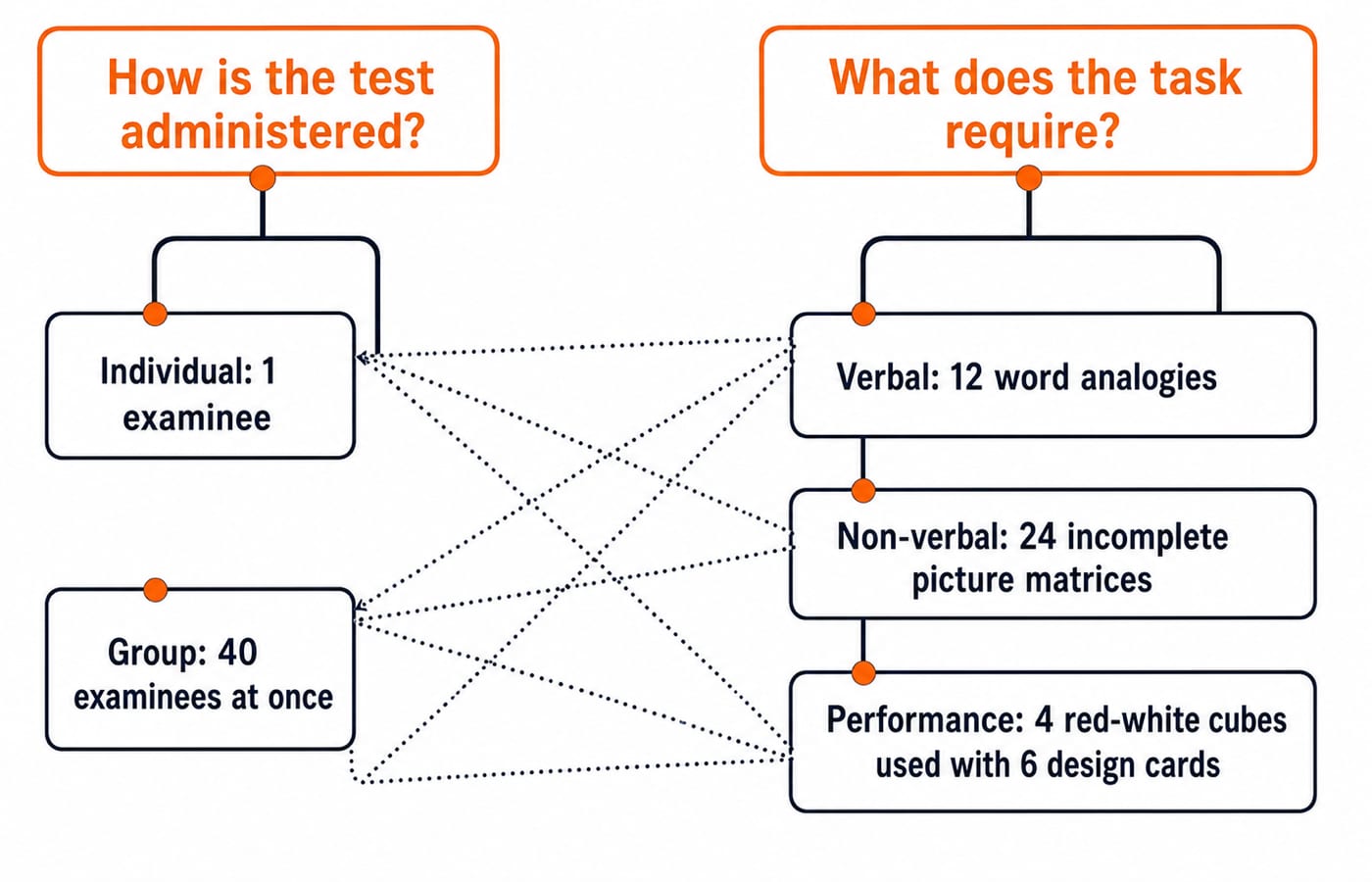
NCERT separates these tests using two questions:
Who takes the test at one time? This gives individual or group.
What material and response does the task use? This gives verbal, non-verbal or performance.
The first axis describes administration. The second describes the item and response form.
These are not rival answers. A test can be individual-verbal, group-verbal, individual-non-verbal, group-non-verbal or individual-performance. A familiar named example is not required for every possible pairing.
A performance test asks the examinee to manipulate objects or materials. It may minimise language in the response, but it is not every picture-based non-verbal test. A matrix may require selection, while a block task requires manipulating objects. Communication uses a broader set of independent labels: Types of Communication for Teaching Exams: Solved Notes separates code, participants, feedback, direction and time. Intelligence testing uses the narrower pair here: administration and response demand.
Individual versus group intelligence tests: classify the setting, not the content
An individual test is administered to one person at a time, permitting close observation, rapport and flexible interaction. A group test is administered to several people simultaneously under common instructions and standardised recording.
The item type does not change either definition.
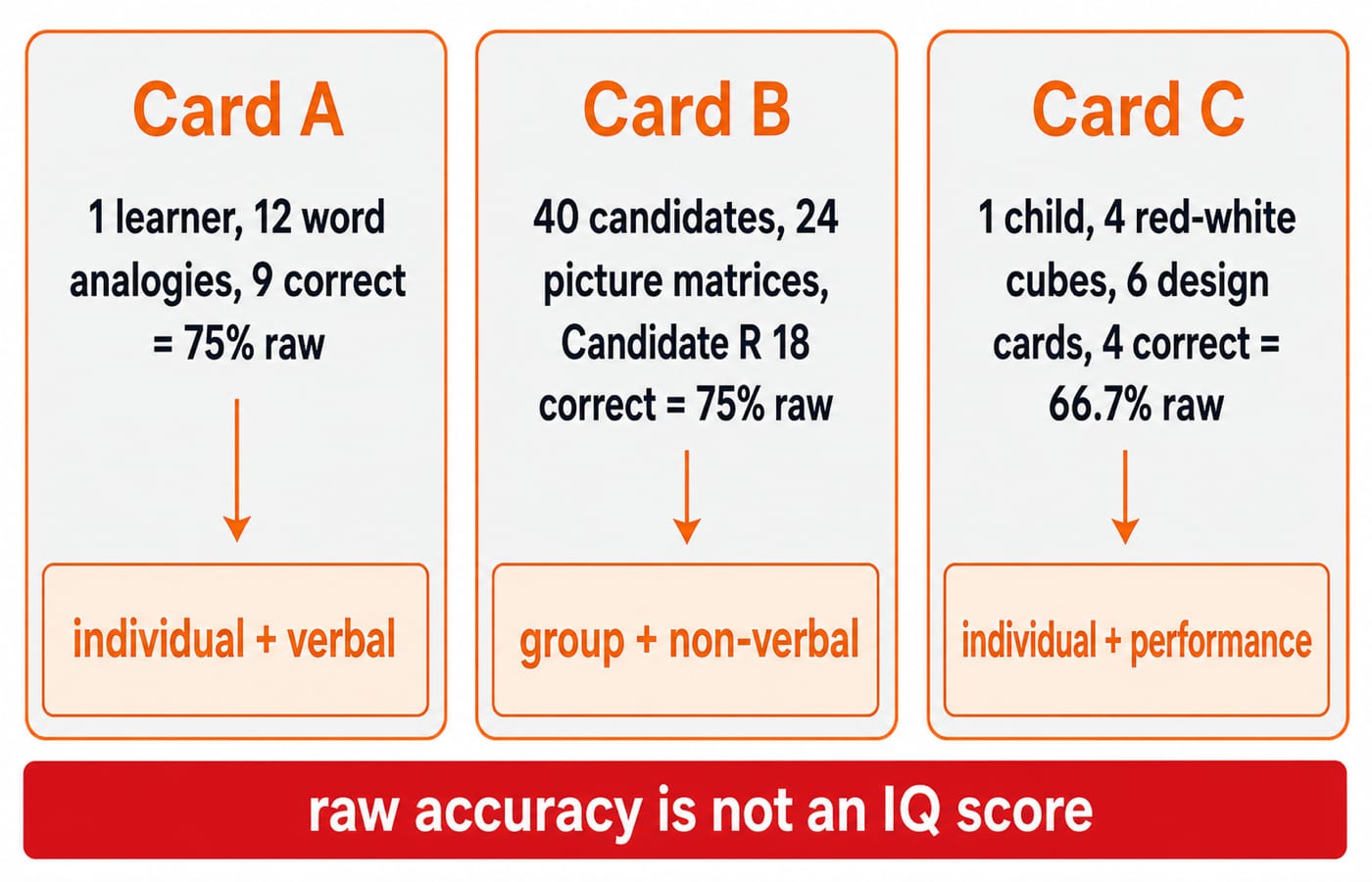
In Session A, 1 learner meets 1 examiner face to face and receives 12 word-analogy items. One learner is tested, so administration is individual. In Session B, 40 candidates receive the same 24 picture-matrix items in one room and start one common timer. They take it simultaneously, so administration is group.
Combine the axes: Session A is individual + verbal, while Session B is group + non-verbal. Words and pictures do not decide the administration. Reject "group tests have no time limit" and "an individual test is always verbal". Neither follows from the definitions.
Verbal intelligence tests use language, whether spoken or written
A verbal intelligence test uses words or language in its items or required responses. The language may appear in the item, response or both. Verbal does not mean spoken only. Written vocabulary, analogy, comprehension and language-based reasoning tasks are also verbal.
Return to Session A. The learner answers 9 of 12 analogies correctly:
9 / 12 = 0.75
Thus, 0.75 × 100 = 75% raw accuracy. This is not an IQ of 75. A standardised intelligence score requires the test's norms and scoring procedure.
The CIE Verbal Group Test and Army Alpha are group-verbal cues, with Army Alpha understood as historical. Stanford-Binet is an individual-test cue. Modern batteries may combine verbal and non-verbal content, so do not call an entire battery purely verbal without qualification.
Non-verbal intelligence tests use pictures, figures or abstract patterns
A non-verbal intelligence test uses pictures, figures or patterns rather than language-heavy items. The substantive problem is visual, even if the examiner explains the procedure before testing. Instructions may still be spoken, written or demonstrated, so some communication can occur.
In Session B, all 40 candidates solve 24 incomplete picture matrices together. Candidate R answers 18 correctly:
18 / 24 = 0.75, and 0.75 × 100 = 75% raw accuracy.
The setting is group, while the item form is non-verbal. Once again, 75% is not an IQ score.
In Raven's Progressive Matrices, the examinee selects the figure completing a pattern. This identifies response form, not administration, which depends on the version and setting. The CIE Non-verbal Group Test and historical Army Beta are group-non-verbal cues.
Performance intelligence tests require doing or manipulating
A performance intelligence test requires action. The learner may arrange, assemble, draw or manipulate material. A picture matrix asks for inspection and selection. A performance task requires an observable action, even if its instructions use little language. The examiner can also observe the approach.
Take a deliberately simple classroom example. One child receives 4 red-white cubes and 6 design cards in a one-to-one session. The child reproduces 4 designs correctly:
4 / 6 = 0.666...
Then 0.666... × 100 = 66.666...%, which rounds to 66.7% raw accuracy to one decimal place. It is individual + performance. This 4-cube, 6-card setup is teaching data, not a named test's scoring protocol.
Kohs Block Design asks the examinee to arrange blocks to reproduce designs. Bhatia's Battery of Performance Tests is a widely cited Indian performance-test example. In either case, observation and a raw success count do not by themselves produce a valid IQ.
Representative intelligence tests: match each test to its safest cue
Use names for recall, but let definitions control the answer.
Test or battery | Safest classification cue | What the examinee does | Do not overclaim |
|---|---|---|---|
Stanford-Binet Intelligence Scale | Individual | Does one-to-one tasks | Modern editions can mix content |
Wechsler scales such as WISC or WAIS | Individual battery | Does verbal and performance/perceptual tasks | Mixed, not single-mode |
CIE Verbal Group Test / Army Alpha | Group-verbal | Answers language items | Army Alpha is historical |
CIE Non-verbal Group Test / Army Beta | Group-non-verbal | Answers figure items | Army Beta is historical |
Raven's Progressive Matrices | Non-verbal patterns | Chooses the missing figure | Administration varies |
Kohs Block Design / Bhatia's Battery | Performance | Manipulates objects | Raw count is not IQ |
Remember: Binet and Wechsler point first to one-to-one batteries; Alpha to verbal group; Beta and Raven to non-verbal; Kohs and Bhatia to performance. Keep the qualifications.
CTET-style one-liners: identify the basis before the test name
Underline whether the stem asks about the number of examinees or nature of items, then classify. For revision, use the CTET previous-year CDP theorists analysis.
Forty candidates solve the same picture matrices together. Which pair fits? (A) individual-verbal, (B) group-verbal, (C) individual-performance, (D) group-non-verbal. Answer: D, because 40 sit together and the items are pictures.
Which task is a performance test? (A) written analogy, (B) oral vocabulary, (C) arranging blocks to copy a design, (D) choosing a missing picture. Answer: C, because the response requires manipulation.
Statements: I. A verbal test may use written language. II. Every non-verbal test is a group test. (A) I only, (B) II only, (C) both, (D) neither. Answer: A. I is correct; II mixes the axes.
Avoid these traps: verbal means spoken only, non-verbal means group, every picture task is performance, and raw percentage equals IQ. A useful drill is to classify a fresh intelligence question twice: first by administration, then by the required response. Confirm the current syllabus or pattern on the official CTET homepage.
Revise the two axes, then practise
Recall the distinctions between administration and response form:
One person = individual.
Several people at once = group.
Words = verbal.
Figures or patterns = non-verbal.
Object manipulation = performance.
Administration and response labels can combine. Primary-level learners can follow structured coverage and practice in the CTET Paper 1 Course 2026. Upper-primary learners can use the CTET Paper 2 Course 2026. If you are still choosing a route, start from CTET Exam Preparation: Paper 1 & 2. Finally, cover the answers, reclassify Sessions A, B and C from the two questions alone, then solve the three one-liners without the mnemonic.
Go deeper with the full courseCTET Paper 1 2026 — प्राथमिक शिक्षक (कक्षा 1–5)
Keep learning
Sheldon and Eysenck’s Personality Theories for CTET: CDP Notes
Separate Sheldon’s body-based somatotypes from Eysenck’s behavioural dimensions. Use the mapping tables, solved E-N quadrant, and quick exam cues to revise both theories responsibly.
Updated 15 Nov 20265 min readCTET & UPTET
CTET Previous Year Analysis: The CDP Theorists and Pedagogy Patterns That Repeat
Across recent CTET cycles the same CDP theorists, concepts and question stems keep returning. Piaget and Vygotsky dominate, with Kohlberg a clear third, while assessment, child development principles and inclusive education carry the pedagogy half. What you must genuinely understand is a far shorter list than what you memorise.
Updated 30 Oct 20266 min read92 viewsCTET & UPTET
CTET CDP: the high-yield concepts and theorists you must know
A CTET Child Development and Pedagogy guide to the high-yield ideas: Piaget, Vygotsky, Kohlberg, constructivism, inclusive education and how CDP is tested.
Updated 31 Oct 20266 min readCTET & UPTET
Individual Differences for Teaching Exams: Complete Notes, Classroom Examples and MCQ Traps
Understand how learners differ, why heredity and environment interact, and how evidence-led teaching adapts support without fixing labels or lowering the learning goal.
Updated 30 Oct 20266 min readCTET & UPTET