

Calendar Reasoning for Competitive Exams: Shortcuts and Solved Examples
Turn calendar questions into small remainder calculations. Learn the core rules, follow solved dates, and avoid the inclusion errors that spoil otherwise correct work.
KnowledgeGate Team
Exam prep & CS education
Updated 31 Oct 20266 min read

Calendar questions can feel like memory tests when you try to recall isolated month codes. They become much simpler once years, months and days are reduced to remainders after complete weeks. Reduce years, months and days to remainders after complete weeks, then apply the method to real dates and check each shortcut against off-by-one traps.
Build the calendar model from weeks, odd days and leap years
An odd day is the remainder left after complete seven-day weeks. An ordinary year has 365 = 52 x 7 + 1 days, so it shifts the weekday by 1. A leap year has 366 = 52 x 7 + 2 days, so it shifts the weekday by 2.
Fix one numbering system and never change it during a calculation:
Sunday = 0, Monday = 1, Tuesday = 2, Wednesday = 3, Thursday = 4, Friday = 5, Saturday = 6
Under the Gregorian rule, a year divisible by 4 is a leap year, except that a century year must also be divisible by 400. Therefore, 1900 and 2100 are ordinary years, 2000 is a leap year, and 2024 is a leap year.
The month lengths are the foundation: January 31, February 28 or 29, March 31, April 30, May 31, June 30, July 31, August 31, September 30, October 31, November 30 and December 31. The Aptitude Courses for Exams and Placements page places this topic inside the wider reasoning and quantitative-aptitude track.
Find the weekday of a given date with one known anchor
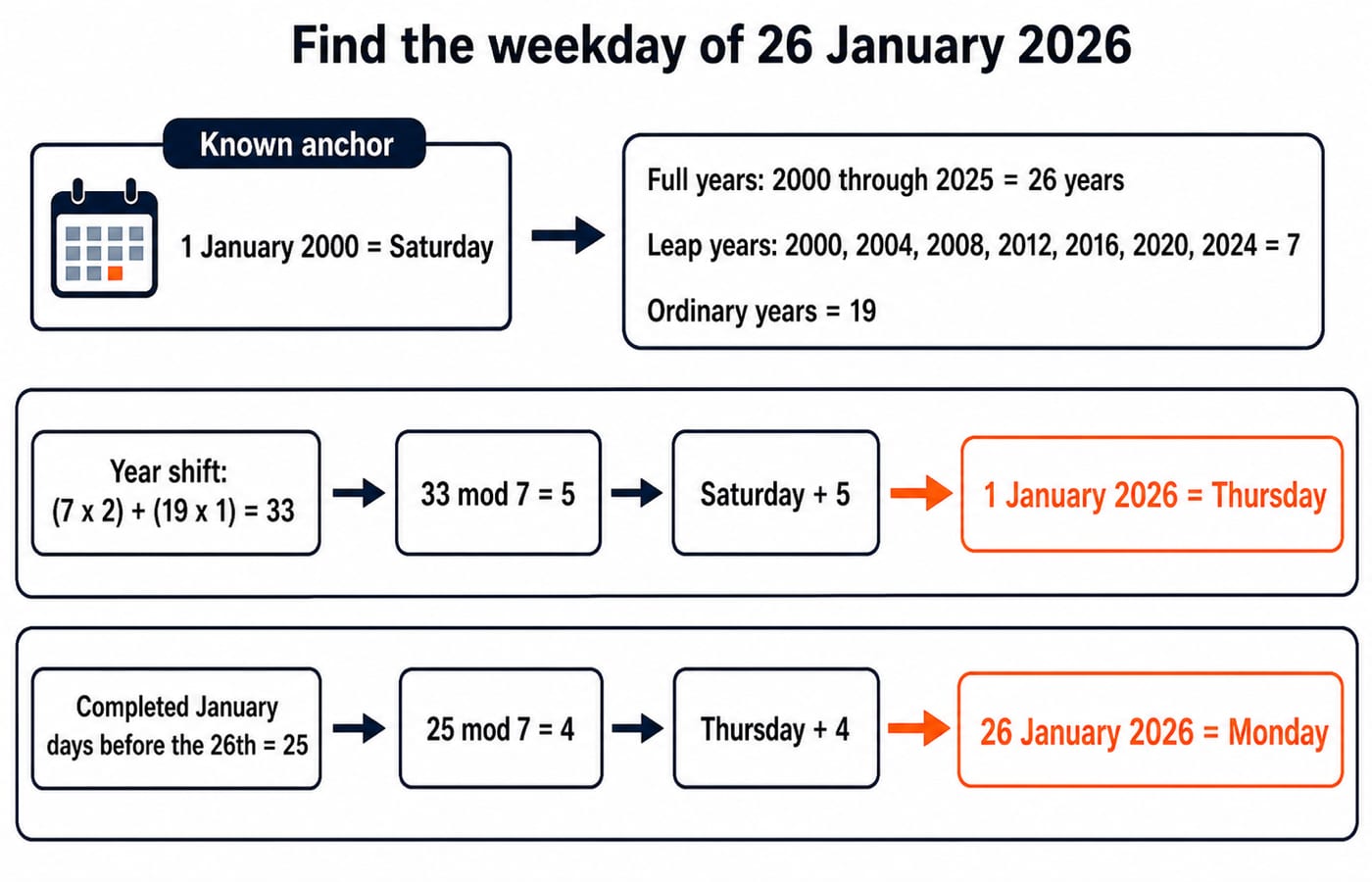
Find the weekday on 26 January 2026, using 1 January 2000 = Saturday as the anchor.
The 26 completed years are 2000 through 2025. They contain seven leap years, 2000, 2004, 2008, 2012, 2016, 2020 and 2024, plus 19 ordinary years.
Year shift:
(7 x 2) + (19 x 1) = 14 + 19 = 33.Reduce it:
33 mod 7 = 5.Five weekdays after Saturday is Thursday, so
1 January 2026 = Thursday.Before 26 January, 25 days have been completed:
26 - 1 = 25.Reduce again:
25 mod 7 = 4.Four weekdays after Thursday is Monday.
Therefore, 26 January 2026 is Monday. The date contributes 25 completed days, not 26, because 1 January itself is the starting point.
Solve day-after and date-to-date questions from the gap
If only the weekday after N days is required, reduce N mod 7 first. Suppose 3 March 2025 is Monday and you need the day 100 days later.
100 mod 7 = 2, so move two weekdays forward from Monday. The answer is Wednesday.
If the date is also required, 3 March is day 62 of ordinary year 2025: 31 + 28 + 3 = 62. Then 62 + 100 = 162. The first five months contain 31 + 28 + 31 + 30 + 31 = 151 days, so day 162 is 11 June 2025. Thus, 11 June 2025 is Wednesday.
Inclusivity matters. If 12 May is Tuesday, 31 May is 31 - 12 = 19 days later, not 20. Since 19 mod 7 = 5, Tuesday moves to Sunday. Subtracting the date numbers already gives the elapsed gap.
For the reverse form, suppose a date 45 days earlier was Friday. The target is 45 mod 7 = 3 days after that known Friday, so it is Monday. The word "earlier" locates the known date; the direction from that date to the target determines the movement.
Count how often each weekday occurs in a month
A 28-day month contains four complete weeks, so every weekday occurs 4 times. The extra days begin from the weekday of day 1:
In 29 days, the first weekday occurs 5 times.
In 30 days, the first two weekdays occur 5 times.
In 31 days, the first three weekdays occur 5 times.
August 2025 began on Friday. Since 31 = 28 + 3, Friday, Saturday and Sunday each occurred 5 times:
Fridays: 1, 8, 15, 22, 29
Saturdays: 2, 9, 16, 23, 30
Sundays: 3, 10, 17, 24, 31
Monday through Thursday occurred 4 times each. Reversing the idea, a 30-day month has 5 Tuesdays and 5 Wednesdays only when day 1 is Tuesday. The two dates left after four weeks inherit the first two weekdays.
Find when a year or month can reuse the same calendar
Two years share a calendar only when they begin on the same weekday and have the same leap status. Matching 1 January is not enough when one February has 28 days and the other has 29.
For months, the equivalent test is the same weekday on day 1 and the same number of days.
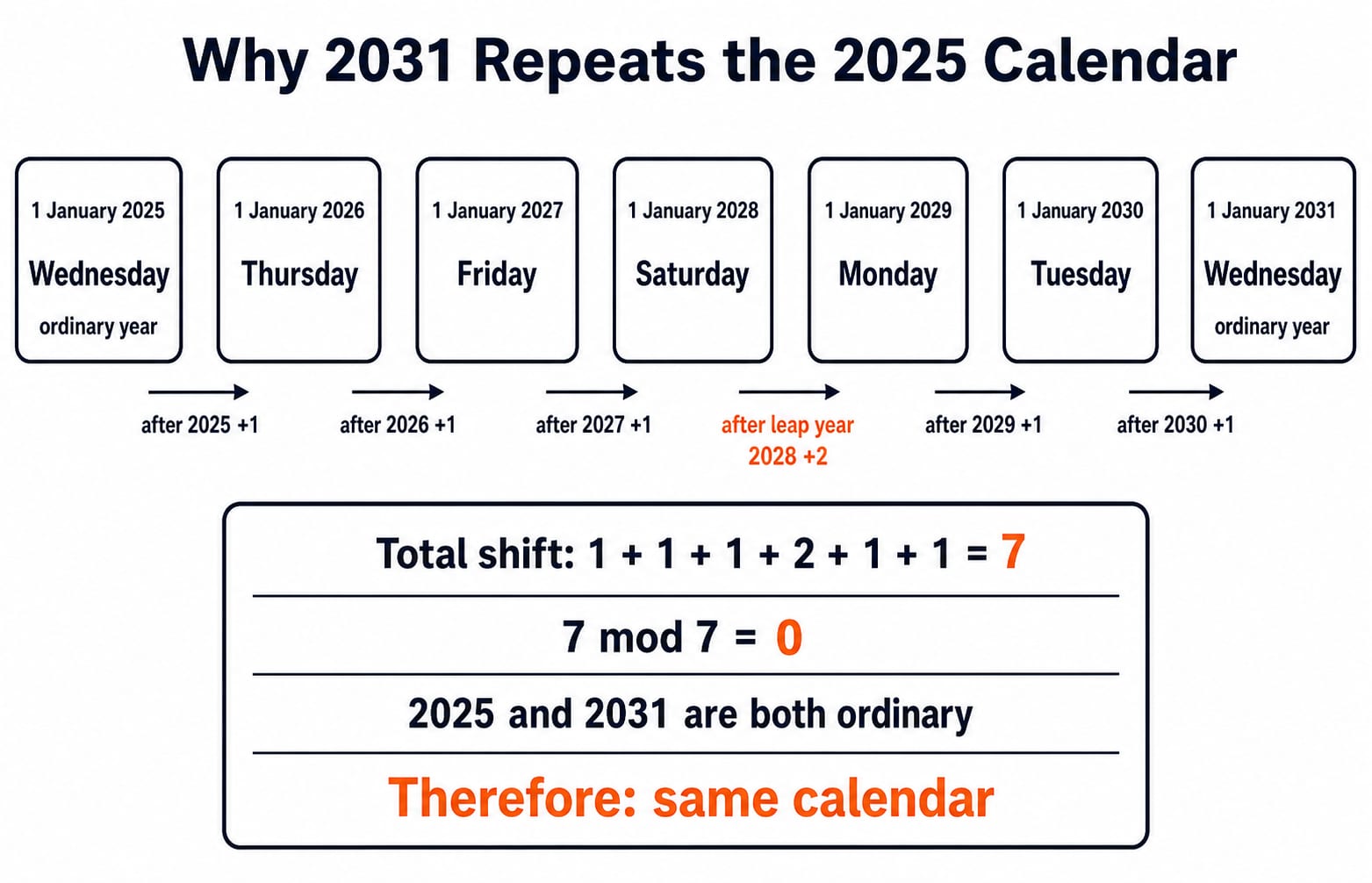
Find the next matching year after 2025. Here 1 January 2025 = Wednesday, and 2025 is ordinary.
Completed year | Shift | Next 1 January |
|---|---|---|
2025 | +1 | 2026, Thursday |
2026 | +1 | 2027, Friday |
2027 | +1 | 2028, Saturday |
2028, leap | +2 | 2029, Monday |
2029 | +1 | 2030, Tuesday |
2030 | +1 | 2031, Wednesday |
The total shift is 1 + 1 + 1 + 2 + 1 + 1 = 7, and 7 mod 7 = 0. Both 2025 and 2031 are ordinary years, so 2031 has the same calendar as 2025.
Use shortcuts without creating an off-by-one error
For a given date, make a four-row scratch calculation: anchor weekday, completed years, completed months and completed days. Reduce every subtotal modulo 7, add the remainders, then reduce the total once more. This keeps the arithmetic small without changing the result.
Use these repair rules when an answer looks wrong:
Test century years for divisibility by 400, not only 4.
Count completed years and stop before the target year.
Use
date - 1for completed days in the target month.Include 29 February only when the target date comes after February in a leap year.
Keep one weekday numbering convention throughout.
Three checks catch many mistakes. Adding 7 or any multiple of 7 days must preserve the weekday. Dates exactly 14 days apart must match. A same-calendar claim must pass both the starting-weekday and leap-status tests. If a memorised code fails these checks, rebuild the answer from month lengths.
Recognise the question shape before choosing the method
Match the wording to the smallest suitable method:
Day on a given date: use an anchor plus completed years, months and days.
Weekday before or after an interval: reduce
N mod 7.Odd days across years: add ordinary-year and leap-year shifts.
Number of Sundays or another weekday in a month: use complete weeks plus extra days.
Identical-calendar years: check the starting weekday and leap status.
Missing first weekday: decide whether the other information is enough to derive it.
Placement candidates can extend these habits with Logical Reasoning for Placement Tests: 3 Solving Methods. For a government-exam reasoning plan, use SSC CGL Reasoning: High-Yield Topics and Solving Order. If you need a broader weekly routine, see Aptitude for Placements: Section Topics and Weekly Plan.
The short version, then practise by question type
For a date question, select an anchor, convert full years into 1-day or 2-day shifts, add only completed months, add date - 1, and reduce the total modulo 7. For an interval question, skip the full calendar total and reduce the stated gap directly.
KnowledgeGate's Calendar question bank has more than 80 practice questions. Try a 15-question loop: 5 direct weekday calculations, 5 interval or weekday-frequency questions, and 5 repeated-calendar or leap-year questions. After every miss, label the cause as leap rule, inclusion, arithmetic or direction.
For a structured route through aptitude, reasoning and verbal ability, continue with Aptitude for Placement.
Keep learning
Clock Reasoning for Competitive Exams: Concepts, Shortcuts and Solved Examples
Clock questions become easier when you treat both hands as moving objects. Derive the core formulas, solve angle and meeting problems, and handle mirrors and faulty clocks without guesswork.
Updated 1 Nov 20266 min readAptitude & Reasoning

Data Sufficiency: A 5-Step Method, Shortcuts and Solved Examples
Learn to test each statement independently, prove insufficiency with two valid cases, and stop as soon as the target becomes unique. Three worked problems make the method concrete.
Updated 15 Nov 20266 min readAptitude & Reasoning

Data Arrangement Questions: Concepts, Shortcuts and Solved Examples
Turn names, cities, roles and scores into a clean grid. This guide shows safe shortcuts and solves one complete arrangement from clues to answer.
Updated 11 Nov 20266 min readAptitude & Reasoning

Coding-Decoding Concepts and Shortcuts with Solved Examples
Identify, validate and reverse coding-decoding rules through letter shifts, rearrangements, number codes and sentence substitution.
Updated 9 Nov 20265 min readAptitude & Reasoning