

Blood Relations Reasoning: Concepts, Shortcuts and Solved Examples
Learn a repeatable way to solve direct family trees, coded relations and photograph statements without assuming gender or inventing missing links.
KnowledgeGate Team
Exam prep & CS education
Updated 30 Oct 20266 min read

Blood Relations questions use familiar family words, but a long sentence can reverse the point of view, hide a person's gender and overload your memory. The reliable method is to translate each statement, place people by generation, mark only stated genders, connect the family and read from the person named in the question. The method works for direct trees, coded relations and photograph statements in your aptitude and reasoning preparation.
1. Blood relation concepts: generation, gender, side and point of view
First locate each person relative to the reference person.
Generation position | Possible relation |
|---|---|
One generation above | Parent, uncle or aunt |
Same generation | Sibling, spouse or cousin |
One generation below | Child, nephew or niece |
Two generations above | Grandparent |
Two generations below | Grandchild |
Generation filters the choices but does not settle the answer. Siblings, spouses and cousins can share a level, so check the branch.
A parent's brother or sister is an uncle or aunt. A sibling's son or daughter is a nephew or niece. An uncle's or aunt's child is a cousin. A child's son or daughter is a grandson or granddaughter. Use paternal or maternal only when the chain identifies that side.
Gender belongs only to the described person. “A is the brother of B” proves A is male, not B's gender. “C is the daughter of D” proves C is female, not D's gender.
For “How is X related to Y?”, stand at Y and trace towards X. Reversing it can change parent to child or aunt to niece.
2. Translate words into a generation ledger before drawing
Use 0 for the reference person's generation, +1 for a parent generation and -1 for a child generation. Siblings and spouses stay at 0. This scratch ledger does not make everyone at 0 the same relation.
Take these statements:
Kabir is the brother of Leena's mother.
Mohan is the son of Kabir.
Place Leena at 0. Her mother and Kabir, the mother's brother, are at +1; Kabir is male. Kabir's son Mohan returns to 0 and is male. Mohan and Leena are cousins because their parents are siblings. Reverse-check: Leena is Kabir's niece, and Kabir is her maternal uncle.
For any chain, use five steps:
Underline the two people in the question.
Translate one statement at a time.
Record generation and stated gender.
Join only confirmed links.
Trace from the second named person back to the first.
Draw a tree when three or more links share a parent or spouse.
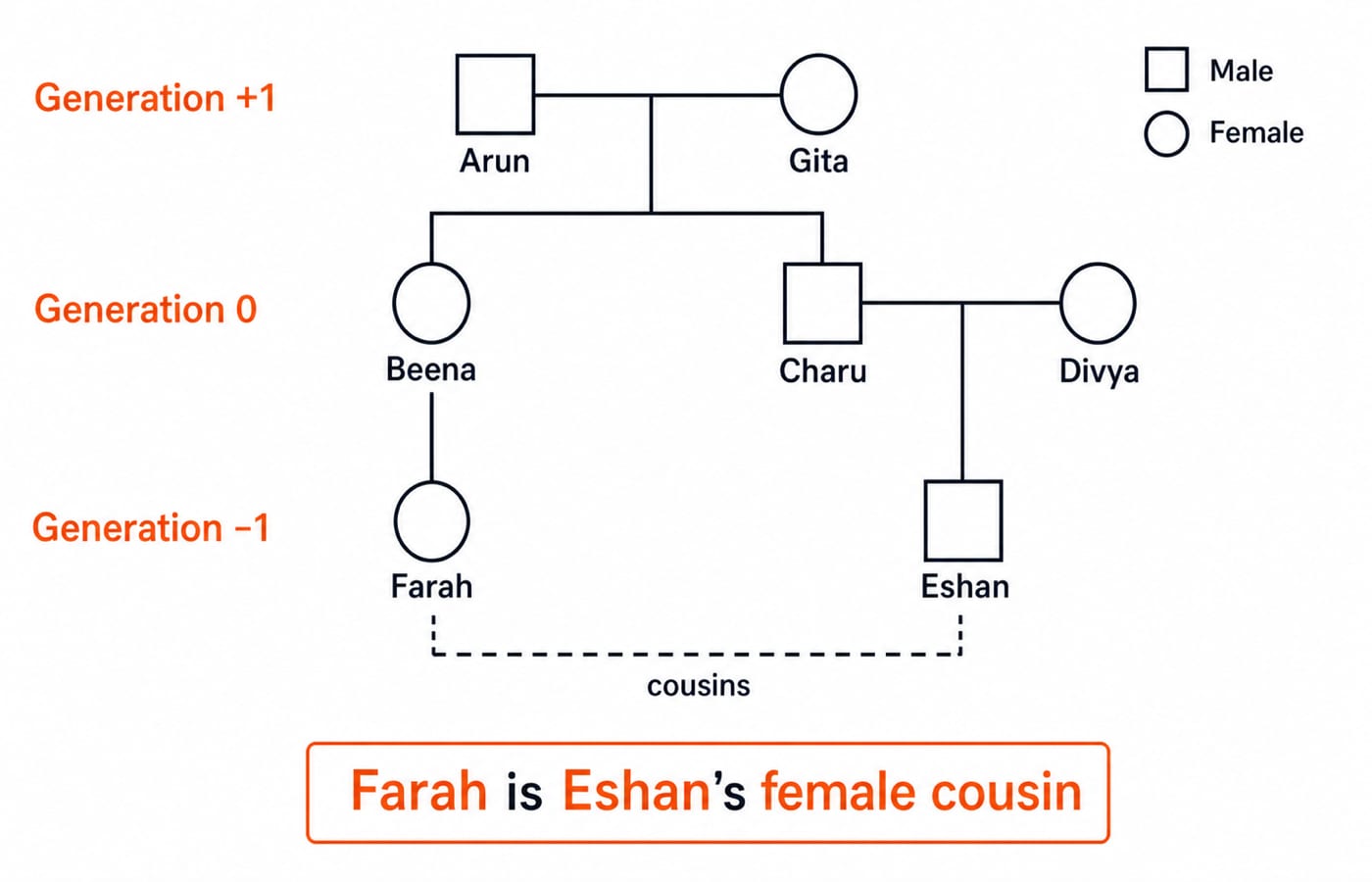
3. Fully worked family-tree example: find Farah's relation to Eshan
Arun is Gita's husband. Their two children are Beena, a daughter, and Charu, a son. Charu is Divya's husband. Charu and Divya have one child, Eshan, a son. Beena has one child, Farah, a daughter.
Question: How is Farah related to Eshan?
Solve from Eshan's point of view:
Beena and Charu are Arun and Gita's children, so they are siblings at generation
0.Farah is Beena's daughter, one generation below Beena.
Eshan is Charu's son, one generation below Charu.
The children of two siblings are cousins.
Farah is female, so she is Eshan's female cousin.
Cross-check: Eshan is Farah's cousin and Arun and Gita's grandson. Beena's spouse is neither supplied nor needed. Farah's gender gives “female cousin”; the sibling-parent structure proves cousin rather than sister.
4. Coded blood relations: decode every symbol as a sentence
For this example only:
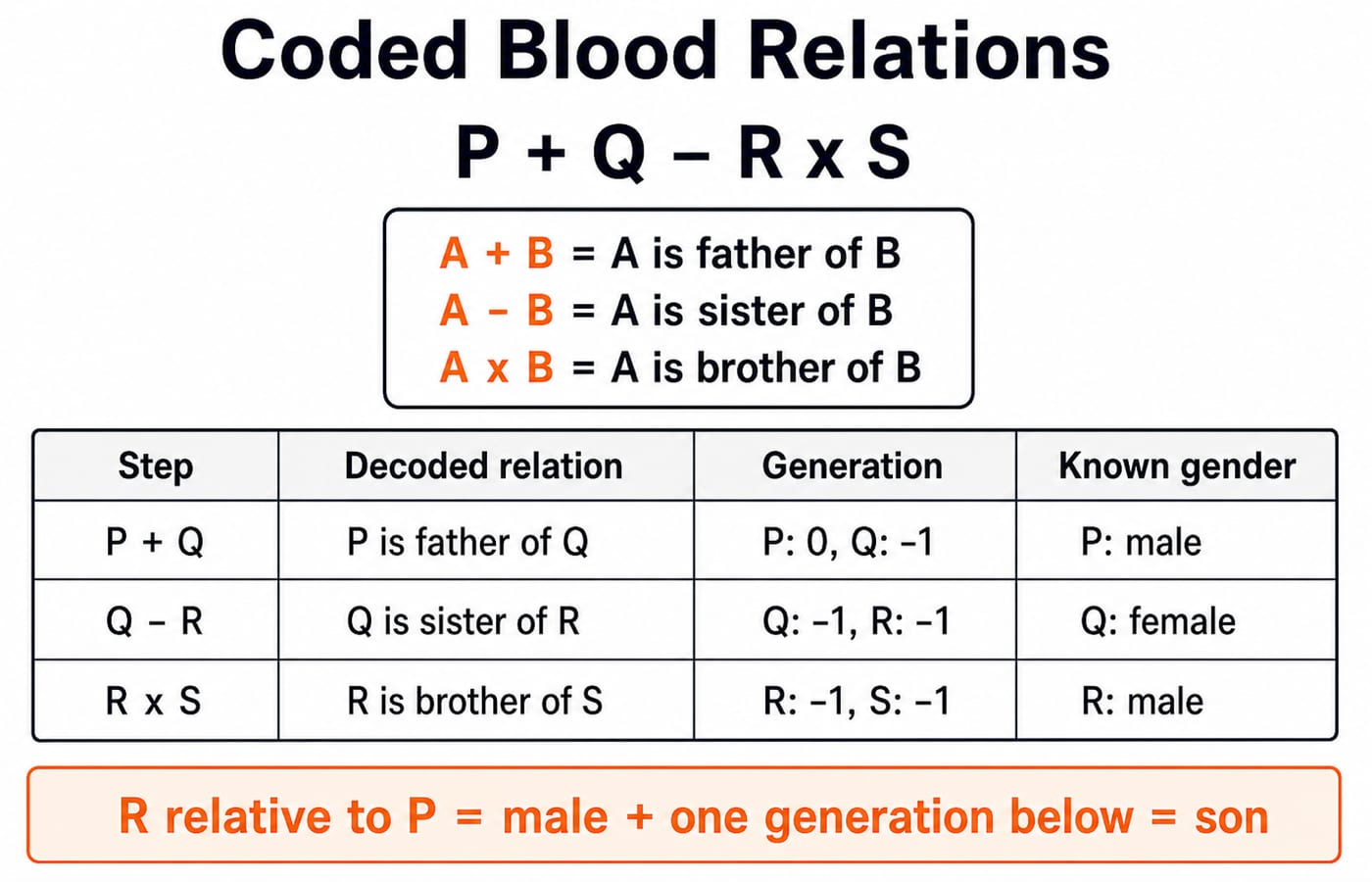
A + B: A is the father of B.A - B: A is the sister of B.A x B: A is the brother of B.
In P + Q - R x S, how is R related to P? These are local meanings, not universal rules.
Decode pair by pair. P + Q makes P Q's father, male and one generation above Q. Q - R makes Q R's sister, so Q and R are siblings and Q is female. R x S makes R S's brother, so R and S are siblings and R is male.
Under the conventional reading that the stated siblings share the stated parent, R is male and one generation below P. Therefore, R is P's son; in reverse, P is R's father. Without R x S, R's gender is unstated, so the safe answer is P's child, not necessarily son.
5. Use safe shortcuts for photograph, pointing and “only” statements
Work inside out: resolve the possessive nearest the named person, then move outward.
Meera says, “The woman in the photograph is the only daughter of my father's only son.” Meera is female.
Meera's father's only son is Meera's brother.
That brother's only daughter is Meera's niece.
Therefore, the woman is Meera's niece, and Meera is the woman's aunt.
Only, brother, sister, son and daughter add constraints. Parent, child, sibling and cousin may not supply gender. Ignore “looking at a photograph”, but retain my, his and her because they control viewpoint.
For a speed check, “father's only son” moves +1, then -1, back to Meera's level. His daughter moves to -1, which is consistent with niece.
6. Shortcuts that save time without inventing a family member
Use this order: identify the reference person, calculate generation, mark explicit gender, find the branch, then name the relation. The tree distinguishes sibling, spouse and cousin at 0.
Recall these reverse pairs: parent and child, uncle or aunt and nephew or niece, grandparent and grandchild. Cousin reverses to cousin. Brother or sister reverses to sibling until the other person's gender is known.
Try a 30-second check. Tara is Uday's sister. Uday is Veer's father. Veer is Waseem's daughter. Veer is female, Tara is her aunt, Uday is her father, and Waseem is her parent with gender unstated. Do not call Waseem the mother or Uday's spouse. Nothing relates the adults.
7. Common traps and how competitive exams frame the topic
Problem | Consequence | Repair |
|---|---|---|
Answering the reverse relation | Parent becomes child, or aunt becomes niece | Rewrite “X relative to Y” before tracing |
Assuming gender from a neutral word | A neutral relation gets a gendered label | Mark gender only from explicit words |
Treating one generation as one relationship | Cousins or spouses become siblings | Check the connecting branch |
Skipping only | Extra family members appear possible | Treat only as a constraint |
Reusing old operator meanings | The chain changes | Rewrite each question's local legend |
Drawing an unstated spouse or parent | The tree gains unsupported links | Draw only stated links |
Remember the specific gender check: “B is the brother of A” makes B male, not A.
Formats include verbal chains, family trees, photograph or pointing statements, coded operators and data-sufficiency checks. Mental Ability Concepts and Shortcuts gives a broad survey of these reasoning families. This post drills blood-relations methods, generation ledgers, coded operators and viewpoint traps. Use Logical Reasoning for Placement Tests for wider puzzle practice and SSC CGL Reasoning for exam planning.
Exam patterns can change. Check the current official notification or syllabus for your chosen examination instead of relying on fixed claims about marks, duration, negative marking, question frequency or cutoffs.
8. Blood Relations short version and the next practice step
Recall five actions: set the viewpoint, translate each link, mark generation and confirmed genders, then trace in the requested direction. Farah is Eshan's female cousin. R is P's son under the stated code and conventional sibling reading.
Use a 15-question practice loop: five direct trees, five coded relations and five photograph or pointing questions. Label each miss as direction, generation, gender, branch or symbol decoding, then practise that type again.
For the next step, redraw the Arun-Gita family and decode P + Q - R x S without looking. Then explore Aptitude for Placement for structured aptitude, reasoning and verbal-ability study.
Keep learning
Fallacy in Logical Reasoning: Types, Shortcuts and Solved Examples
Learn to test fallacy questions by separating the conclusion, evidence and hidden bridge. Includes conditional, survey, analogy, causation and language examples.
Updated 18 Nov 20266 min readAptitude & Reasoning
Cubes and Dice Reasoning: Concepts, Shortcuts and Solved Examples
Learn cubes and dice through ordered face positions, anchored net folding, and disjoint painted-cube counts, with shortcuts and fully checked examples.
Updated 10 Nov 20265 min readAptitude & Reasoning
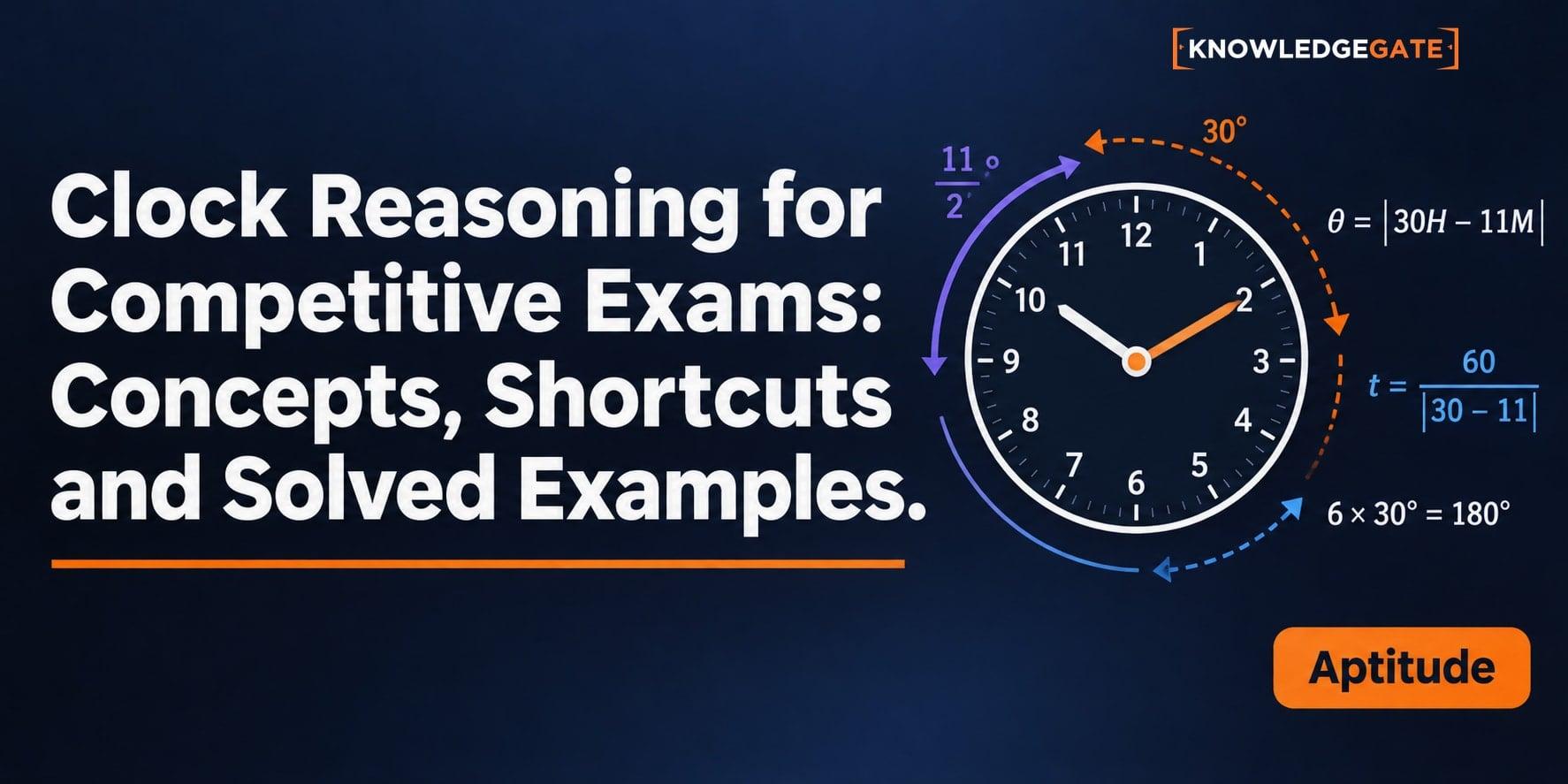
Clock Reasoning for Competitive Exams: Concepts, Shortcuts and Solved Examples
Clock questions become easier when you treat both hands as moving objects. Derive the core formulas, solve angle and meeting problems, and handle mirrors and faulty clocks without guesswork.
Updated 1 Nov 20266 min readAptitude & Reasoning

Calendar Reasoning for Competitive Exams: Shortcuts and Solved Examples
Turn calendar questions into small remainder calculations. Learn the core rules, follow solved dates, and avoid the inclusion errors that spoil otherwise correct work.
Updated 31 Oct 20266 min readAptitude & Reasoning