Estimation and Scheduling in Software Engineering: COCOMO, PERT and CPM Worked Examples
Follow one project from functional size to modelled effort and duration, then solve a dependency network, PERT uncertainty and schedule compression.
KnowledgeGate Team
Exam prep & CS education
Updated 26 Jul 20267 min read
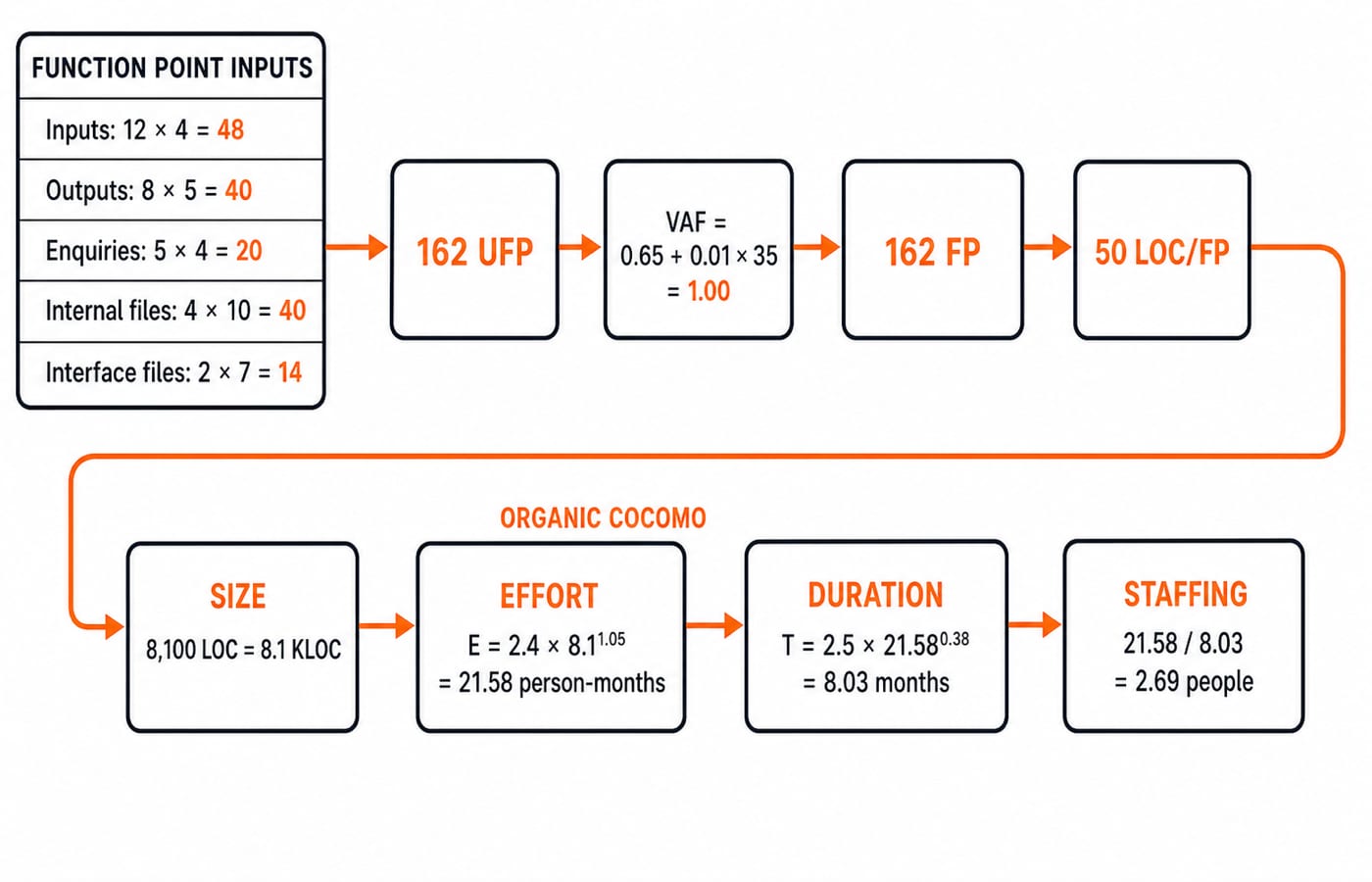
A size estimate, an effort estimate and a delivery date are three different outputs, but weak solutions often treat them as interchangeable. A functional description of 12 inputs, 8 outputs, 5 enquiries, 4 internal files and 2 interface files works out to 162 FP, then 8.1 KLOC, then 21.58 person-months of effort and an 8.03-month modelled duration. A separate six-activity dependency network gives a 15-week critical path. Carry the assumptions and the units with every number, because a model fitted to one set of projects describes yours only as far as its inputs hold.
Estimation and scheduling in software engineering: separate the outputs
Estimation predicts size, effort, resources and uncertainty before all work is known. Scheduling arranges activities against dependencies, people, milestones and calendar time. LOC or FP measure size, person-hours or person-months measure effort, and days, weeks or months measure duration. Thus, 21.58 person-months means neither 21.58 months nor 21.58 people for one month.
A sound flow is: clarify scope and assumptions, build a WBS, estimate size, choose calibrated productivity or a model, derive duration and staffing, map dependencies, add visible risk reserve, baseline, then re-estimate.
Expert judgement or Wideband Delphi helps early, but can retain expert bias.
Analogy uses a similar completed project, but differences weaken it.
Top-down is quick for planning, but can hide difficult components.
Bottom-up exposes component work, but needs stable decomposition.
Parametric models are repeatable, but depend on calibration and inputs.
Estimation questions of this kind sit alongside the rest of a GATE CS Exam Preparation reading list, and the companion post on Software Quality in Software Engineering carries the metrics and testing side of the same discipline.
Function-point and LOC estimation: calculate project size
Function points measure externally visible functionality without tying size to a language. Count each component type, then multiply by its average-complexity weight. Low and high complexity carry different weights, so use whichever table the question hands you:
Component | Count | Weight | Product |
|---|---|---|---|
External inputs | 12 | 4 | 48 |
External outputs | 8 | 5 | 40 |
External enquiries | 5 | 4 | 20 |
Internal logical files | 4 | 10 | 40 |
External interface files | 2 | 7 | 14 |
Unadjusted function points | 162 |
UFP = 12 x 4 + 8 x 5 + 5 x 4 + 4 x 10 + 2 x 7
= 48 + 40 + 20 + 40 + 14 = 162 UFP
With a general-system-characteristic total of 35:
VAF = 0.65 + 0.01 x 35 = 1.00
Adjusted size = 162 x 1.00 = 162 FP
At the question-specific conversion of 50 LOC/FP, 162 x 50 = 8,100 LOC = 8.1 KLOC.
Weights and conversions must come from the question, organisational history or a named standard. LOC is language-dependent and hard to know early. FP starts from requirements, but boundaries and complexity still matter. Label assumptions and use a range for uncertain counts.
Basic COCOMO: turn 8.1 KLOC into effort and duration
Basic COCOMO is a parametric model fitted to a historical project set. For this organic-mode example:
E = 2.4 x KLOC^1.05 person-months
T = 2.5 x E^0.38 months
Identify the mode and coefficients before substitution. Then:
E = 2.4 x 8.1^1.05 = 21.5834 = 21.58 person-months
T = 2.5 x 21.5834^0.38 = 8.0335 = 8.03 months
Average staffing is only a rough value: 21.58 / 8.03 = 2.69, or about 3 people. Staffing changes by phase, and rounding does not remove assumptions.
For sensitivity, a 10% larger size is 8.91 KLOC: E = 2.4 x 8.91^1.05 = 23.8552, about 23.86 person-months. The nonlinear exponent exposes input uncertainty. A historical model is not automatically a reliable modern-team forecast.
Project scheduling tools: WBS, dependencies, Gantt, CPM and PERT
A WBS splits a deliverable into estimable activities with an owner and completion condition. Finish-to-start dependencies express order; milestones have zero duration. Gantt charts show calendar placement, while network diagrams expose dependency arithmetic. A drawn date does not prove feasibility.
CPM uses stated durations to find times, slack and the critical path, the longest-duration path rather than the one with most activities. PERT uses t_e = (O + 4M + P) / 6 and variance ((P - O) / 6)^2.
Parallel tasks may compete for one engineer; leave, approvals and integration queues also constrain the plan. Keep justified reserve visible; hidden padding prevents baseline learning.
CPM worked example: find the 15-week critical path and slack
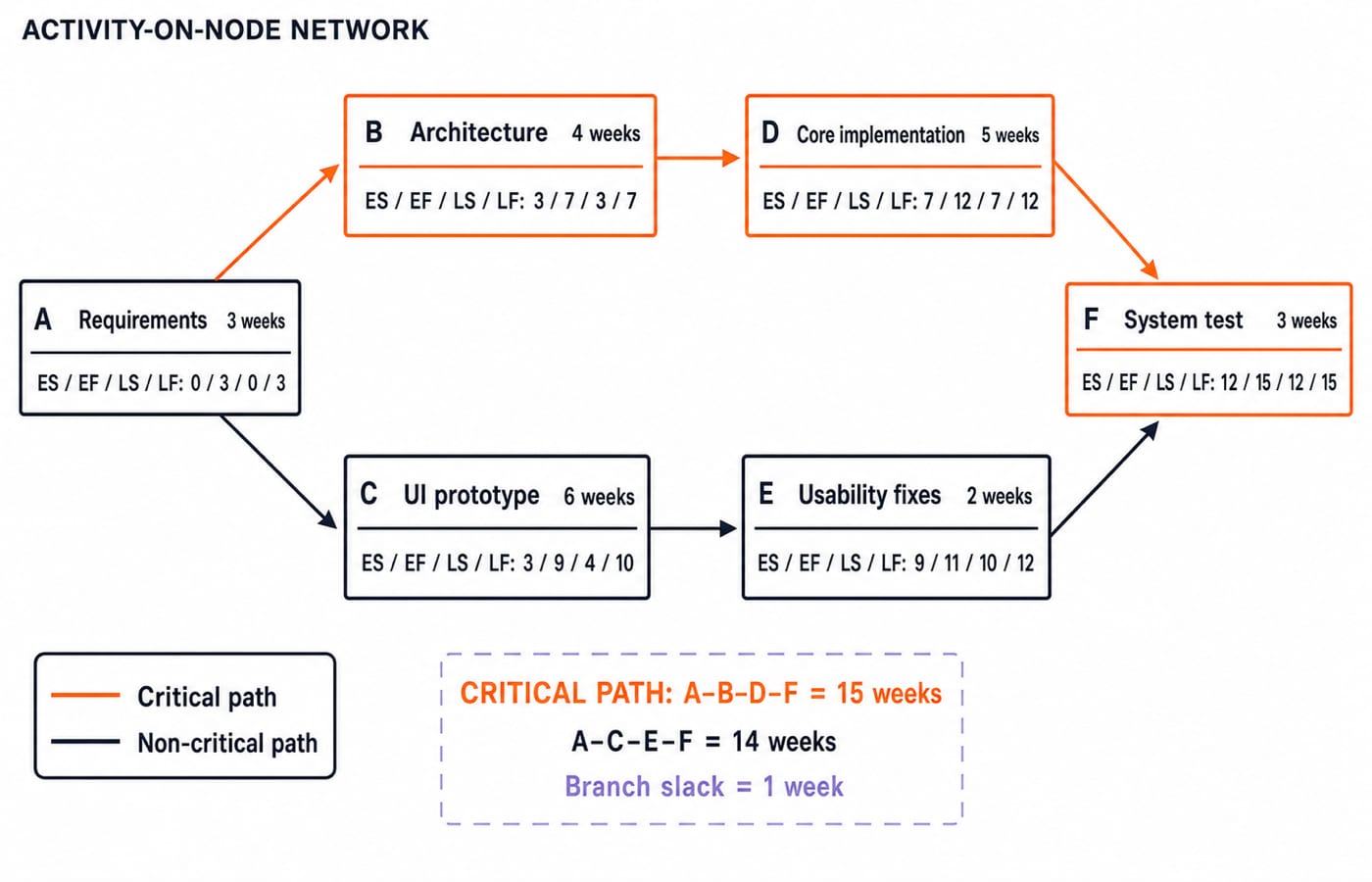
A precedes parallel B and C; B precedes D, C precedes E, and F waits for both. The two passes give:
Activity | Duration | Predecessor | ES | EF | LS | LF | Slack |
|---|---|---|---|---|---|---|---|
A Requirements | 3 | None | 0 | 3 | 0 | 3 | 0 |
B Architecture | 4 | A | 3 | 7 | 3 | 7 | 0 |
C UI prototype | 6 | A | 3 | 9 | 4 | 10 | 1 |
D Core implementation | 5 | B | 7 | 12 | 7 | 12 | 0 |
E Usability fixes | 2 | C | 9 | 11 | 10 | 12 | 1 |
F System test | 3 | D, E | 12 | 15 | 12 | 15 | 0 |
In the forward pass, F starts at max(12, 11) = 12 and ends at 15. The paths are A-B-D-F = 3 + 4 + 5 + 3 = 15 weeks and A-C-E-F = 3 + 6 + 2 + 3 = 14 weeks. Project duration is 15 weeks; A-B-D-F is critical.
Backward from finish 15, LS/LF values are F 12/15, D 7/12, E 10/12, B 3/7, C 4/10 and A 0/3. Slack is LS - ES. C and E share one branch week, so spending it twice can delay the merge.
PERT uncertainty, schedule compression and progress control
For API integration with O = 2, M = 5 and P = 14 weeks:
t_e = (2 + 4 x 5 + 14) / 6 = 36 / 6 = 6 weeks
Variance = ((14 - 2) / 6)^2 = 4 weeks^2
Standard deviation = sqrt(4) = 2 weeks
The expected duration differs from the most likely because PERT weights three estimates. Uncertainty accumulates along the relevant path; do not add every activity's standard deviation.
Shorten D from 5 to 3 weeks. A-B-D-F falls to 13 weeks, but A-C-E-F stays 14, so the project finishes in 14 and the critical path switches. Shortening E by one week on its own leaves the 15-week finish unchanged, because E already carries a week of slack. Recompute all paths after compression.
At each review, record actual starts and finishes, remaining effort, blockers and scope changes. Compare the baseline, update estimate-to-complete, and retain the old baseline unless controlled re-baselining is approved. Honest forecast change creates information; silently moving dates destroys it.
Estimation and scheduling questions: exam formats, interviews and traps
IIT Guwahati's official GATE 2026 CS syllabus lists ten subject sections, and Software Engineering is not one of them, so these calculations reach you through university papers and GATE-style practice rather than a named GATE section. Response formats are set out in MCQ, MSQ or NAT? GATE Question Types Explained, and the subjects that do carry weight are ranked in GATE CS Subject Weightage: Where Hours Pay Off.
Error | Consequence | Correction |
|---|---|---|
Mix LOC and KLOC | Wrong scale | Convert before substitution |
Wrong COCOMO mode | Invalid coefficients | Identify mode first |
Person-months as months | Effort becomes a date | Keep units explicit |
Round every step | Error compounds | Round at the end |
Sum all activities | Parallelism vanishes | Compare paths |
Count path nodes | Wrong critical path | Compare durations |
Spend slack twice | Merge slips | Recheck branch slack |
Add people mechanically | Constraints vanish | Analyse resources and communication |
Compress one task | Critical path switches | Recompute paths |
In interviews, replace a magic number with questions about scope, team familiarity, dependencies, quality and uncertainty. Decompose, give a range and confidence, name the critical dependency, state re-estimation triggers, and justify analogy, bottom-up or parametric estimation. Try: "You can shorten only one activity by two weeks. What changes, and why is the project gain only one week if D is chosen?"
Estimation and scheduling: the short version and next step
Requirements become size:
162 FP, then8.1 KLOChere.A calibrated model gives
21.58 person-monthsof effort.Effort is not
8.03 monthsof elapsed duration.Dependencies make
A-B-D-F = 15 weekscritical.Slack belongs to the network, not to isolated tasks.
PERT gives
6 weeksexpected with a2 weeksstandard deviation for the API integration activity, and each review updates that forecast.
GATE Guidance by Sanchit Sir is the structured route through this discipline alongside the rest of GATE CS preparation. For one exercise tonight, take a blank page and recompute the FP total, both COCOMO outputs, both CPM passes and the path switch after crashing D.
Keep learning

ICT in Education MCQs: 12 Solved Questions on Digital Learning Tools
Solve 12 ICT in Education MCQs, then use clear explanations and a five-layer model to separate files, tools, platforms and public initiatives.
Updated 3 Oct 20268 min readUGC NET Computer Science

Requirements Elicitation Techniques and Use Case Development: Worked Library Example
Follow a fictional library reservation from interviews and observation through testable requirements, a UML use-case model, UC-07, and acceptance checks.
Updated 28 Sep 20266 min readUGC NET Computer Science

Quality Factors: McCall’s and ISO 9126 Models with a Worked Scoring Example
Build both quality models around one maintainability audit. This guide maps their vocabulary, calculates McCall-style and ISO-style scores, and ends with exam-focused checks.
Updated 25 Sep 20265 min readUGC NET Computer Science
Cohesion and Coupling MCQs: 10 Solved Questions on Functional Independence
Practise 10 solved MCQs on cohesion, coupling, functional independence, module dependencies, and the distinctions that make closely matched options easier to separate.
Updated 24 Sep 20267 min readUGC NET Computer Science