BPSC Teaching CS Weightage: Convert PYQ Evidence into Weekly Study Hours
Build a traceable syllabus-to-PYQ sheet, combine recurrence with your own accuracy, and turn the result into a resilient 16-hour weekly plan.
KnowledgeGate Team
Exam prep & CS education
Updated 22 Jul 20265 min read
One old paper can make a topic look permanently important. A generic weightage chart can be just as misleading, because it ignores the current BPSC syllabus and your own accuracy. The alternative is a sheet you can audit: the applicable official syllabus, recurrence across papers you have actually traced, and your own error record, converted into weekly study hours you can defend. The figures worked through below belong to a simulated learner so that every step of the arithmetic stays visible; the weightage that should drive your week is the one your own verified papers produce.
Freeze the official scope before counting questions
Start a scope record with recruitment cycle | advertisement number | exact post/class level | subject or post code | syllabus document | checked on. A syllabus from an earlier TRE phase, from a different class level, or from another teaching post can look close enough to copy and still be the wrong scope; the record is what stops that from happening quietly.
For each exam-specific claim, write: “The applicable BPSC document states...” and record its page or section. Check current material on the BPSC official website first, then a BPSC-issued question booklet and answer key. Use an archive only when you can independently match its cycle, paper, question number and wording. Put recalled questions, crops and unattributed compilations in an unverified column worth zero until traced. Record the issue date of every document you rely on, and prefer the one issued for your own recruitment cycle. The BPSC preparation category is where our own BPSC teaching material sits once the scope record tells you what to study.
Build one syllabus-to-evidence sheet
Use these columns: exact current official syllabus heading, paper ID, paper date or cycle, question number, verified source URL or file, answer-key status, topic, Q occurrence count, P distinct-paper count, learner correct, learner attempts, accuracy, error type and next review date. Deduplicate an item reproduced in two collections.
Q measures recurrence inside your audited set. P rewards spread across separate papers. Accuracy is correct/attempted from recent closed-book work. Keep every confirmed syllabus block visible even when audited Q is zero, because a small sample cannot remove a topic the syllabus still lists. The GATE CS subject-weightage method shows the same evidence-to-hours move on a paper with a long public record; borrow the allocation logic there, not its subject list.
Work a 40-item, four-paper audit
Four papers, 40 traced items. Read each row for recurrence and each column for how evenly a topic is spread across separate papers.
Topic | Paper A | Paper B | Paper C | Paper D | Q | P | Latest accuracy |
|---|---|---|---|---|---|---|---|
DBMS | 2 | 2 | 1 | 2 | 7 | 4 | 5/10 = 50% |
Operating Systems | 1 | 2 | 2 | 1 | 6 | 4 | 6/10 = 60% |
Data Structures and Algorithms | 2 | 1 | 1 | 2 | 6 | 4 | 8/10 = 80% |
Computer Networks | 2 | 0 | 1 | 2 | 5 | 3 | 4/8 = 50% |
Computer Organization | 0 | 2 | 1 | 2 | 5 | 3 | 6/8 = 75% |
Theory of Computation | 1 | 1 | 0 | 2 | 4 | 3 | 5/8 = 62.5% |
Software Engineering | 2 | 0 | 2 | 0 | 4 | 2 | 7/8 = 87.5% |
Digital Logic | 0 | 1 | 0 | 2 | 3 | 2 | 6/8 = 75% |
The row checksum is 7+6+6+5+5+4+4+3=40; the paper checksum is 10+9+8+13=40. Overall accuracy across the audited attempts is 47/70=67.1%. Treat that as a baseline to move rather than a target score; the useful question is which rows are dragging it down.
Convert recurrence and weakness into a 16-hour week
Use learner-owned planning formulas: E = Q + P, W = 1 + (1 - accuracy), and U = E x W. Spread raises evidence points E; lower accuracy raises weakness multiplier W. Both weights are yours to tune, but tune them once and then leave them alone: the rule stays fixed while the evidence changes, otherwise you are just rediscovering your preferences.
Topic | Priority calculation | U | Final hours |
|---|---|---|---|
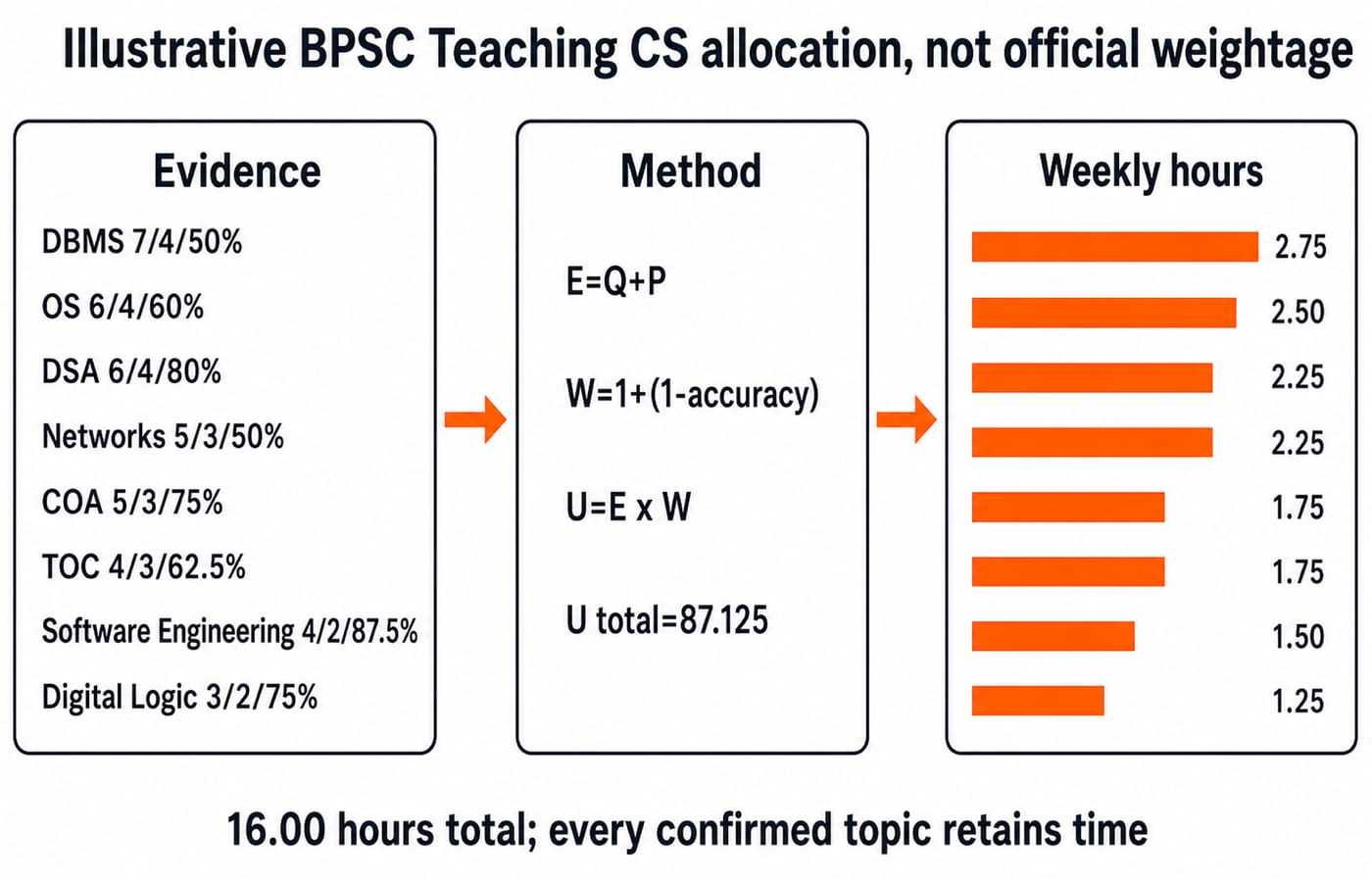
DBMS | (7+4)x1.50 | 16.50 | 2.75 |
Operating Systems | (6+4)x1.40 | 14.00 | 2.50 |
Data Structures and Algorithms | (6+4)x1.20 | 12.00 | 2.25 |
Computer Networks | (5+3)x1.50 | 12.00 | 2.25 |
Computer Organization | (5+3)x1.25 | 10.00 | 1.75 |
Theory of Computation | (4+3)x1.375 | 9.625 | 1.75 |
Software Engineering | (4+2)x1.125 | 6.75 | 1.50 |
Digital Logic | (3+2)x1.25 | 6.25 | 1.25 |
The checksum is U total = 87.125. Reserve 0.5 hour x 8 topics = 4 hours as a syllabus-protection floor. Allocate the remaining 12 hours through 12 x U/87.125, then round to 15-minute blocks while preserving the total: 2.75+2.50+2.25+2.25+1.75+1.75+1.50+1.25=16.00 hours.
Stress-test one-paper dependence
Remove Paper D, the largest paper in this simulated matrix at 13/40 items, while keeping personal accuracies unchanged. The new units are DBMS (5+3)x1.50=12.00, OS (5+3)x1.40=11.20, DSA (4+3)x1.20=8.40, Networks (3+2)x1.50=7.50, COA (3+2)x1.25=6.25, TOC (2+2)x1.375=5.50, Software Engineering (4+2)x1.125=6.75, and Digital Logic (1+1)x1.25=2.50.
Software Engineering now overtakes COA and TOC because its evidence did not depend on Paper D. Digital Logic falls sharply because 2/3 of its illustrative occurrences came from that paper. Mark unstable rows provisional; a row that swings this hard is telling you the sample is thin, not that the topic is unimportant, which is why it never drops to zero hours.
Make the hours executable and resilient
Split each block into 40% concept repair, 40% closed-book questions and 20% error-log review. For DBMS, 2.75 hours = 165 minutes: use 65 + 65 + 35 = 165. For DSA, 2.25 hours = 135 minutes: use 55 + 55 + 25 = 135.
If 16 hours falls to 12, use DBMS 2.00, OS 2.00, DSA 1.75, Networks 1.75, COA 1.50, TOC 1.25, Software Engineering 1.00, and Digital Logic 0.75. The sum is 12.00 hours; preserve practice and review in every block. Use the BPSC course for structured concept repair and the BPSC test series for organised timed practice. The scope record still decides what goes into either.
Recalculate every two weeks, then take one small step
Recompute after one newly verified paper or at least 10 fresh traceable attempts per affected topic. If OS moves from 6/10=60% to 8/10=80% while Q=6 and P=4 stay unchanged, its units fall from (10)x1.40=14.00 to (10)x1.20=12.00. Reduce its next allocation only after 15-minute rounding and while retaining the floor. The teaching-exam mock review method supplies a sit, classify, repair and retest loop.
The short version is simple: freeze official scope, count only traceable items, reward cross-paper spread, add personal weakness, stress-test one-paper dependence and revise fortnightly. Your next 30 minutes: enter one verified booklet in the sheet and quarantine every doubtful item.
Keep learning
BPSC Headmaster Selection Process: Written Exam, Merit List and Document Verification
Trace the completed 2024 BPSC Head Master route from one objective paper to provisional merit and certificate checks. Includes checked arithmetic and a practical six-week plan.
Updated 14 Aug 20264 min readBPSC Teaching

BPSC Teaching vs KVS/NVS: Bihar Posting, Transfers and Best Fit
Choose by document fit, mobility and work context, not by the recruiting body's name. Compare the Bihar state cadre against central-school postings and score the routes against your own constraints.
Updated 7 Aug 20266 min readBPSC Teaching
BPSC Teaching CS PYQs: Four-Pass Revision Plan
Turn one 40-question PYQ set into four rounds that expose weak concepts, repair them, add a practice clock and test mixed recall with a usable error log.
Updated 5 Aug 20265 min read65 viewsBPSC Teaching

BPSC Computer Science: DBMS, SQL and Data Structures Worked Guide
Follow one student-result example from functional dependencies and 3NF through SQL aggregation, queues, stacks, hashing and max-heap extraction.
Updated 2 Aug 20266 min readBPSC Teaching