BPSC Headmaster Selection Process: Written Exam, Merit List and Document Verification
Trace the completed 2024 BPSC Head Master route from one objective paper to provisional merit and certificate checks. Includes checked arithmetic and a practical six-week plan.
KnowledgeGate Team
Exam prep & CS education
Updated 14 Aug 20264 min read
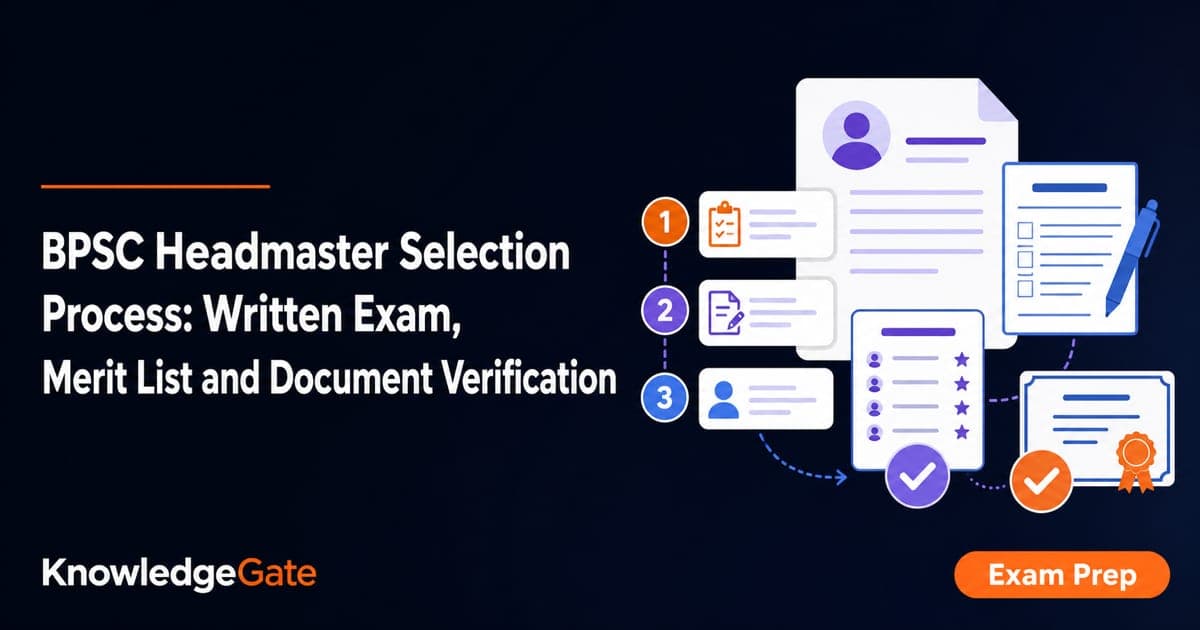
Is BPSC Head Master selection prelims, mains and interview, or one paper followed by checks? The 2024 cycle used the second route. Do not mix Head Master, Head Teacher and BPSC TRE.
Cycle-specific numbers come from BPSC Advt. No. 26/2024 and its result. This worked example is not a permanent rule. Read the live advertisement before acting.
BPSC Headmaster selection process at a glance
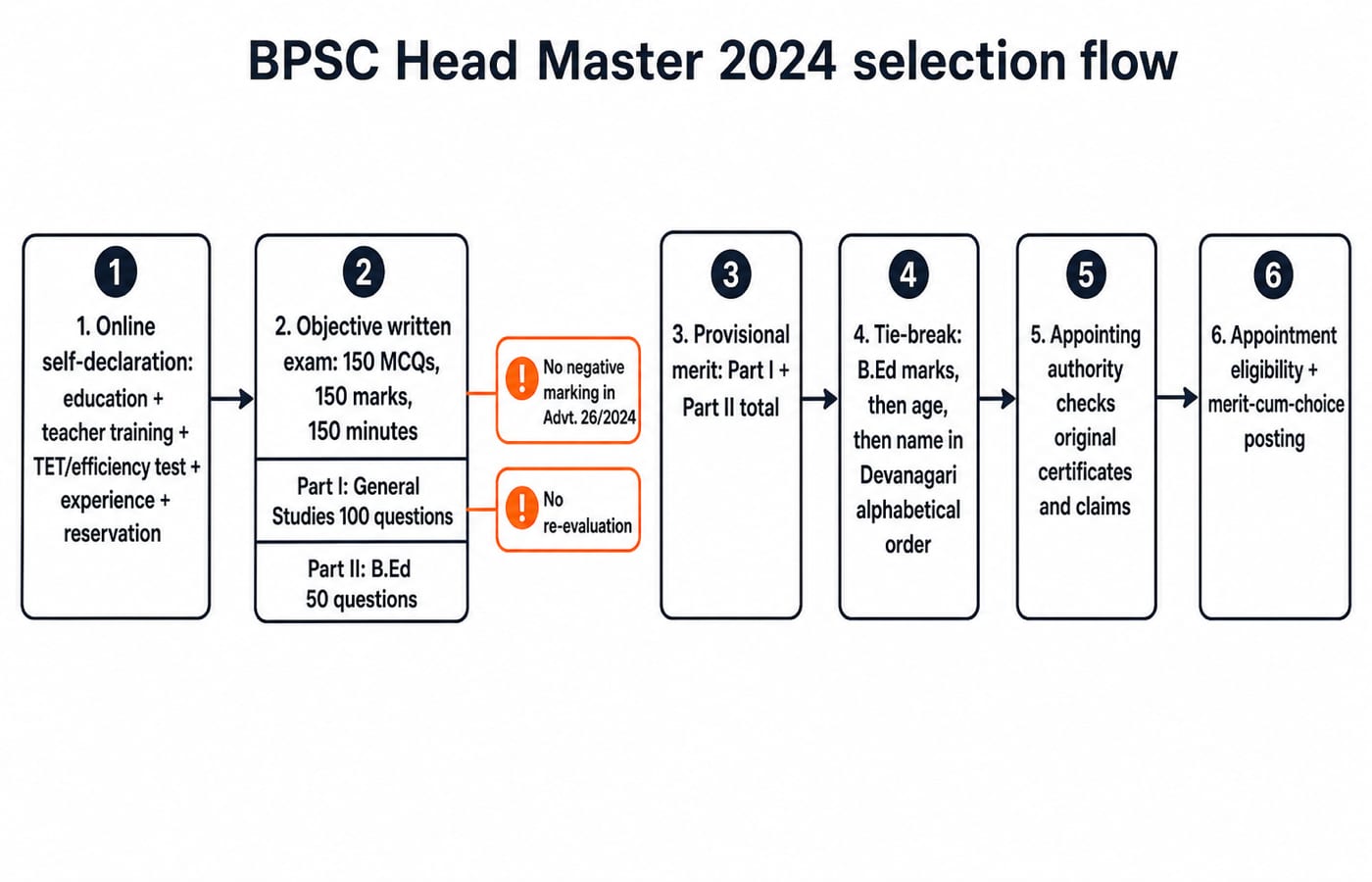
Under the 2024 advertisement, applicants declared eligibility claims online. Selection rested on one objective exam, with no interview specified. BPSC prepared provisional merit, then the appointing department checked claims and originals.
Document verification was an eligibility gate, not a marks-bearing exam. The 1 November 2024 BPSC result said the 28 June exam produced a provisional Education Department merit list of 5,971 candidates. That is not a vacancy count or forecast.
What the written examination actually screened
Advt. No. 26/2024 specified 150 objective questions for 150 marks in 2 hours 30 minutes: 100 General Studies and 50 B.Ed. Each carried 1 mark, with no negative marking or re-evaluation specified.
For that 2024 duration, 2 hours 30 minutes = 150 minutes, so 150 ÷ 150 = 1 minute per question. Try 70 minutes for General Studies, 35 for B.Ed, 25 for flagged questions and 20 for OMR checking. Total: 70 + 35 + 25 + 20 = 150. These are practice allocations, not section limits.
Under the 2024 no-penalty rule, 82 General Studies + 41 B.Ed = 123/150. Rebuild the logic if a future notice adds a penalty.
Minimum qualifying marks are not the merit cutoff
The 2024 minimums were 40% for general, 36.5% for backward class, 34% for extremely backward class, and 32% for SC, ST, women and candidates with disabilities. They were not cutoffs.
On the 2024 paper total, the arithmetic is:
General category: 150 × 40% = 60 marks.
Backward class: 150 × 36.5% = 54.75 marks.
Extremely backward class: 150 × 34% = 51 marks.
SC, ST, women and candidates with disabilities: 150 × 32% = 48 marks.
Do not invent a rounding rule for 54.75. Official handling governs it. General-category Candidate A scores 61 and clears 60; Candidate B scores 59 and does not. A only qualifies for merit consideration. Comparative merit, category rules, verified eligibility and available posts still apply.
How provisional merit and the tie-break worked
Under Advt. No. 26/2024, combined marks determined rank. Ties went to B.Ed marks, then age, then the candidate's name in Devanagari alphabetical order.
Candidate R has 82 General Studies + 41 B.Ed = 123. Candidate S has 85 + 38 = 123. R ranks ahead because 41 B.Ed marks exceed 38. Further 2024 ties moved to age, then Devanagari alphabetical order. The BPSC eligibility and exam-pattern guide distinguishes other stage structures, but does not govern Head Master numbers.
Why document verification can still stop a high scorer
The 2024 process began with self-declared claims, but recommendation created no right to appointment. The appointing department still had to accept evidence.
For a candidate claiming a postgraduate degree, B.Ed, STET, 8 years of continuous qualifying secondary-teacher service and EBC status, audit five rows:
Check | Candidate file |
|---|---|
Claim | Postgraduate degree, B.Ed, STET, 8 years of continuous qualifying service, EBC status |
Document named in the application | Degree, B.Ed, STET, experience, bank-salary and EBC records |
Issuing authority | Confirm each issuer against the notice |
Date/validity checkpoint under the relevant notice | Test qualifications, service and category papers against the applicable date |
Original-vs-upload match | Match names, dates, identifiers, category and service exactly |
A score of 123/150 cannot cure a mandatory mismatch. Check birth-date, academic, training, TET or efficiency-test, experience, required bank-salary, domicile and claimed-category evidence. Use the BPSC teaching eligibility audit to organise it, then follow the Head Master notice.
A six-week preparation plan for the 100:50 split
A working teacher can build a 14-hour week. Five 90-minute weekdays give 5 × 1.5 = 7.5 hours. Add 3 hours Saturday and 3.5 Sunday: 7.5 + 3 + 3.5 = 14. Six weeks gives 6 × 14 = 84. Recover a missed 90-minute block with 45 minutes each weekend day.
Phase | General Studies | B.Ed | Practice and review | Phase total |
|---|---|---|---|---|
Weeks 1 and 2, per week | 8 h | 4 h | 2 h error review | 14 h |
Weeks 3 and 4, per week | 6 h | 5 h | 3 h timed sets | 14 h |
Weeks 5 and 6, per week | 4 h | 4 h | 6 h full-paper simulation and review | 14 h |
Each two-week phase is 2 × 14 = 28 hours, and 28 + 28 + 28 = 84. The BPSC TRE 4.0 preparation course and BPSC TRE 4.0 test series are teaching-preparation options, but TRE is not Head Master recruitment. Compare their coverage with the live Head Master syllabus.
Turn mocks into a selection-ready file
Under the 2024 pattern, log Mock 1 as 62 General Studies + 29 B.Ed = 91/150, Mock 2 as 70 + 34 = 104/150, and Mock 3 as 78 + 39 = 117/150. For each error, record the topic, classify it as knowledge, reading or OMR handling, and set one corrective task. Raise the total and B.Ed component.
Use three checks: current Head Master advertisement first, current BPSC notice or result second, preparation resource third. Expand the same diagnose, study, test and review cycle if needed. Open the Govt Teaching Jobs category only after confirming the recruitment.
The short version
For Advt. No. 26/2024, written score created provisional merit, B.Ed could break a tie, and verified eligibility controlled appointment. Download the live notice, copy its stages into a one-page checklist, then begin a timed diagnostic.
Keep learning
BPSC Teaching vs KVS/NVS: Bihar Posting, Transfers and Best Fit
Choose by document fit, mobility and work context, not by the recruiting body's name. Compare the Bihar state cadre against central-school postings and score the routes against your own constraints.
Updated 7 Aug 20266 min readBPSC Teaching
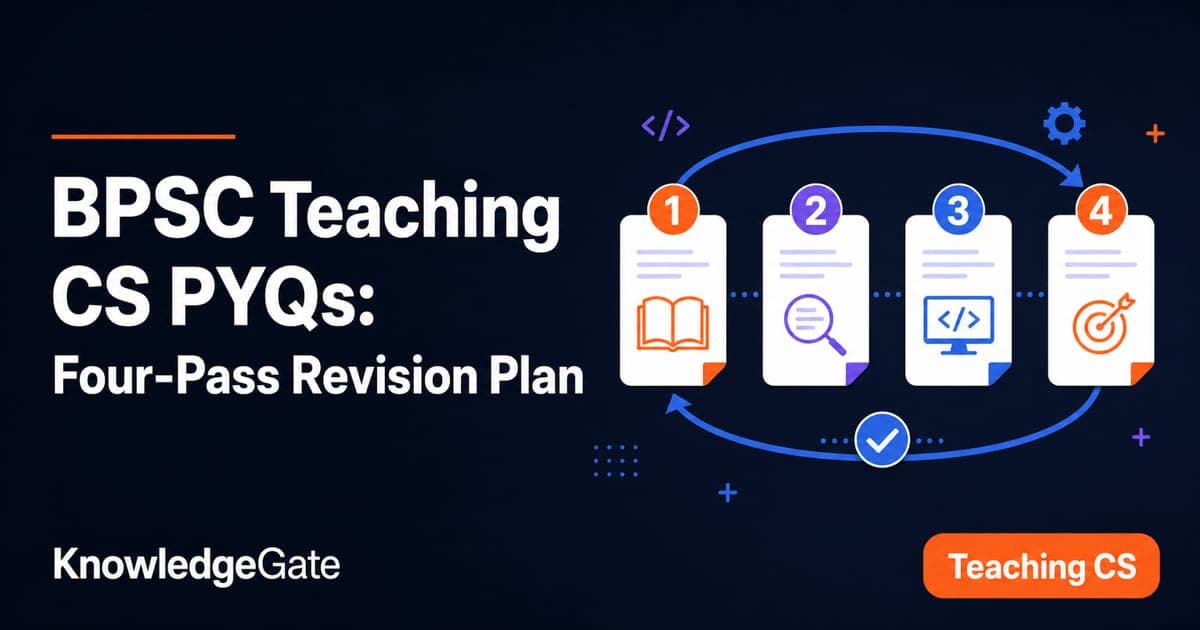
BPSC Teaching CS PYQs: Four-Pass Revision Plan
Turn one 40-question PYQ set into four rounds that expose weak concepts, repair them, add a practice clock and test mixed recall with a usable error log.
Updated 5 Aug 20265 min read65 viewsBPSC Teaching

BPSC Computer Science: DBMS, SQL and Data Structures Worked Guide
Follow one student-result example from functional dependencies and 3NF through SQL aggregation, queues, stacks, hashing and max-heap extraction.
Updated 2 Aug 20266 min readBPSC Teaching
BPSC Teaching Computer Science Preparation: A Practical 16-Week Plan
Use a sustainable 14-hour weekly model to diagnose six CS lanes, repair gaps, rotate practice, review mocks and finish with two focused revision passes.
Updated 30 Jul 20266 min read68 viewsBPSC Teaching