BPSC Teaching vs KVS/NVS: Bihar Posting, Transfers and Best Fit
Choose by document fit, mobility and work context, not by the recruiting body's name. Compare the Bihar state cadre against central-school postings and score the routes against your own constraints.
KnowledgeGate Team
Exam prep & CS education
Updated 7 Aug 20266 min read
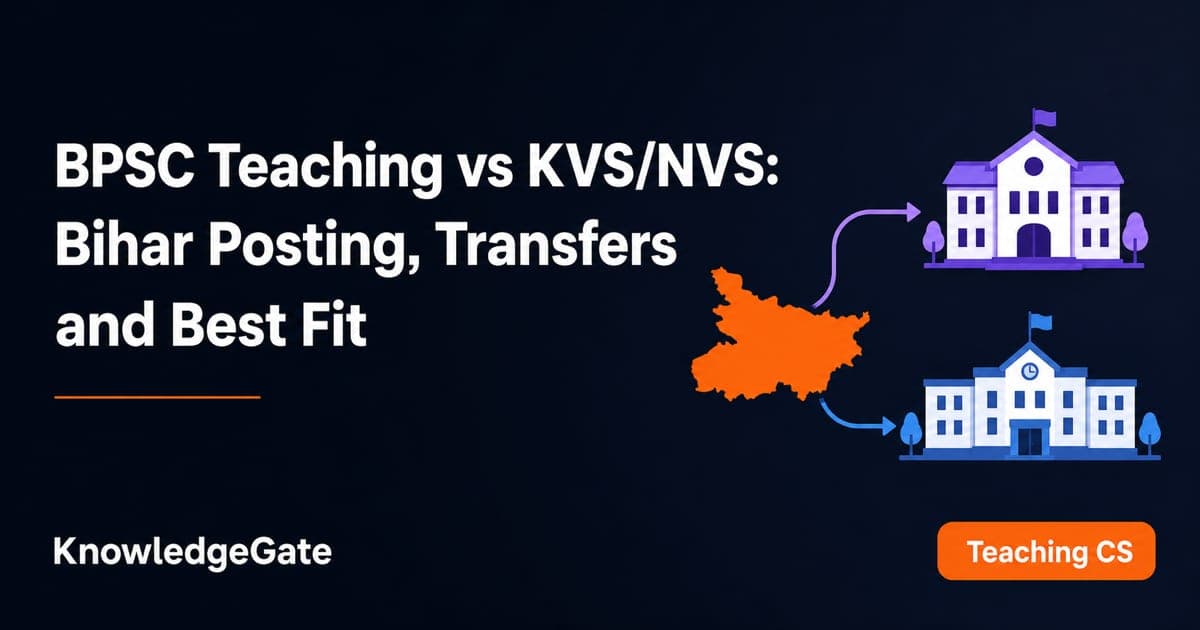
The real question is whether staying in Bihar matters more to you than the wider set of postings central-school recruitment opens up. BPSC recruits for Bihar government schools. KVS and NVS are two separate central organisations, each with its own notices and service conditions. Neither route hands you the station you want. What separates them is the certificate each accepts, how far you can be posted, and whether the campus is residential.
BPSC teaching vs KVS/NVS at a glance
These are three employers, not one teacher cadre, and geography is the first thing that splits them.
BPSC teaching route: the Bihar Public Service Commission recruits for posts in Bihar government schools. This is a state cadre, so posting and transfer stay within Bihar under state rules. Eligibility has typically run through a teacher-eligibility certificate such as Bihar STET or CTET depending on the level; the current notification confirms which certificate a post accepts.
KVS: Kendriya Vidyalaya Sangathan runs central-government day schools across India, often attached to central-government stations. Recruitment is all-India and appointment carries all-India transfer liability. CTET has typically featured in teacher eligibility; the exact clause sits in the current KVS notice.
NVS: Navodaya Vidyalaya Samiti runs the Jawahar Navodaya Vidyalayas, district-level residential schools with a largely rural intake. Posting is all-India, and the residential campus adds hostel routine, supervised evening study and pastoral duty on top of classroom teaching.
A Bihar cadre keeps you inside one state for your whole service. A central appointment can move you to any state, and in the NVS case to a campus you would also live on.
Eligibility fit comes before location preference
Audit five gates before you rank anything: the post and its subject, the degree combination, teacher training, the TET or other certificate the post names, and the notice-date conditions on age, category and language. Copy each value from that organisation's own current notice. A CTET certificate is not interchangeable with Bihar STET, and neither body reads the other's eligibility clause.
Consider a candidate with a computer-science degree, a B.Ed and CTET Paper II but no Bihar STET certificate. If the BPSC post she wants requires STET, she is not eligible for it this cycle, and no strength in her other three documents changes that. Her real shortlist is KVS and NVS until she clears STET. One unmet mandatory condition removes a route outright, so settle every gate against the notice before spending a week weighing preferences.
A state route does not guarantee a district
Keep three things apart: the employer's geography, your first allocation, and where you can be moved later. A BPSC recruitment covers the Bihar posts in its advertisement, under state service rules, so it narrows your posting to one state, not to Patna or to your home district, and transfers within Bihar remain possible.
On the central side the wording is explicit. The KVS Transfer Policy 2023 FAQ tells applicants that it is compulsory to opt for five different stations when applying for transfer or displacement, and that an employee who does not apply after completing tenure can be posted anywhere as per the requirement of KVS. Those are KVS's words about KVS employees; NVS runs its own transfer policy, set out in its current notice and service rules.
A candidate whose family situation keeps her in Bihar for the next five years reads that and shortlists BPSC, dropping the posts with wider liability. A candidate content to move keeps all three routes open.
KVS and NVS are different work settings
A Kendriya Vidyalaya posting is a conventional day school inside a national network. A Navodaya posting puts you on a residential campus in a mostly rural district, where hostel routine, supervised evening study and children living away from home are part of the job rather than an extra duty. Both run CBSE-affiliated schools, so the syllabus you would teach is much the same. The working day around it is not.
The residential difference decides whether your evenings are your own, whether your family lives on campus, and how you answer a teaching-aptitude question about pastoral care. Bihar government school posts are ordinarily day schools too, so on this axis BPSC and KVS sit together and NVS sits apart.
Beyond the residential question, rate your own comfort with computer-lab teaching, assessment load, co-curricular responsibility and the teaching language. KVS and NVS Computer Science: exam structure and how to prepare sets out the selection shape both organisations use; the duties attached to a specific post come from that post's own notice and service rules.
Reuse the common preparation core, then split by notice
For a computer-science teaching post, the part that carries across all three routes is the subject core: programming and problem solving, data structures and algorithms, database management and SQL, operating systems, computer networks, and computer organisation. Teaching aptitude and pedagogy carry across as well, and they are the marks a CS graduate most often leaves on the table. That base is the bulk of your work, and you build it once.
What does not carry across is the eligibility certificate each post names, and each notice's own general and language sections, stage sequence and paper structure. Those you read fresh, per organisation, per cycle.
So give the shared block one deep pass, then a short notice-specific pass for every route you actually apply to. Tag every topic shared, BPSC only, KVS only or NVS only, and a second application costs you the tag list rather than another preparation cycle.
Use a weighted decision matrix, not a brand name
Weight the criteria that matter to you out of ten, rate each route 1 to 5 on each, then multiply and add. Take a candidate holding both CTET Paper II and Bihar STET, so all three routes are open, who can move anywhere in India but would find a residential campus hard.
Criterion | Weight | BPSC | KVS | NVS |
|---|---|---|---|---|
Location continuity in Bihar | 2 | 5 | 2 | 2 |
Range of postings and openings | 3 | 2 | 5 | 4 |
Day-school hours, no residential duty | 3 | 5 | 5 | 1 |
Preparation that carries to other exams | 2 | 4 | 4 | 4 |
Weighted total (out of 50) | 10 | 39 | 42 | 27 |
KVS 42, BPSC 39, NVS 27. NVS is out for her, and it is out on one criterion rather than on any general judgement about Navodaya schools. But 42 against 39 is three points in fifty, which is a tie rather than a decision: when two routes finish that close, apply to both and let the calendars and the certificates settle it. Note too that the fourth criterion scores 4 everywhere, so it moves the ranking not at all.
Now change one weight. If she could not leave Bihar and location continuity went from 2 to 5, the totals become BPSC 54, KVS 48 and NVS 33 out of 65, and BPSC leads by six. That is what weighting is for: the routes did not change, her constraint did. Score only routes you are eligible for, because the matrix ranks preferences and cannot create eligibility or predict a result.
Keep three official-rule sheets and one study tracker
Create BPSC notice and rules, KVS notice and policy and NVS notice and policy, plus one shared preparation tracker. In each official sheet record the document title, its publication date, the post code, the clause or page, the value you copied and the source URL.
Age limits, vacancies, marks, paper duration, negative marking and transfer terms all change from cycle to cycle, so leave those cells empty, with the date you last checked, until the notice is out. Filling them from a projected notice or a coaching summary is how candidates end up preparing for a paper that no longer exists. For a wider shortlist first, read Which teaching Computer Science exam should you target?
The short version and next step
Clear the eligibility gates first, because they delete routes that no amount of preference weighting can restore. Then be honest about geography and work setting. If you cannot leave Bihar, BPSC is the route and the rest are optional extras. If you can move and want day-school hours, KVS ranks first. NVS suits you only if a residential campus is something you want rather than tolerate. Then put your hours into the shared subject core and pedagogy, and add route-specific practice once you know which notices you are answering.
Start with the BPSC TRE Exam Preparation category, use the BPSC TRE 4.0 Preparation Course for structured coverage, and the BPSC TRE 4.0 Test Series for diagnosis and timed practice.
Keep learning
BPSC Headmaster Selection Process: Written Exam, Merit List and Document Verification
Trace the completed 2024 BPSC Head Master route from one objective paper to provisional merit and certificate checks. Includes checked arithmetic and a practical six-week plan.
Updated 14 Aug 20264 min readBPSC Teaching
BPSC Teaching CS PYQs: Four-Pass Revision Plan
Turn one 40-question PYQ set into four rounds that expose weak concepts, repair them, add a practice clock and test mixed recall with a usable error log.
Updated 5 Aug 20265 min read65 viewsBPSC Teaching

BPSC Computer Science: DBMS, SQL and Data Structures Worked Guide
Follow one student-result example from functional dependencies and 3NF through SQL aggregation, queues, stacks, hashing and max-heap extraction.
Updated 2 Aug 20266 min readBPSC Teaching
BPSC Teaching Computer Science Preparation: A Practical 16-Week Plan
Use a sustainable 14-hour weekly model to diagnose six CS lanes, repair gaps, rotate practice, review mocks and finish with two focused revision passes.
Updated 30 Jul 20266 min read68 viewsBPSC Teaching