BPSC Teaching Computer Science Syllabus: Topic Map and Boundaries
Organise BPSC Computer Science preparation into five bounded clusters without mistaking a course taxonomy for the official syllabus. Includes source checks, topic boundaries, and a 24-hour planning example.
KnowledgeGate Team
Exam prep & CS education
Updated 25 Jul 20265 min read278 views
A BPSC Computer Science topic list is hard to use when programming, systems, databases, networks, pedagogy, and supporting subjects sit in one flat column. Grouped into five bounded clusters, the same list tells you which folder a note belongs in and what you are revising next. BPSC recruits teachers in numbered TRE cycles, each with its own advertisement, so work the map alongside the advertisement, syllabus, notice, and corrigendum for your own cycle.
1. Freeze the exact BPSC syllabus before using any topic map
First record recruitment cycle | advertisement number | exact post | class level | subject/post code | syllabus document date. A syllabus saved from an earlier post or TRE cycle will not define the scope you are sitting for. Copy each topic into your tracker in the official wording, with its document title and page or section. The advertisement, syllabus, notice, corrigendum, archive, and question-booklet sections all sit on the BPSC official website. Where that document is silent, leave the row blank rather than filling it from a coaching page.
Claim | Official wording | Document | Page/section | Checked on |
|---|---|---|---|---|
Claim to verify | Copy exactly | Title and date | Page or section | Check date |
Use the BPSC preparation category only for orientation. If you are choosing a route, read Which Teaching CS Exam Should You Target?, but never transfer another body’s pattern to BPSC.
2. See the whole preparation map as five bounded clusters
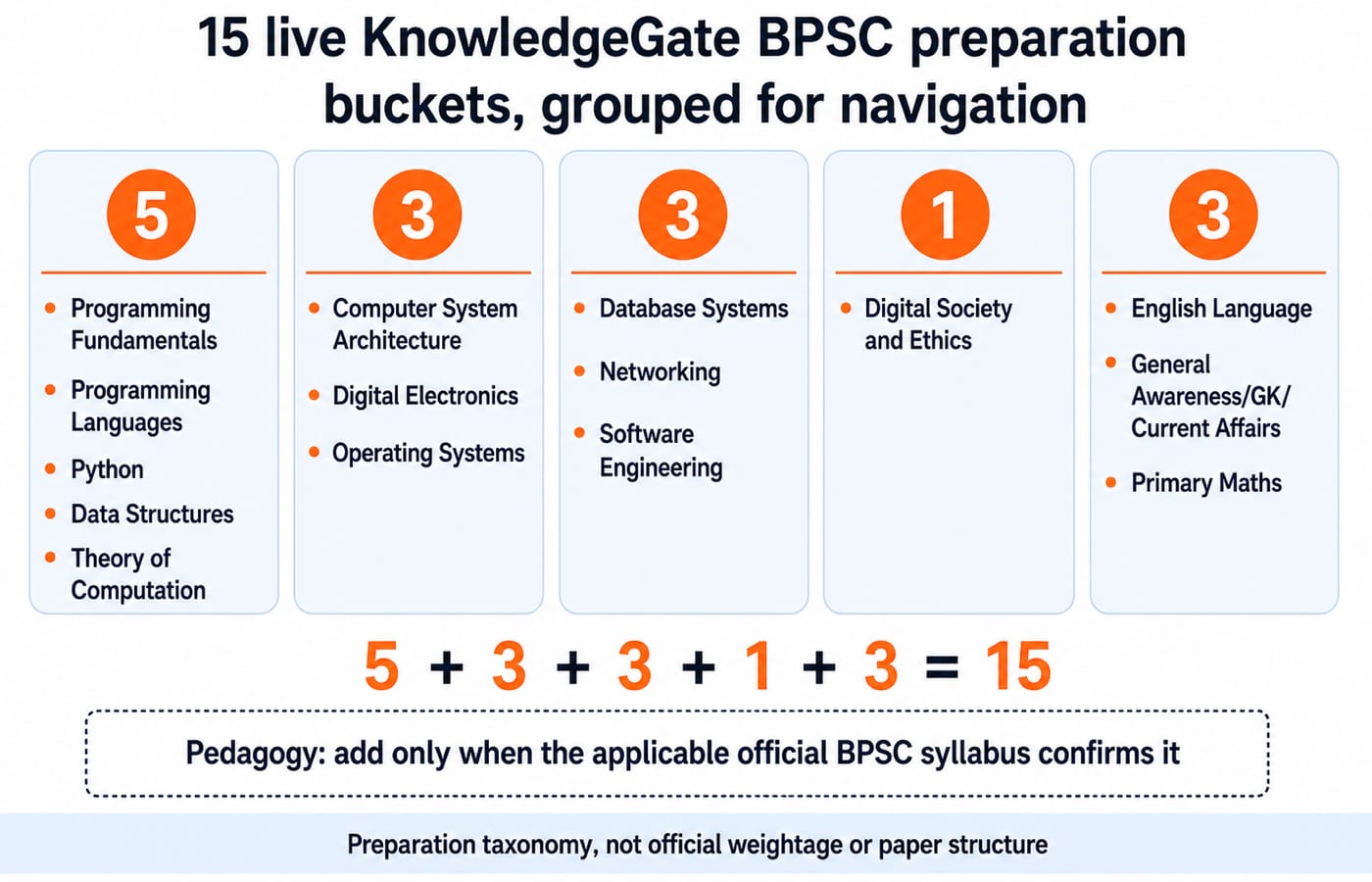
KnowledgeGate's BPSC Computer Science coverage runs to 15 preparation buckets. Reading them as five clusters is what makes the list usable: you revise a cluster, not a column.
Cluster | Count | Preparation buckets |
|---|---|---|
Programming and theory | 5 | Programming Fundamentals, Programming Languages, Python, Data Structures, Theory of Computation |
Systems and hardware | 3 | Computer System Architecture, Digital Electronics, Operating Systems |
Data, connectivity, and software | 3 | Database Systems, Networking, Software Engineering |
Digital society | 1 | Digital Society and Ethics |
Supporting preparation | 3 | English Language, General Awareness/GK/Current Affairs, Primary Maths |
Pedagogy: official-check overlay | Not counted | Add only if the applicable BPSC syllabus names it; KnowledgeGate material is supplementary |
The counts check out: 5 + 3 + 3 + 1 + 3 = 15. Pedagogy is an overlay, not a sixteenth bucket, and enters your plan only when the applicable syllabus names it.
3. Keep programming, data structures, Python, and theory separate
Programming Fundamentals covers variables, control flow, functions, and tracing. Programming Languages covers language models and comparisons. Python owns language-specific syntax and behaviour. Data Structures covers arrays, lists, stacks, queues, trees, graphs, searching, and sorting. Theory of Computation covers formal languages, automata, grammars, and computability. None of the five subsumes another, so a topic filed in the wrong one is lost at revision time.
Start with x = 3 and apply x = 2x - i for i = 1, 2, 3, 4: 3 -> 5 -> 8 -> 13 -> 22. File this under Programming Fundamentals. Inserting 40, 20, 60, 10 into a binary search tree belongs under Data Structures. A DFA over {0,1} belongs under Theory of Computation. Give each note one primary folder.
4. Draw a clean boundary around systems and hardware
Computer System Architecture owns instruction formats, registers, memory hierarchy, I/O organisation, and CPU organisation. Digital Electronics owns Boolean logic, gates, and combinational or sequential circuits. Operating Systems owns processes, scheduling, synchronization, memory management, files, and deadlocks. When a topic touches two areas, give it one primary home and one cross-reference.
A 32-bit virtual address with 4 KiB = 2^12 byte pages has a 12-bit page offset. The remaining 32 - 12 = 20 bits form the virtual page number. File the split and page-table use under Operating Systems, then cross-reference address width and memory organisation under Architecture.
5. Separate databases, networks, software engineering, and pedagogy
Schema design, keys, normalization, SQL, transactions, and indexing go to Database Systems. Layers, addressing, routing, switching, transport, and application protocols go to Networking. Requirements, design models, testing, maintenance, and life-cycle methods go to Software Engineering. Digital Society and Ethics covers responsible technology use and its social implications, which is not the same subject as teaching pedagogy.
Official heading | Exact listed topic | My note | Practice source | Status |
|---|---|---|---|---|
Leave blank until verified | Leave blank until verified | What to study | Booklet, course, or questions | Pending/confirmed |
If the official syllabus confirms pedagogy, Computer Science Pedagogy for Teacher Exams covers those concepts as supplementary reading.
6. Worked example: turn 15 buckets into a 24-hour first pass
A first pass touches every bucket once, before any reweighting. Budget 12 sessions x 2 hours = 24 hours and split them like this.
Programming and theory,
8 hours: Programming Fundamentals1.5, Programming Languages1, Python1, Data Structures2.5, Theory of Computation2.Systems,
5 hours: Architecture2, Digital Electronics1, Operating Systems2.Data, connectivity, and software,
4.5 hours: Database Systems2, Networking1.5, Software Engineering1.Digital Society and Ethics,
1.5 hours.Support,
5 hours: English1.5, General Awareness2, Primary Maths1.5.
The total is 8 + 5 + 4.5 + 1.5 + 5 = 24 hours. In each session, spend 70 minutes reviewing concepts, 35 minutes answering questions, and 15 minutes updating the error log. Across 12 sessions, that is 840 minutes = 14 hours, 420 minutes = 7 hours, and 180 minutes = 3 hours. The check is 14 + 7 + 3 = 24 hours. If the official syllabus confirms pedagogy, buy its hours back from your strongest bucket: these 24 have none spare.
7. Test the map against an official BPSC question booklet
Take one applicable official BPSC question booklet. Give every relevant item one primary cluster and an optional cross-reference.
Question number | Primary bucket | Cross-reference | Correct/incorrect | Error type | Source booklet |
|---|---|---|---|---|---|
Fill after solving | One bucket | Optional | Your result | Concept, recall, or calculation | Exact BPSC booklet |
Note which booklet each tally came from. A count from one cycle's paper is evidence about that paper; the next cycle earns its own tally.
BPSC Computer Science: the short version
Freeze the official document, navigate with the 15 buckets, keep pedagogy as an official-check overlay, and treat the 24-hour plan as a template. The BPSC TRE 4.0 Preparation Course gives you that coverage already assembled. Take the BPSC TRE 4.0 Test Series once you have matched it against the official pattern; it carries 16 unit tests + 7 full-length mocks + 3 previous-year papers = 26 tests.
KnowledgeGate carries over 700 BPSC Computer Science questions. Sort each one into a bucket as you solve it, and the map itself shows you your weakest cluster.
Keep learning
BPSC Headmaster Selection Process: Written Exam, Merit List and Document Verification
Trace the completed 2024 BPSC Head Master route from one objective paper to provisional merit and certificate checks. Includes checked arithmetic and a practical six-week plan.
Updated 14 Aug 20264 min readBPSC Teaching
BPSC Teaching vs KVS/NVS: Bihar Posting, Transfers and Best Fit
Choose by document fit, mobility and work context, not by the recruiting body's name. Compare the Bihar state cadre against central-school postings and score the routes against your own constraints.
Updated 7 Aug 20266 min readBPSC Teaching
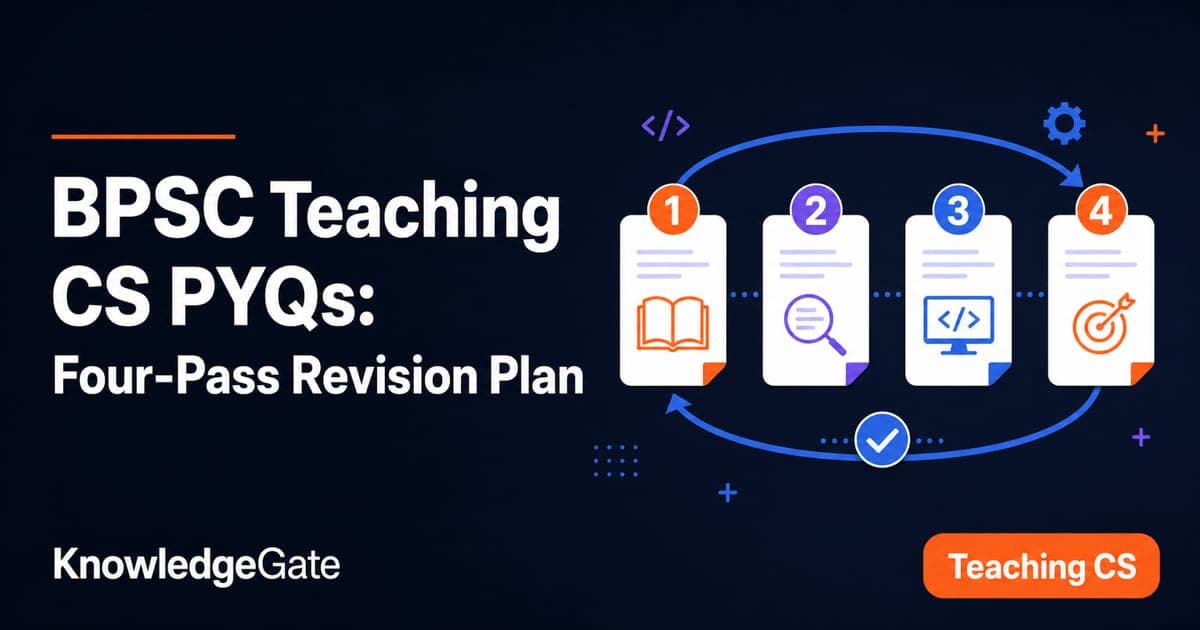
BPSC Teaching CS PYQs: Four-Pass Revision Plan
Turn one 40-question PYQ set into four rounds that expose weak concepts, repair them, add a practice clock and test mixed recall with a usable error log.
Updated 5 Aug 20265 min read65 viewsBPSC Teaching

BPSC Computer Science: DBMS, SQL and Data Structures Worked Guide
Follow one student-result example from functional dependencies and 3NF through SQL aggregation, queues, stacks, hashing and max-heap extraction.
Updated 2 Aug 20266 min readBPSC Teaching