Requirements Elicitation Techniques and Use Case Development: Worked Library Example
Follow a fictional library reservation from interviews and observation through testable requirements, a UML use-case model, UC-07, and acceptance checks.
KnowledgeGate Team
Exam prep & CS education
Updated 28 Sep 20266 min read
Collecting stakeholder statements is not the same as producing testable requirements. Drawing actors and ovals is not yet a useful use case either. The requirements process moves from interviews, observation, a questionnaire, policy review, and a workshop to a traceable specification and acceptance checks. In the fictional campus library, every policy value remains consistent from evidence through modelling and acceptance tests.
Requirements elicitation: where it starts and what it must produce
Elicitation discovers stakeholder goals, constraints, assumptions, exceptions, and conflicts. The chain is: collect evidence, analyse and reconcile it, specify requirements, then validate the intended need. Software Requirements in Software Engineering: SRS, Elicitation and Validation with a Worked Example follows the wider lifecycle through SRS writing, validation, traceability, and change control. The library reservation here concentrates on choosing evidence sources and developing one use case from them.
Outputs are a stakeholder map, evidence log, rules, functional and non-functional requirements, a use-case diagram, a fully dressed use case, and acceptance criteria. “Members need faster service” is raw input. “Show reservation confirmation within 2 minutes” is measurable; its threshold needs agreement.
For document placement, standards context, and a tested lab-booking specification, use SRS Document Structure and Standards: A Worked Lab Booking Specification. The library reservation instead traces raw elicitation evidence into actors, UC-07, alternate flows, and acceptance criteria.
How to choose an elicitation technique
Technique | Best question | Campus-library application | Limitation |
|---|---|---|---|
Interview | Why do exceptions occur? | Ask the librarian about exception-heavy workflows | Recall can differ |
Observation | What actually happens? | Watch the 16:00 counter rush for workarounds | Narrow sample |
Questionnaire | How broad is the preference? | Ask 120 students closed questions | Little context |
Policy review | Which rules exist? | Find the 3-loan, 2-reservation, and 48-hour rules | Documents may be stale |
Workshop | How is conflict settled? | Reconcile students' 72 hours with the librarian's 24 | Dominant voices |
Prototype | Is interaction understood? | Test queue position and confirmation | Polish can imply completeness |
They complement one another: interviews find reasons, observation behaviour, questionnaires breadth, documents rules, workshops agreement, and prototypes interface confusion. Focus groups compare views; brainstorming generates options. Match “why” to interviews, reported-versus-actual work to observation, repeated closed questions to questionnaires, rules to documents, conflict to workshops, and uncertain interaction to prototypes.
Worked example, part 1: evidence into requirements
For the fictional goal “Reserve an unavailable library title”, stakeholders are Student, Librarian, Notification Service owner, and Library Administrator:
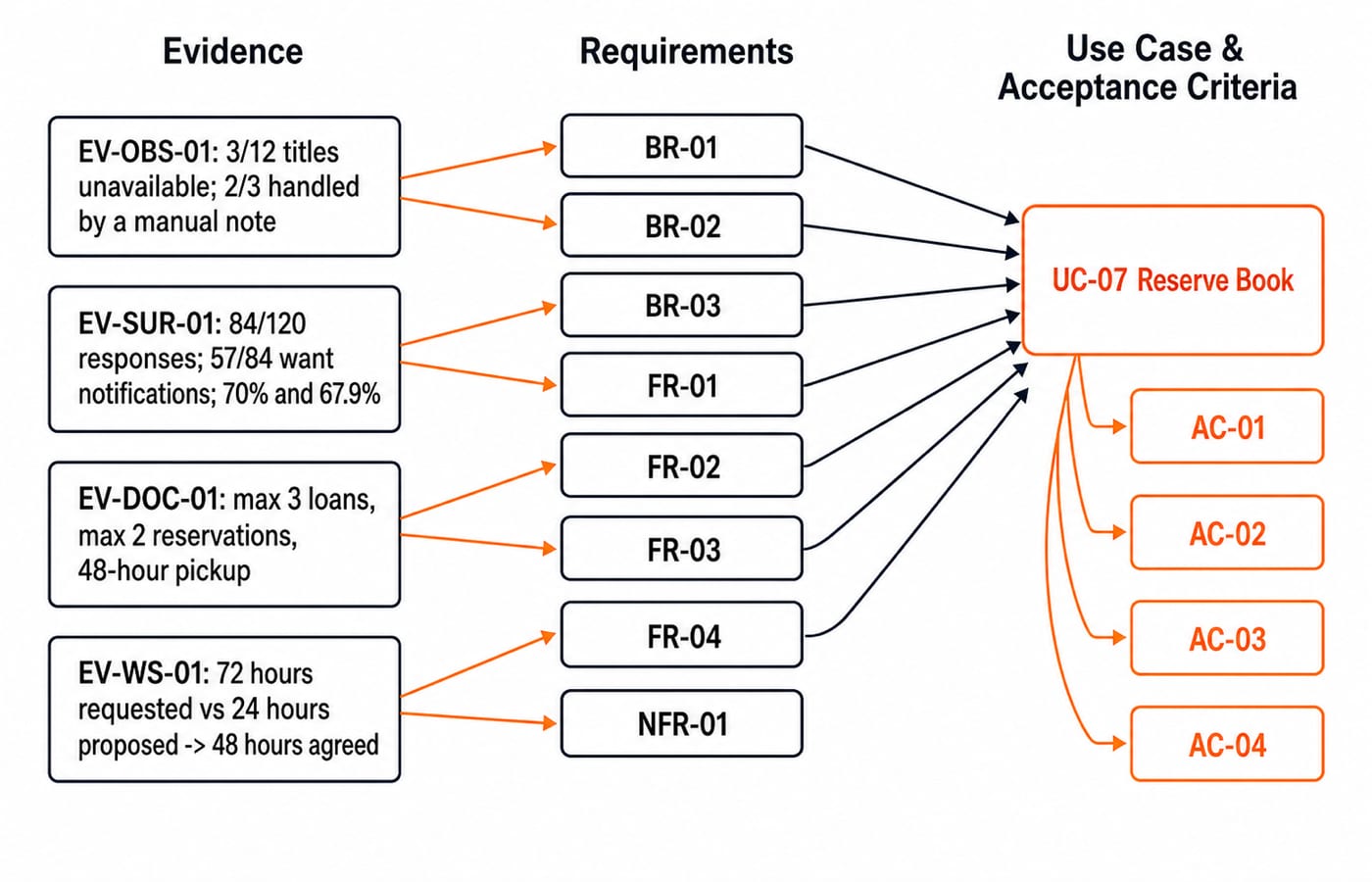
EV-OBS-01: During 12 book-seeking sessions in a 30-minute peak, 3 requested titles had zero copies. Staff manually noted a name in 2 of those 3 cases.
EV-SUR-01: Of 120 invited students, 84 responded and 57 wanted an automatic notification. Response rate = 84 / 120 x 100 = 70%. Respondent preference = 57 / 84 x 100 = 67.9% to one decimal place, not 67.9% of all invitees.
EV-DOC-01: The fictional policy allows at most 3 active loans and 2 active reservations per member, with 48 hours to collect an assigned copy.
EV-WS-01: Students requested 72 hours, the librarian proposed 24 hours, and the workshop retained the documented 48-hour rule.
Derived artefacts are: BR-01, member must be active; BR-02, reservations below 2; BR-03, assignment expires after 48 hours; FR-01, reserve a zero-copy title; FR-02, join after existing reservations; FR-03, show position; FR-04, request notification; NFR-01, display and dispatch within 2 minutes. NFR-01 needs validation.
Artefact | Evidence trace |
|---|---|
BR-01 | EV-DOC-01, active-status wording to confirm |
BR-02, BR-03 | EV-DOC-01; BR-03 also reconciled by EV-WS-01 |
FR-01 | EV-OBS-01 and EV-DOC-01 |
FR-02, FR-03 | EV-OBS-01, queue behaviour to validate |
FR-04 | EV-SUR-01 |
NFR-01 | EV-SUR-01 supports notifications, not the 2-minute threshold |
Worked example, part 2: build the use-case model
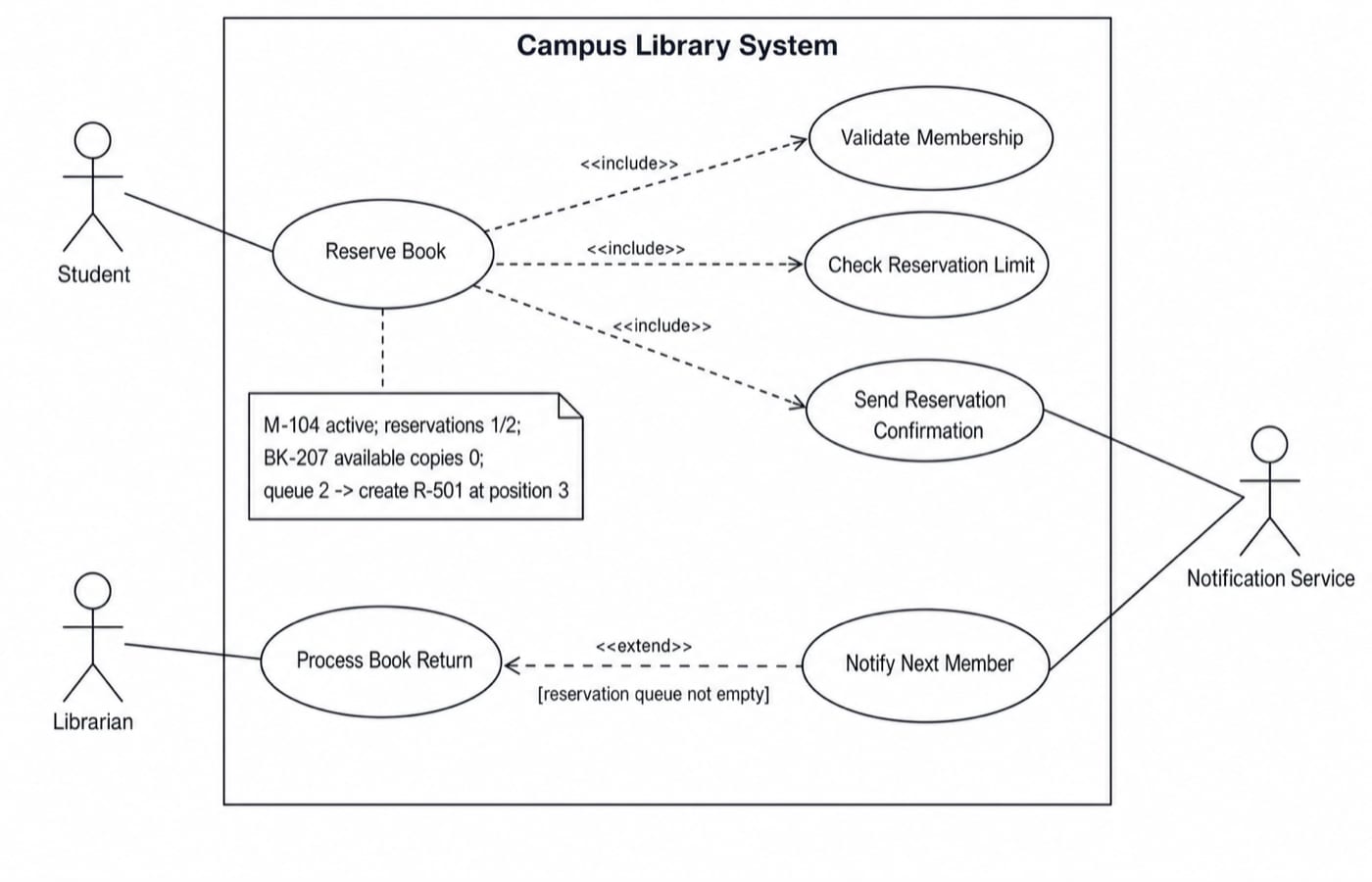
The Campus Library System boundary leaves Student and Librarian outside as human roles, and Notification Service outside as a supporting system. An actor is a role with a goal, not a person, table, screen, or system.
Inside are Reserve Book, Validate Membership, Check Reservation Limit, Send Reservation Confirmation, Process Book Return, and Notify Next Member. Reserve Book uses <<include>> for the three required sub-behaviours. Notify Next Member uses <<extend>> for a non-empty queue; its arrow points to Process Book Return.
Worked example, part 3: specify UC-07
Field | Value |
|---|---|
ID | UC-07 |
Name | Reserve Book |
Scope | Campus Library System |
Level | User goal |
Primary actor | Student |
Supporting actor | Notification Service |
Trigger | Student selects Reserve for BK-207 |
Preconditions | Student authenticated; M-104 active; BK-207 has 0 copies |
Minimum guarantee | Failure changes no count or queue |
Success guarantee | R-501 exists once; member sees position 3 |
Main flow: (1) Student requests BK-207. (2) System validates active M-104. (3) It reads 1 reservation and confirms 1 < limit 2. (4) It confirms 0 copies and queue 2. (5) It creates R-501 at position 3. (6) It displays both. (7) It requests the same Notification Service confirmation, measuring display and dispatch against 2 minutes.
Alternate and exception flows. A2: if M-104 is inactive, the system rejects the request and creates nothing. A3: if the member already holds 2 reservations, it reports the limit reached and leaves the queue unchanged. A4: if BK-207 has 1 copy, it offers normal borrowing instead of wait-listing. E5: if a duplicate request arrives with the same idempotency key, it returns the existing R-501 rather than creating R-502. A step earns a place in these flows only when it changes behaviour, so ordinary clicks stay out.
AC-01: Given active M-104 with 1/2 reservations, BK-207 availability 0, and queue 2, when reserving, then R-501 has position 3.
AC-02: Given count 2/2, when reserving, then create nothing.
AC-03: Given inactive M-104, when reserving, then create nothing.
AC-04: Given assignment at 09:00 on 18 July 2026, when calculating the deadline, then return 09:00 on 20 July 2026, exactly 48 hours later. The date is fictional.
Common traps in elicitation and use cases
Picking a technique out of habit, with no question behind it, collects irrelevant evidence. Start from the uncertainty you actually need to close.
“Fast” and “easy” are untestable. Define a measure.
A named student is not an actor. Model the Student role.
Notification Service inside the boundary hides dependency. Keep it outside.
Reversed relationships change meaning. Point
<<include>>to required behaviour and<<extend>>to its base.Button instructions bind one interface. Describe intent and responsibility.
Calling 57/84 “67.9% of all 120” swaps the denominator. State the base every percentage is taken on.
Changing 48 to 72 hours breaks consistency. Trace rules to approved sources.
In objective questions, one changed word can shift an answer from evidence collection to modelling, or from a functional requirement to a quality target.
How exams can test these concepts
A common question asks which technique fits a situation: observation when reported work differs from actual work, or a workshop when 72 hours and 24 hours have to be reconciled. Others ask you to classify “maximum 2 active reservations” as a business rule, “confirmation within 2 minutes” as a non-functional requirement, mandatory Validate Membership as <<include>>, and conditional Notify Next Member after Process Book Return as <<extend>>.
A numerical question can test the denominator: 84 / 120 x 100 = 70%, while 57 / 84 x 100 = 67.9%. Classification questions test whether a statement is a business rule, functional requirement, or non-functional requirement. Exam pattern and marks still come from the official notification for the applicable cycle.
Short version and the next practice step
Match the technique to the uncertainty.
Keep evidence IDs.
Separate rules, functional requirements, and quality targets.
Define actors and the boundary before relationships.
Test the main and alternate flows with unchanged values.
Use NTA UGC NET Paper 2 for the complete subject sequence, or the NET catalogue to compare related courses and test series.
Keep learning

ICT in Education MCQs: 12 Solved Questions on Digital Learning Tools
Solve 12 ICT in Education MCQs, then use clear explanations and a five-layer model to separate files, tools, platforms and public initiatives.
Updated 3 Oct 20268 min readUGC NET Computer Science
Quality Factors: McCall’s and ISO 9126 Models with a Worked Scoring Example
Build both quality models around one maintainability audit. This guide maps their vocabulary, calculates McCall-style and ISO-style scores, and ends with exam-focused checks.
Updated 25 Sep 20265 min readUGC NET Computer Science
Cohesion and Coupling MCQs: 10 Solved Questions on Functional Independence
Practise 10 solved MCQs on cohesion, coupling, functional independence, module dependencies, and the distinctions that make closely matched options easier to separate.
Updated 24 Sep 20267 min readUGC NET Computer Science
Cryptography and Digital Security Technologies: Encryption, Hashes, Signatures and Mobile Security
Learn what encryption, hashes, MACs and signatures actually guarantee. Follow a full RSA calculation and map layered controls onto a mobile payment path.
Updated 23 Sep 20265 min readUGC NET Computer Science