

E-Waste Management MCQs: 10 Solved Questions with Clear Explanations
E-waste questions mix definitions, lifecycle decisions, hazards and dated rules. Solve ten published MCQs, then audit each choice with a clear explanation.
KnowledgeGate Team
Exam prep & CS education
Updated 14 Nov 20267 min read
E-waste questions look like general awareness, but their options mix three layers: what counts as e-waste, what should happen to it and what unsafe handling releases. Memorising only “reduce, reuse, recycle” can still leave you guessing about refurbishing, lead, informal burning or a historical rule.
These ten questions stay centred on e-waste management. Questions 3 and 6 extend the same reasoning into waste classification and soil pollution, so you also test environmental consequences. Attempt each option before reading its explanation. Use the E-Waste Management PYQ Questions page for further practice, or open UPPSC Polytechnic Lecturer (CS) Preparation for the surrounding course and test routes.
Build an e-waste decision map before solving
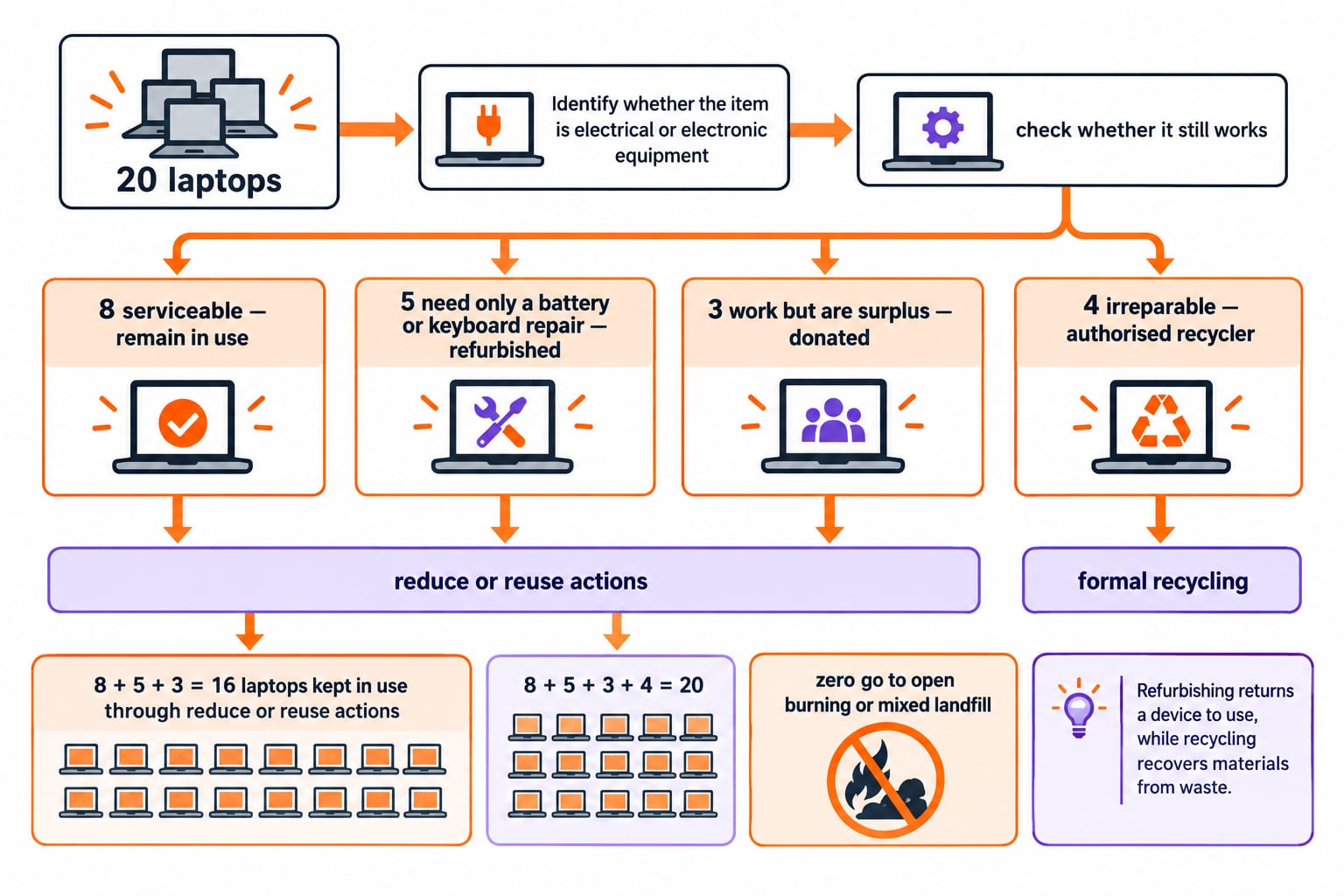
Use four decisions in order. Identify whether the item is electrical or electronic equipment, then check whether it still works. Repair or refurbish equipment that can remain in use. Send only the irreparable remainder to an authorised recycler. Refurbishing returns a device to use, while recycling recovers materials from waste.
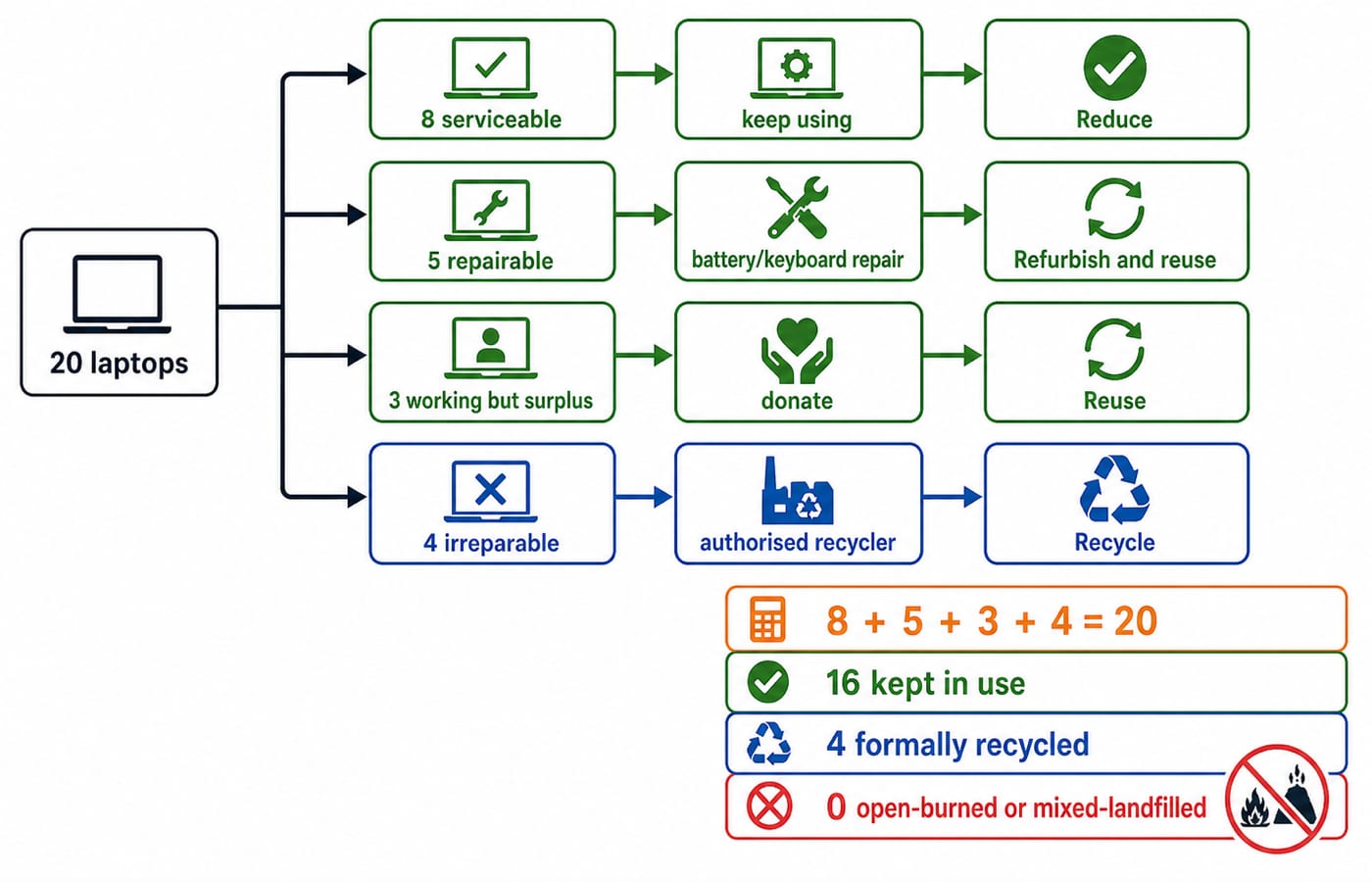
Take an office audit of 20 laptops. Eight are serviceable and remain in use, avoiding premature replacement. Five need only a battery or keyboard repair, so they are refurbished. Three work but are surplus, so they are donated. The remaining four are irreparable and go to an authorised recycler.
The count reconciles as 8 + 5 + 3 + 4 = 20. The first three groups give 8 + 5 + 3 = 16 laptops kept in use through reduce or reuse actions. Four go to formal recycling, and zero go to open burning or mixed landfill.
For the full lifecycle, chain-of-custody records and a 600 kg mass-balance calculation, read E-Waste Management Explained: Lifecycle, Recovery Example and Exam Traps. The 20-laptop audit here serves a different purpose: it is a classification key for the ten MCQs. For structured coverage of the surrounding syllabus, use the UPPSC Polytechnic Lecturer 2025 (CS) Course.
E-waste management MCQs 1-3: definition and classification
Question 1
The term “e-waste” refers to:
A. Electrical shortage
B. Electronic waste
C. Ethical waste
D. Energy waste
Correct answer: B. Electronic waste.
Explanation: The abbreviation expands directly: the e refers to electronic, and the waste is discarded electrical or electronic equipment. A discarded laptop can enter the e-waste stream when it reaches its waste stage. A power cut, by contrast, is an electrical shortage. It affects the supply of electricity but is not a category of physical waste.
Question 2
Irreparable computer and other electronic goods are known as _____ in tech world.
A. Man made waste
B. Natural waste
C. Waste
D. Electronic waste
Correct answer: D. Electronic waste.
Explanation: The word irreparable places the equipment at the waste stage, while computer and other electronic goods identifies the stream as electronic waste. The five repairable laptops are refurbished and returned to use. The four irreparable laptops enter the formal e-waste channel.
Question 3
Which of the following is not considered as a type of e-waste?
A. Televisions
B. Personal Electronic Devices
C. Scanner and Copier
D. Newspaper
Correct answer: D. Newspaper.
Explanation: Related question from the adjacent waste-classification topic. Televisions, personal electronic devices, scanners and copiers have electrical or electronic components and can become e-waste. A newspaper is paper waste, not e-waste. Review the individual solved question after answering it unaided.
E-waste management MCQs 4-5: RRR and refurbishing
Question 4
Which of the following practices supports proper e-waste management?
A. Reduce
B. Reuse
C. Recycle
D. All of the above
Correct answer: D. All of the above.
Explanation: Every option has a role in the audit. Keeping eight serviceable laptops reduces premature replacement. Repairing five and donating three enables reuse. Sending four irreparable units to an authorised recycler enables material recovery. All three actions support the result, so the answer is all of the above. Continued use and repair come before recycling useful equipment.
Question 5
Repairing and reselling used electronic devices is known as:
A. Recycling
B. Refurbishing
C. Reducing
D. Replacing
Correct answer: B. Refurbishing.
Explanation: Refurbishing restores a used device for continued use or resale. It matches the five laptops receiving battery or keyboard repairs. Recycling instead dismantles the four irreparable units to recover materials. Replacing obtains another device, while reducing prevents unnecessary consumption or waste.
E-waste management MCQs 6-7: toxic materials and unsafe burning
Question 6
Which of the following materials found in E-waste is considered a “toxic heavy metal” that can lead to significant soil and groundwater contamination if not disposed of correctly?
A. Aluminium
B. Lead
C. Silica
D. Gold
Correct answer: B. Lead.
Explanation: Related question from the adjacent soil-pollution topic. Lead is the toxic heavy metal among these options. The WHO e-waste fact sheet says informal recycling, storage and dumping can release lead, while unsound handling can contaminate air, soil, dust and water. This supports the key without claiming every other listed material is harmless. Check the individual solved question.
Question 7
What is the primary environmental concern associated with the “informal recycling” or burning of E-waste in open landfills?
A. The release of persistent organic pollutants (POPs) and toxic fumes like dioxins.
B. An increase in the local temperature due to the heat generated by the devices.
C. The depletion of atmospheric nitrogen levels.
D. The creation of magnetic fields that interfere with local wildlife migration.
Correct answer: A. The release of persistent organic pollutants (POPs) and toxic fumes like dioxins.
Explanation: WHO identifies open burning and heating as hazardous because they create toxic fumes, and it includes dioxins among e-waste substances of public-health concern. The other choices miss the primary documented hazard. The audit therefore sends four irreparable laptops to formal recycling and zero to open burning or mixed landfill. See the individual solved question.
E-waste management MCQs 8-10: movement, historical rules and exposure
Question 8
Over half of the e-waste generated in the developed world are exported to developing countries, mainly to _____, where metals like copper, iron, silicon, nickel and gold are recovered during recycling process.
A. Afghanistan
B. Kazakistan
C. UAE
D. India
Correct answer: D. India.
Explanation: India is the answer given for this dated DSSSB 2024 item. The stem's “over half” wording is source text, not a current statistic. WHO states more broadly that e-waste movement to low- and middle-income countries continues, frequently illegally. Recoverable metals have economic value, but do not make unsafe processing acceptable. Review the individual solved question.
Question 9
The E-waste (management) rules 2016 of India, recognizes two broad categories: IT and telecommunication equipment and consumer electrical and electronics including which of the following material?
I. Fluorescent
II. Mercury
A. Only I
B. Only II
C. Both I and II
D. Neither I nor II
Correct answer: C. Both I and II.
Explanation: This is a historical-rules question, not current law. CPCB's 2016 implementation guidelines described two covered categories and included fluorescent and other mercury-containing lamps under consumer electricals and electronics. The question splits that phrase into I and II, so the key is both. For current compliance, the MoEFCC rules register lists the E-Waste (Management) Rules, 2022 and subsequent amendments. See the individual solved question.
Question 10
In E-waste management, from which factors, there comes the exposure variability in electronic waste?
A. Type of E-waste
B. Quantity of the Pollutants in air
C. Management processes of the air pollution
D. Medical waste
Correct answer: A. Type of E-waste.
Explanation: The source grammar is awkward, but its intended distinction is clear. Device types contain different components and potential toxicants, so type changes the exposure profile. WHO also explains that exposure depends on handling and released contaminants. Device type is the best answer among these options, not the only real-world factor. See the individual solved question.
Audit the four traps before counting your score
Trap | Fast distinction |
|---|---|
Device versus waste | A working device remains equipment; an irreparable item enters the waste stream. |
Refurbish versus recycle | Refurbish the |
Hazard versus distractor | Link lead, POPs and dioxins to soil, water and air pathways, not temperature, nitrogen or magnetic-field distractors. |
Historical wording versus current rule | Keep the 2016 question tied to CPCB's historical document; use MoEFCC's register for current rules. |
For any PYQ, separate what the question asks from what you would state as a current fact. First classify the wording as historical or current, then apply the relevant rule or source.
For a 30-second audit, identify the object, choose its lifecycle stage, flag any dated number or rule, then select the option. This stops a familiar word from overriding the precise clue.
Short version and the next practice step
Keep this recall chain: working -> keep/reuse, repairable -> refurbish, irreparable -> authorised recycling, open burning -> toxic exposure risk. Also remember that newspaper is not e-waste, and lead is the toxic heavy metal among the supplied options.
Retry only the questions you missed, this time without looking at the options. Then use the E-Waste Management PYQ Questions route for more practice. Move to the UPPSC Polytechnic Lecturer (CS) Test Series when you want timed exam-style practice. A historical MCQ preserves its source wording, but any present-day regulatory decision must be checked against the current MoEFCC rules register.
Keep learning
E-Waste Management Explained: Lifecycle, Worked Recovery Example and Exam Traps
Learn how e-waste moves from use to reuse, recycling and controlled residue. A hypothetical 600 kg batch shows how to close the mass balance and avoid denominator traps.
Updated 16 Oct 20266 min readUGC NET Computer Science
Noise Pollution and Waste Management for Teaching Exams: UGC NET Paper 1 Notes and Solved Examples
Build reliable Unit 9 concepts with noise-control logic, legal limits, waste segregation, solved decibel and mass-balance examples, and a quick correction table.
Updated 21 Sep 20266 min readCTET & UPTET
Types of Software MCQs: 12 Solved Questions with Clear Explanations
Twelve previous-year MCQs on software types and language translators, from BPSC, KVS, DSSSB, EMRS and UP Police papers. Each answer names the clue, the distractors and the concept to remember.
Updated 30 Oct 20268 min readComputer Organization MCQs
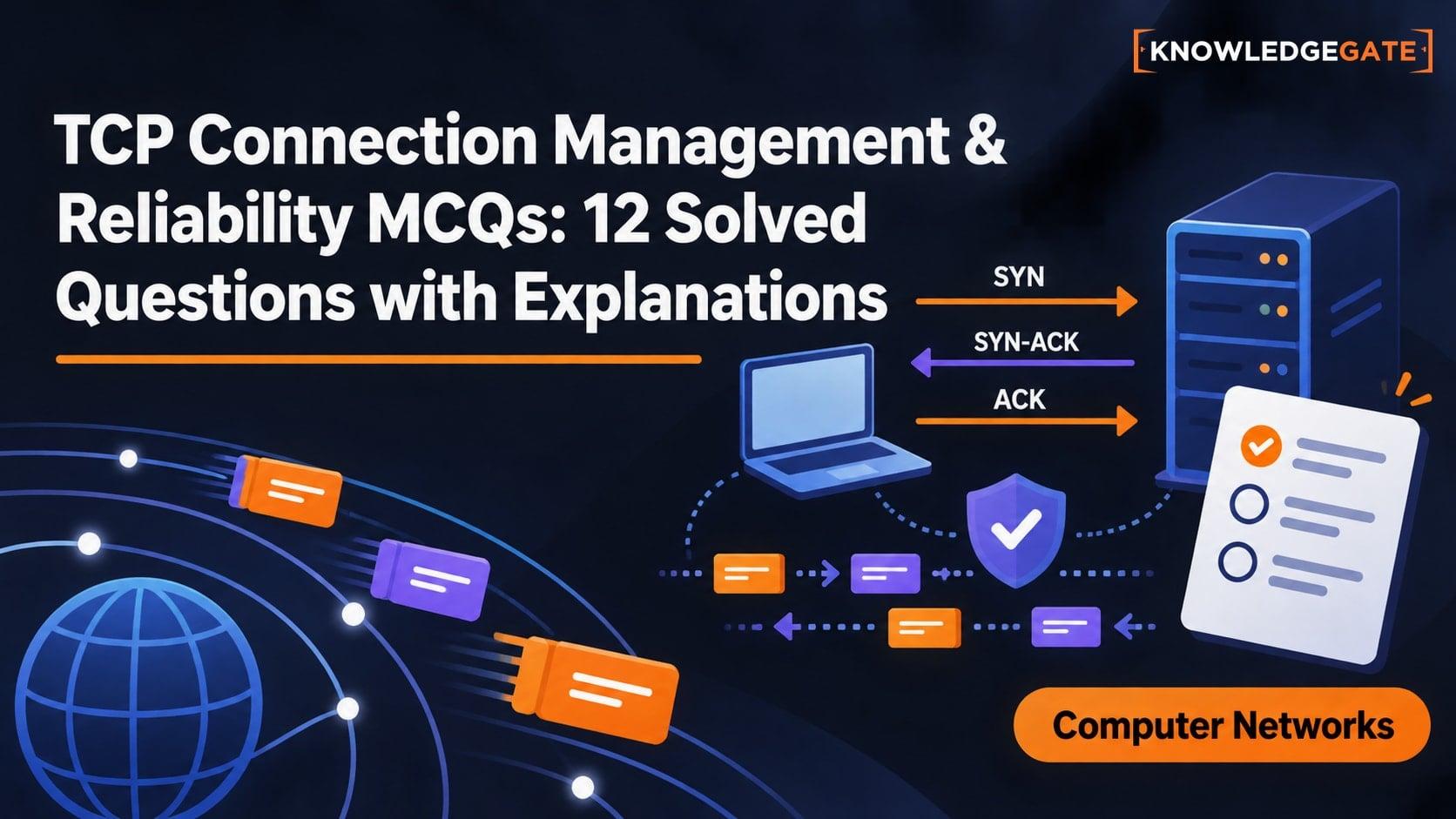
TCP Connection Management & Reliability MCQs: 12 Solved Questions with Explanations
Practise 12 TCP connection management MCQs and MSQs on handshakes, sequence numbers, TIME-WAIT, persist probes, sender windows, resets and SYN floods.
Updated 18 Nov 20268 min readComputer Networks MCQs