

Concept of Growth and Development MCQs: 10 Solved Questions for Teaching Exams
Is becoming taller the same as becoming more capable? Solve ten questions on growth, developmental principles, motor skills and play, then use the explanations to identify your mistakes.
KnowledgeGate Team
Exam prep & CS education
Updated 20 Nov 20267 min read
A child becoming taller and a child becoming more capable illustrate different aspects of development, but MCQ options can make them look interchangeable. These ten questions give you answers and short elimination explanations; attempt each before reading its solution. For further practice, use the Teaching Exams (Classes 1–8) collection on Concept of Growth and Development. This is a conceptual practice set, not an official paper.
Growth and development: the distinction behind the options
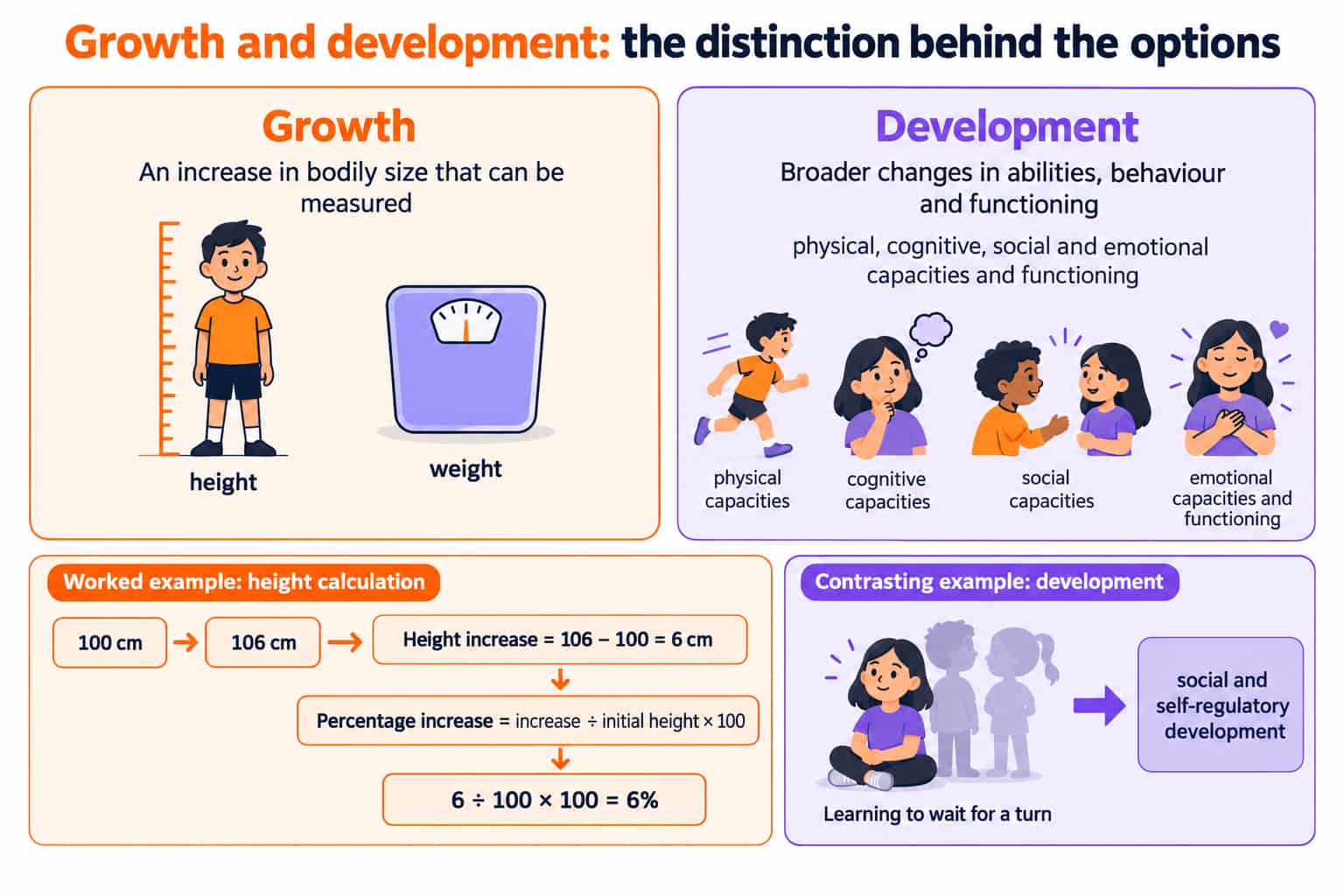
Growth means a measurable increase in bodily dimensions, such as height or weight. Development is broader: it includes changes in physical, cognitive, social and emotional capacities and functioning. Development includes both quantitative and qualitative changes, so “development is only qualitative” is an unsafe shortcut.
Concept | What to look for |
|---|---|
Growth | An increase in bodily size that can be measured |
Development | Broader changes in abilities, behaviour and functioning |
Suppose a child's height changes from 100 cm to 106 cm over 12 months:
Height increase = 106 - 100 = 6 cm.
Percentage increase = increase ÷ initial height × 100.
Substituting the values gives 6 ÷ 100 × 100 = 6%.
Learning to wait for a turn illustrates social and self-regulatory development. The height calculation cannot measure that change.
For the wider foundation, read Child Development for CTET and TET: Notes with Examples before returning to the options.
Questions 1–2: growth and characteristics of development
Q1. Growth of a child is mainly related to
(a) Moral Development
(b) Social Development
(c) Physical Development
(d) Emotional Development
Answer: (c) Physical Development. Growth concerns measurable physical increase, such as the 6 cm height gain calculated above. Social development may make a child more capable in groups, but it does not describe an increase in bodily size. Moral and emotional changes also belong to wider development. Remember that physical development includes changes in coordination and control as well as growth.
Use the growth versus development worked answer to revisit this distinction.
Q2. Which of the following is not a characteristic of development?
(a) To be cumulative.
(b) To be Directional.
(c) To proceed from general to specific.
(d) To be uncontrolled and independent.
Answer: (d) To be uncontrolled and independent. Notice not: you need the exception. Development is cumulative because later abilities build on earlier ones, and it follows recognisable directions and general-to-specific progressions. Option (b) can tempt readers who confuse direction with a rigid timetable. Patterned development does not mean every child develops at the same speed; it is shaped by interacting biological and environmental influences.
Questions 3–4: sequence and direction
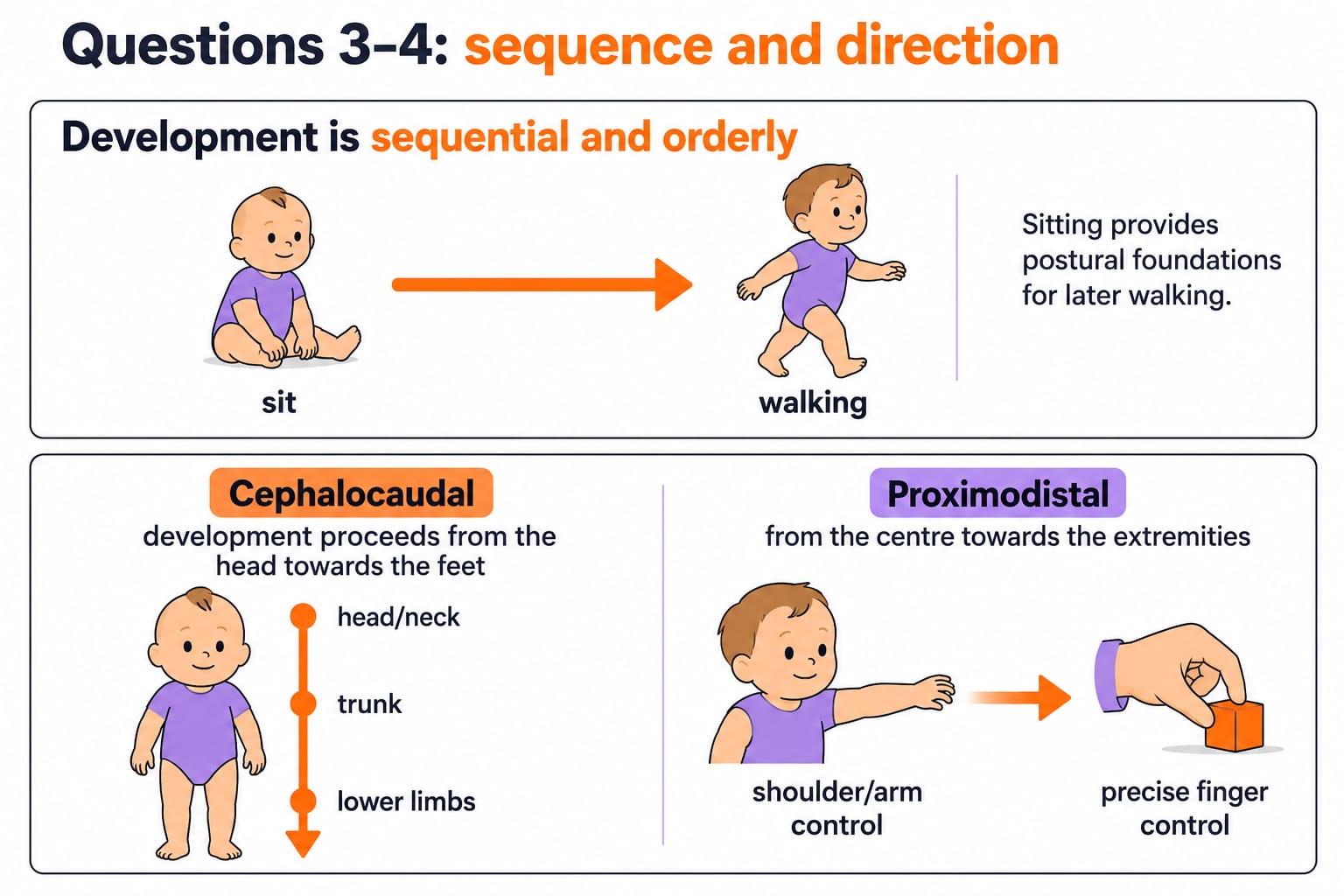
Q3. Which principle explains why a child first learns to sit before walking?
(a) Development occurs continuously
(b) Development varies across individuals
(c) Development depends on experience
(d) Development is sequential and orderly
Answer: (d) Development is sequential and orderly. The clue is “before”: the question asks about order. Sitting provides postural foundations for later walking. Continuity, option (a), describes ongoing change, but does not identify the sequence being tested. Individual variation concerns differences between children, while experience concerns an influence on development.
Q4. Growth and development usually follow a pattern from head to toe. What is this principle called?
(a) Proximodistal
(b) Cephalocaudal
(c) Sequential
(d) Differentiation
Answer: (b) Cephalocaudal. This means development proceeds from the head towards the feet: head/neck → trunk → lower limbs. Proximodistal development proceeds from the centre towards the extremities, illustrated by shoulder/arm control → precise finger control.
Option (c) describes order generally, but the stem names a particular anatomical direction. Differentiation means increasing specialisation. In the growth and development module (question page unavailable), focus on the direction named in the stem before selecting the term.
Questions 5–8: fine and gross motor development
Q5. Which activity best demonstrates the development of fine motor skills in children?
(a) Threading beads
(b) Running
(c) Climbing stairs
(d) Hopping
Answer: (a) Threading beads. A child must grasp a bead, align its hole with a cord and guide the cord through. That demands precise finger movement and hand-eye coordination. Climbing stairs also requires coordination, which makes it a plausible distractor, but its principal demand is large-muscle movement and balance. Running and hopping also belong mainly to gross motor activity.
Q6. Which of the following is an example of a gross motor skill in children?
(a) Listening
(b) Buttoning a shirt
(c) Jumping
(d) Drawing
Answer: (c) Jumping. Jumping uses large muscle groups to propel and land the whole body. Buttoning a shirt and drawing involve movement too, but their defining demand is precise hand control. Listening is primarily a receptive auditory activity.
Apply one rule across both questions: precise finger manipulation points to fine motor skills; large-muscle whole-body movement points to gross motor skills. Classify the principal demand, since an activity can involve several abilities together.
Q7. In planning physical activities for young children, why is it important to include both gross and fine motor tasks?
(a) To boost emotional and social growth
(b) To improve balance and coordination only
(c) To enhance communication and language skills
(d) To support overall physical development
Answer: (d) To support overall physical development. Children need opportunities for both large-muscle movement and precise small-muscle manipulation. Option (b) is attractive because balance and coordination matter, but “only” makes it too narrow. Social, emotional and language gains can occur during activities; they do not answer this physical-planning question most directly.
Consider a hypothetical classroom activity block:
Supervised jumping and balance activities: 6 minutes, principally gross motor control.
Button-board practice: 6 minutes, principally fine motor control.
Total activity time = 6 + 6 = 12 minutes.
The two tasks serve complementary purposes.
Q8. Which skill is an example of fine motor development in early childhood?
(a) Buttoning a shirt
(b) Shouting
(c) Climbing
(d) Running
Answer: (a) Buttoning a shirt. The thumb and index finger grasp and turn a button through its hole. Transfer the bead-threading rule here: precision is the clue. Climbing and running mainly use large muscle groups; shouting is not the intended fine-motor category.
Questions 9–10: childhood and purposeful play
Q9. The concept of childhood is
(a) universally the same across different cultural contexts.
(b) a social construction according to contemporary socio-constructivist theorists.
(c) that children are born evil and have to be civilized.
(d) that children begin with nothing at all and their characteristics are shaped entirely by environment.
Answer: (b). Contemporary socio-constructivist theorists view childhood as socially constructed: expectations about children's roles and experiences differ across contexts. Option (d) may seem close because it mentions environment, but “entirely” wrongly excludes other influences. Universal sameness and the claim of innate evil also fail to express this perspective.
Q10. A curriculum developer aims to foster higher-order thinking skills and self-regulation in children by including activities that require planning and adapting strategies based on changing group dynamics. Which type of play should be emphasized to achieve these goals, and why is it most suitable?
(a) Constructive play
(b) Games with rules
(c) Functional play
(d) Parallel play
Answer: (b) Games with rules. Children must remember shared constraints, wait, plan, monitor outcomes and adapt to others. These demands connect strategic thinking with self-regulation.
Constructive play can involve planning, making (a) the strongest distractor. However, changing group dynamics and shared constraints make games with rules the better match. Functional play centres on repeated actions; parallel play involves children playing alongside one another with limited coordination. Revisit the growth and development module (question page unavailable) to practise choosing the best fit rather than any educationally useful activity.
Check your answers and diagnose the error
Answer key: 1 (c), 2 (d), 3 (d), 4 (b), 5 (a), 6 (c), 7 (d), 8 (a), 9 (b), 10 (b).
If you answer 7 of 10 correctly, accuracy = 7 ÷ 10 × 100 = 0.7 × 100 = 70%. Suppose your three errors are Q2, Q4 and Q10. Record them specifically:
Question | Error to correct |
|---|---|
Q2 | Missed negative stem |
Q4 | Confused developmental direction |
Q10 | Missed shared-rule cue |
Use CTET CDP: High-Yield Concepts & Theorists for targeted revision, then reattempt those three questions. An error label tells you what to revise more clearly than the total alone.
Turn this set into the next practice session
Set aside 15 minutes: 5 minutes reviewing the three error explanations, 5 minutes reattempting without the key, and 5 minutes explaining why you rejected the strongest distractor. Total = 5 + 5 + 5 = 15 minutes. If you made no errors, use the same routine for Q4, Q7 and Q10.
Say the deciding clue aloud: direction, overall physical development, or shared rules. This checks whether you understand the answer beyond remembering its letter.
If you are choosing a preparation route, explore CTET & UPTET Teaching Eligibility Test Prep. For structured study focused on that paper, consider the UPTET Paper 1 course alongside your revision and question practice.
Go deeper with the full courseCTET Paper 1 2026 — प्राथमिक शिक्षक (कक्षा 1–5)
Keep learning
Child Development for Teaching Exams: CTET and TET Pedagogy Notes with Examples
Build a usable concept map of child development, then apply it to classroom evidence through examples, assessment choices and a worked fraction case.
Updated 30 Oct 20266 min read98 viewsCTET & UPTET
Personality Development for CTET and Teaching Exams: Complete Notes with Solved Examples
Build exam-ready personality notes from type and trait theories to Freud, Erikson, humanistic views and assessment. Then apply them to classroom cases and MCQs.
Updated 24 Jul 20265 min readCTET & UPTET
Communication Models for Teaching Exams: 10 Models with Worked Classroom Examples
Learn the major linear, interactive and transactional communication models through one classroom situation, compact comparisons and solved exam-style prompts.
Updated 30 Jul 20266 min read61 viewsCTET & UPTET

Web Development Project Ladder: 3 Portfolio Builds with Review Gates
Move from a responsive event page to a persistent React tracker and a role-aware full-stack review board. Each four-week block ends in evidence, scoring, and repair.
Updated 19 Nov 20265 min readWeb Development