

SDLC and Development Approaches in System Analysis and Design: Models, Selection Rules, and a 16-Week Worked Example
Learn how analysis, design, traceability, and major SDLC models fit together. Then use project conditions and risk exposure to plan a 16-week examination portal.
KnowledgeGate Team
Exam prep & CS education
Updated 6 Nov 20265 min read
A memorised SDLC phase list does not show why Waterfall, V-model, prototyping, Spiral, Agile, and DevOps differ, or how to choose. The approaches differ in how they handle sequence, feedback, risk, and release, as shown by the college examination portal example.
SDLC in system analysis and design: lifecycle, model, and methodology
The systems development life cycle governs an information system from problem recognition to retirement. A process model orders activities; a methodology supplies practices, roles, and artefacts. The lifecycle tells us what work exists; the model tells us when; the methodology tells us how.
Textbooks may merge or rename these eight activities:
Preliminary investigation and planning
Feasibility study
Requirements analysis
Logical and physical design
Implementation
Verification and validation
Deployment or conversion
Operation and maintenance
Feedback and change control make this a lifecycle, not a checklist. Place it in the wider syllabus through GATE CS Exam Preparation.
System analysis and system design: questions, artefacts, and traceability
System analysis asks what problem must be solved and why. It covers scope, stakeholders, functional and non-functional requirements, constraints, and TELOS feasibility: technical, economic, legal, operational, and schedule. Outputs include a scope statement, context diagram or DFDs, use cases, data dictionary, feasibility note, prioritised requirements, and SRS.
System design asks how approved requirements will be realised. Logical design covers processes, data flows, entities, and controls. Physical design chooses architecture, database schemas, interfaces, UI, deployment, security, backup, and recovery. Implementation, testing, conversion, and maintenance follow.
Traceability connects them. R17, "A candidate can download the hall ticket only after payment is confirmed," maps to UC-07, PaymentService, HallTicketService, and acceptance test T-42. A later admin-fee-waiver change must trigger an impact check across every record, not an isolated code edit.
SDLC development approaches: predictive, iterative, incremental, and adaptive
Model or approach | Core flow | Strong fit | Main limitation |
|---|---|---|---|
Waterfall | Sequential phase gates | Stable requirements | Late change is costly |
V-model | Stages paired with test levels | Early test planning | Rigid under change |
Iterative | Revisit and improve | Repeated learning | Full scope arrives later |
Incremental | Release usable slices | Independent feature value | Integration needs planning |
Prototyping | Build to clarify uncertainty | Unclear interaction | Rough code may be misused |
Spiral | Objective, risk, build, evaluate, plan loops | High technical risk | Needs risk-analysis skill |
RAD | Time-boxed component construction | Modular scope and available users | Weak for tight coupling |
Agile | Short adaptive iterations | Frequent reprioritisation | Needs active feedback |
DevOps | Automate delivery and operations feedback | Repeatable releases | Does not replace the lifecycle |
An iteration improves a slice; an increment adds usable scope. A throwaway prototype answers a question and is discarded; an evolutionary prototype is hardened. Each Spiral loop sets objectives, analyses risk, develops, evaluates, and plans.
In the V-model, verification checks a work product against its predecessor, such as design against the SRS. Validation checks the running system against user needs, such as T-42 against UC-07.
Choosing an SDLC model from project conditions
Project condition | Initial choice |
|---|---|
Stable, regulated requirements | Predictive phase-gated model |
Early test planning | V-model |
Unclear user interaction | Prototyping |
High technical or integration risk | Spiral |
Independently valuable functions | Incremental |
Frequent reprioritisation with user feedback | Agile |
Repeatable deployment and production feedback | DevOps practices around the chosen process |
Also assess stability, late-change cost, early-software need, user availability, compliance, integration, release frequency, and team maturity. In a hybrid, each practice must solve a named condition. Link conditions to model features and acknowledge limitations.
SDLC worked example: a 16-week college examination portal
A six-person team has 16 weeks and 48 requirements: 30 stable, 12 likely to change after staff feedback, and 6 technically high-risk. The non-stable set is 12 + 6 = 18, and 18 / 48 x 100 = 37.5%. One frozen specification and a late release fit poorly, but the stable core supports usable increments.
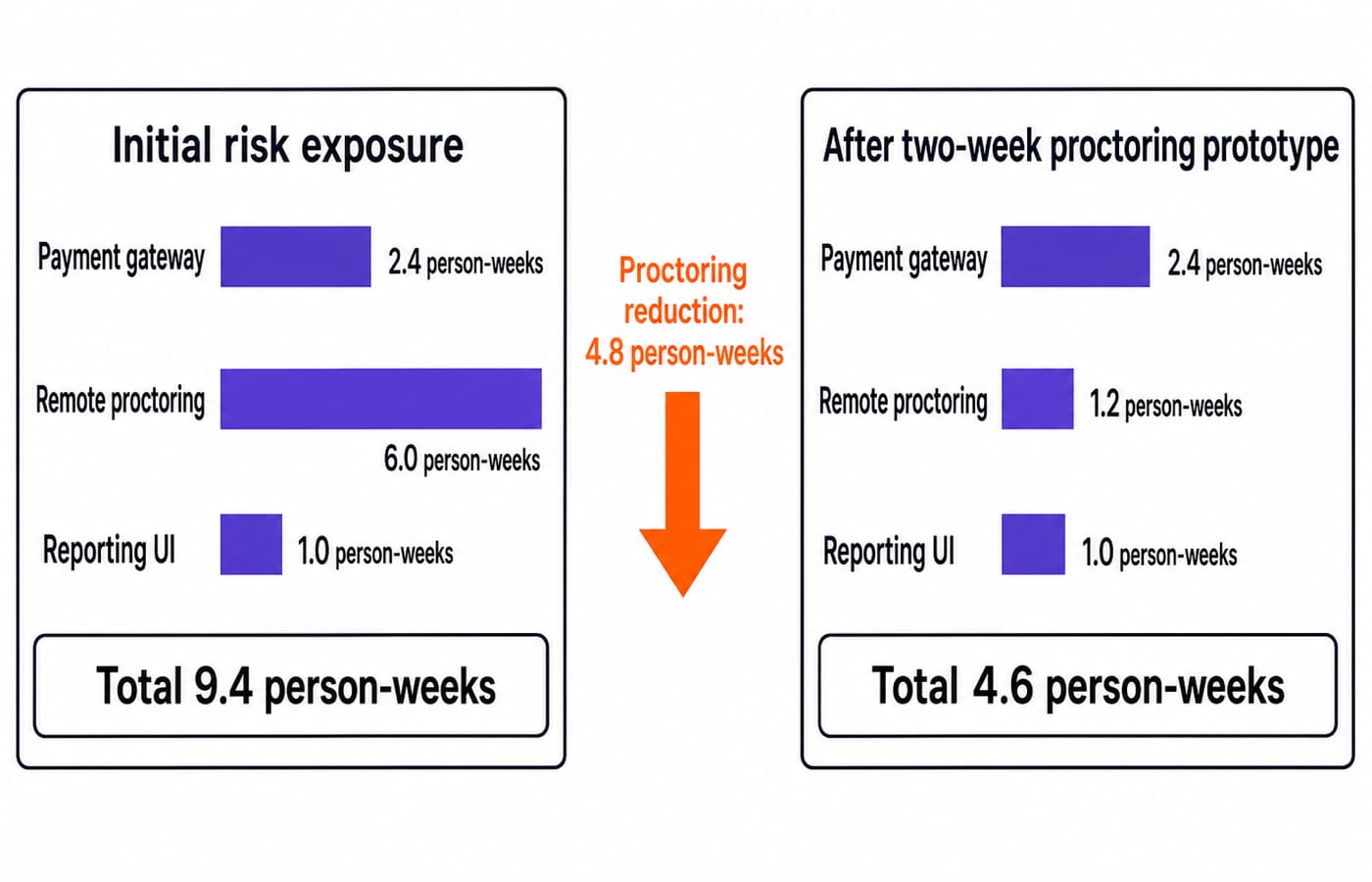
Risk exposure is probability x impact in person-weeks:
Payment-gateway failure:
0.30 x 8 = 2.4person-weeks.Remote-proctoring integration:
0.50 x 12 = 6.0person-weeks.Reporting-UI misunderstanding:
0.20 x 5 = 1.0person-week.Total initial exposure:
2.4 + 6.0 + 1.0 = 9.4person-weeks.
Remote proctoring ranks first. Prototype evidence lowers its estimated failure probability from 0.50 to 0.15 and its estimated impact from 12 to 8 person-weeks. Its revised exposure is 0.15 x 8 = 1.2 person-weeks. The new total is 2.4 + 1.2 + 1.0 = 4.6; the reduction is 9.4 - 4.6 = 4.8 person-weeks. Expected risk guides a decision, it does not promise saved effort.
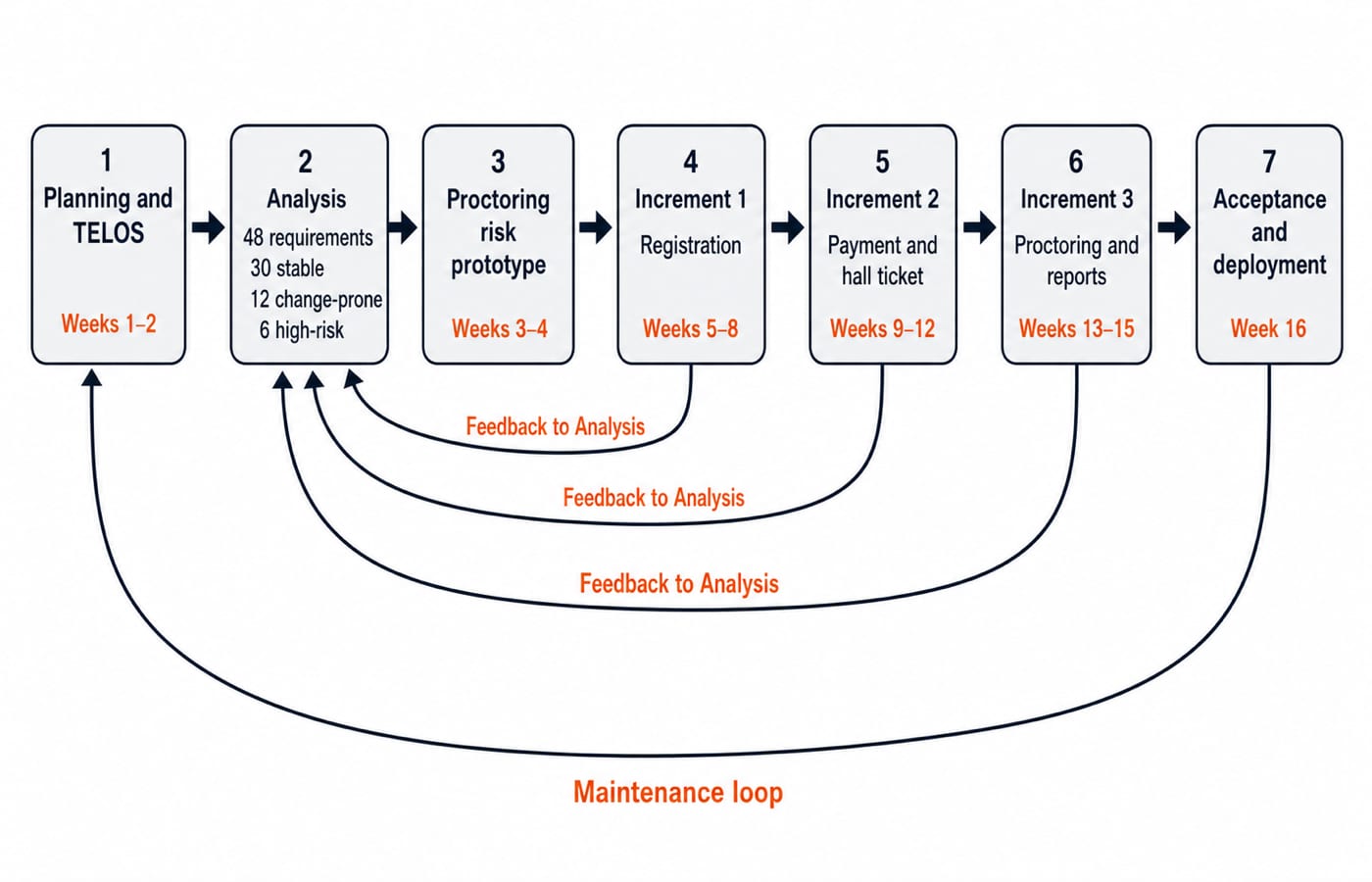
A Spiral-plus-incremental hybrid gives this calendar:
Weeks | Work |
|---|---|
1-2 | Planning, TELOS feasibility, scope, and requirements baseline |
3-4 | Proctoring risk prototype |
5-8 | Increment 1: registration |
9-12 | Increment 2: payment confirmation and hall-ticket generation |
13-15 | Increment 3: proctoring and reports |
16 | Acceptance, conversion, and deployment |
Each increment feeds findings into the backlog. Any R17 change is traced through UC-07, both services, and T-42.
SDLC traps: similar terms and wrong shortcuts
Wrong shortcut | Correct reasoning |
|---|---|
Iterative means incremental | Iteration improves; an increment adds usable scope |
Every prototype is a release | Throwaway prototypes are discarded; increments are usable |
Spiral means repeat until done | Every loop has objectives and risk analysis |
V-model is Waterfall | V-model pairs work products with test levels |
Verification means acceptance | Verification checks artefacts; validation checks user need |
Logical equals physical design | Logical models; physical chooses implementation |
Maintenance only fixes faults | Corrective fixes, adaptive responds, perfective improves, preventive protects |
Agile still plans and documents, but closer to changing work. DevOps retains analysis, design, and testing while shortening development and operations feedback.
Pure Waterfall ignores 18 non-stable requirements. Choosing Spiral because the project seems "large" ignores the 6.0 person-week exposure. Prototyping every module wastes effort on 30 stable requirements.
GATE-style questions and interviews on SDLC approaches
Questions ask you to arrange phases or artefacts, match scenarios to models, distinguish paired concepts, or rank risk exposure. Here, proctoring starts highest at 6.0 person-weeks, then falls below payment because 1.2 < 2.4.
In an interview, state volatility, rank risk, choose feedback cadence, name artefacts, then explain testing and change control. Here: prototype proctoring, deliver stable scope incrementally, and trace R17 through T-42.
For SDD structure, requirement-to-design traceability, test documentation, and QA metrics, continue with the live exam hub for related study. This post owns lifecycle sequencing and model selection. Use GATE CS Subject Weightage: Where Hours Pay Off for revision-priority context.
SDLC and development approaches: the short version
Use this five-step decision ladder:
Define the problem and test TELOS feasibility.
Baseline requirements and create traceability.
Classify requirement stability, technical risk, and feedback needs.
Select or combine models for named reasons.
Validate each increment and control change through maintenance.
For this portal, a risk-first Spiral loop followed by usable increments beats one late release. For the full sequence, use GATE Guidance by Sanchit Sir. For practice, use the GATE Test Series. If you only need this concept, redraw both diagrams and justify the choice.
Go deeper with the full courseGATE Guidance by Sanchit Sir
Keep learning
Software Development Life Cycle MCQs: 12 Solved Questions on SDLC Stages
Solve 12 published SDLC MCQs with direct explanations, stage cues, and a worked campus clinic portal that connects requirements, design, testing, and maintenance.
Updated 17 Nov 20267 min readUGC NET Computer Science
Software Engineering Basics Explained: SDLC, Process Models and Worked Example
Learn how software engineering extends beyond coding, how major process models differ, and how to choose and apply one in a constructed student portal project.
Updated 30 Oct 20266 min readUGC NET Computer Science
Software engineering for CS teaching exams: SDLC, models and testing
The software engineering spine for TGT and PGT computer science papers: the SDLC phases in order, waterfall vs spiral vs agile, functional and non-functional requirements, cohesion and coupling, and the four testing levels.
Updated 18 Jul 20265 min read64 viewsUGC NET Computer Science
System Analysis and Design for GATE: What the CS Syllabus Includes and What to Skip
Audit System Analysis and Design against the official GATE CS syllabus, keep examinable overlaps in their proper subjects, and redirect study time with two worked examples.
Updated 12 Nov 20264 min readGATE Strategy & Roadmap