Table given below shows ratio of books to pens sold by four different shops…
2021
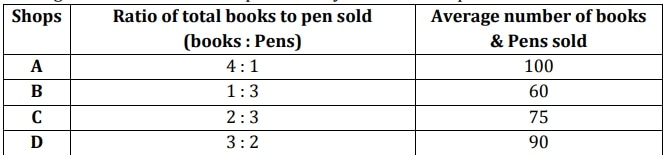
Table given below shows ratio of books to pens sold by four different shops and it also shows average number of books and pens sold by these four shops.
Total books sold by shop B is what percent less than total pens sold by shop C?
Answer: D. 66 2/3 % — ConceptIn a part-to-part ratio with a known average of the two parts, the total of the two parts equals the average multiplied by 2. Each part is then the…
- A.
63 2/3 %
- B.
33 1/3 %
- C.
60 2/3 %
- D.
66 2/3 %
- E.
66 1/3 %
Attempted by 4 students.
Show answer & explanation
Correct answer: D
Concept
In a part-to-part ratio with a known average of the two parts, the total of the two parts equals the average multiplied by 2. Each part is then the total split in the ratio. To express how much smaller one quantity X is than another quantity Y, the percent-less is computed on the LARGER (reference) quantity Y: percent less = ((Y − X) / Y) × 100.
Application
Shop B: books : pens = 1 : 3, average of books and pens = 60, so total = 60 × 2 = 120. Books in B = (1 / (1+3)) × 120 = (1/4) × 120 = 30.
Shop C: books : pens = 2 : 3, average of books and pens = 75, so total = 75 × 2 = 150. Pens in C = (3 / (2+3)) × 150 = (3/5) × 150 = 90.
Reference quantity is pens in C = 90 (the larger), compared quantity is books in B = 30. Percent less = ((90 − 30) / 90) × 100 = (60 / 90) × 100.
(60 / 90) × 100 = (2/3) × 100 = 200/3 = 66 2/3 %.
Cross-check
Since books in B (30) is exactly one-third of pens in C (90), it is two-thirds less than 90, i.e. 66 2/3 % less — consistent with the step-by-step result. Note the base of the percentage is pens in C (90), not books in B; dividing by 30 instead would answer a different question.