Read the information and answer the following questions. The table shows the…
2023
Read the information and answer the following questions.
The table shows the number of males working in private and public companies and number of females working in private and public company in four (A, B, C & D) different cities.
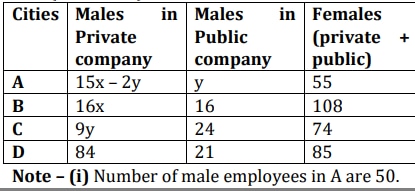
Note –
(i) Number of male employees in A are 50.
(ii) Total males working in private company from B and C are 154.
(iii) Total employees (male + female) working in any city = private companies + public company (iv) Males/females working in any city = Sum of males/females working in private and public company.
Average number of male employees in C and F is 200. 80% out of the total employees (private and public) from city F are females. Find the total employees in F is how much more/less than 100y.
Answer: D. 430 — When a data-interpretation table gives two linear relationships involving unknowns, solve them simultaneously to fix every unknown first. Any additional…
- A.
360
- B.
400
- C.
410
- D.
430
- E.
420
Attempted by 4 students.
Show answer & explanation
Correct answer: D
When a data-interpretation table gives two linear relationships involving unknowns, solve them simultaneously to fix every unknown first. Any additional entity not shown in the table (like city F here) can still be found from extra conditions stated only in the question stem — such as an average with another city's value, or a percentage split of male/female employees within it.
From the table, total males in city A = (15x − 2y) + y = 15x − y. Note (i) gives this total as 50, so 15x − y = 50.
Note (ii) gives the private-company males of B and C together: 16x + 9y = 154.
Solving the two equations together gives x = 4 and y = 10.
Total males in city C = 9y + 24 = 90 + 24 = 114.
The average of the male employees in C and F is 200, so their combined total is 2 × 200 = 400; hence males in F = 400 − 114 = 286.
Females are 80% of F's total employees, so males (the remaining 20%) correspond to 286; total employees in F = 286 ÷ 0.20 = 1430.
100y = 100 × 10 = 1000.
Total employees in F exceeds 100y by 1430 − 1000 = 430.
As a check, note (i) states males in A are 50; substituting x = 4, y = 10 gives (15×4 − 2×10) + 10 = (60−20)+10 = 50, confirming the values of x and y used throughout.
So the total employees in city F are 430 more than 100y.