Q125. Find the difference between the number of non-graduate people in A and D…
2025
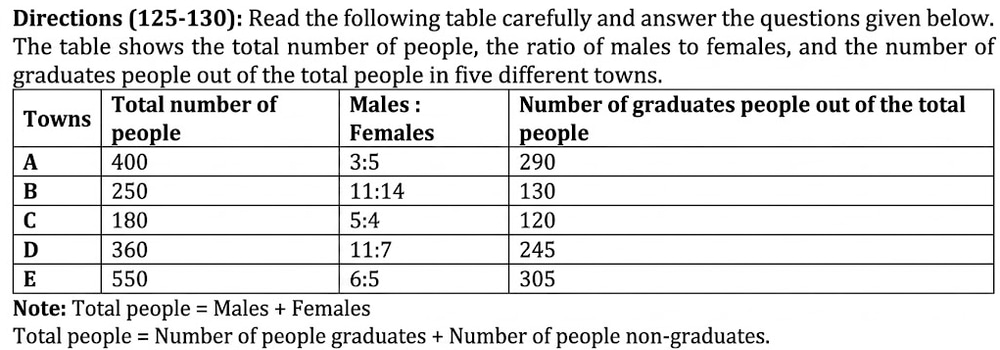
Q125. Find the difference between the number of non-graduate people in A and D together and the number of females in E.
Answer: A. 25 — ConceptIn a data-interpretation table, two standard sub-results are needed here. First, non-graduates = total people − graduates, since every person is either…
- A.
25
- B.
20
- C.
35
- D.
40
- E.
45
Attempted by 4 students.
Show answer & explanation
Correct answer: A
Concept
In a data-interpretation table, two standard sub-results are needed here. First, non-graduates = total people − graduates, since every person is either a graduate or a non-graduate. Second, a gender count from a ratio = (that gender's ratio part ÷ sum of ratio parts) × total people. To find the difference between two quantities, compute each one independently first, then subtract the smaller from the larger.
Application
Non-graduates in A = total − graduates = 400 − 290 = 110.
Non-graduates in D = total − graduates = 360 − 245 = 115.
Non-graduates in A and D together = 110 + 115 = 225.
Females in E: the male-to-female ratio is 6 : 5, so females = (5 ÷ 11) × 550 = 250.
Required difference = |225 − 250| = 25.
Cross-check
Graduates in A and D = 290 + 245 = 535; total in A and D = 400 + 360 = 760, so non-graduates = 760 − 535 = 225. This matches step 3.
Males in E = (6 ÷ 11) × 550 = 300, so females = 550 − 300 = 250. This matches step 4.
Hence the difference is 250 − 225 = 25.