Read the information and answer the following question. The table shows the…
2023
Read the information and answer the following question.
The table shows the number of males working in private and public companies and the number of females working in private and public companies in four (A, B, C and D) different cities.
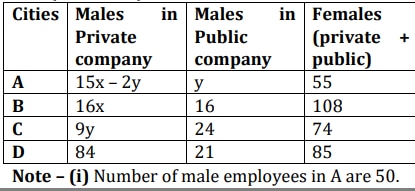
Note:
(i) Number of male employees in A is 50.
(ii) Total males working in private companies from B and C is 154.
(iii) Total employees (male + female) working in any city = private company + public company.
(iv) Males/females working in any city = sum of males/females working in private and public companies.
(v) 50% of the total females work in private companies across all the cities.
Find the total employees (male + female) working in public companies across all the cities.
Answer: D. 232 — ConceptIn a data-interpretation table that uses unknowns, first translate every stated condition into a linear equation, solve for the unknowns, and only then…
- A.
297
- B.
250
- C.
255
- D.
232
- E.
231
Attempted by 2 students.
Show answer & explanation
Correct answer: D
Concept
In a data-interpretation table that uses unknowns, first translate every stated condition into a linear equation, solve for the unknowns, and only then read each cell as a number. A '50% in private' condition means the females split exactly in half: private females equal public females, each being half of the grand female total. The total working in public companies is simply the sum of all 'public' males and all 'public' females.
Setting up the equations
Let the table unknowns be x and y. Two conditions are given:
Males in A: private (15x − 2y) + public (y) = 50, which simplifies to 15x − y = 50.
Males in private from B and C: 16x + 9y = 154.
Solving
From 15x − y = 50, write y = 15x − 50.
Substitute into 16x + 9y = 154: 16x + 9(15x − 50) = 154.
16x + 135x − 450 = 154, so 151x = 604, giving x = 4.
Then y = 15(4) − 50 = 10.
Reading the public columns
Public-company males by city: A = y = 10, B = 16, C = 24, D = 21, so the public-male total is 10 + 16 + 24 + 21 = 71.
Female totals (private + public) by city: A = 55, B = 108, C = 74, D = 85, giving a grand female total of 322. Since 50% of females work in private companies, the public-company females are the other half, 322 ÷ 2 = 161.
Result
Total employees in public companies = public males + public females = 71 + 161 = 232.
Cross-check
Verify the constraints with x = 4, y = 10: males in A = (15·4 − 2·10) + 10 = (60 − 20) + 10 = 40 + 10 = 50 ✓; private males from B and C = 16·4 + 9·10 = 64 + 90 = 154 ✓. Both stated conditions hold, confirming 232.