Directions : Read the data carefully and answer the questions. Some data are…
2019
Directions : Read the data carefully and answer the questions. Some data are missing which you have to calculate as per information provided in the questions.
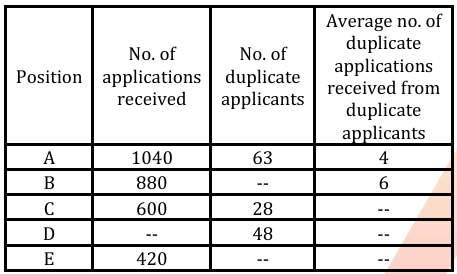
NOTE:- A duplicate applicant is an applicant who has submitted additional (duplicate) application after submitting their original application. All application forms (original + duplicate) received from duplicate applicant were rejected. Remaining all application were accepted. None of the applicants applied for more than one post.
For position D, if respective ratio of accepted & rejected applications is 4 : 1. Which of the following can be true? (average number of duplicate applications received for D is a non – zero integer)
A. no. of applications received for D (all original + all duplicate) can be 240.
B. no. of applications accepted for D can be 768.
C. least no. of applications (all original + all duplicate) were received for D is a possibility.
Answer: E. only B — ConceptA duplicate applicant submits one original form plus some duplicate forms, and every form they submit (the original and all its duplicates) is…
- A.
only B & C
- B.
None of these
- C.
only C
- D.
only A & C
- E.
only B
Attempted by 4 students.
Show answer & explanation
Correct answer: E
Concept
A duplicate applicant submits one original form plus some duplicate forms, and every form they submit (the original and all its duplicates) is rejected; genuine single applications are accepted. If a position has d duplicate applicants and the average number of duplicate forms per such applicant is x, then the rejected forms are R = d(x + 1) — the +1 being each duplicate applicant's own original. Here x must be a non-zero positive integer.
Application to position D
For D the table gives d = 48 duplicate applicants, and the accepted : rejected ratio is 4 : 1.
Rejected forms: R = 48(x + 1).
Accepted : Rejected = 4 : 1, so Accepted = 4R = 192(x + 1).
Total received = Accepted + Rejected = 5R = 240(x + 1).
Testing each claim
Claim A — total received = 240: 240(x + 1) = 240 forces x + 1 = 1, i.e. x = 0. Because x must be a non-zero integer, a total of 240 is impossible.
Claim B — accepted = 768: 192(x + 1) = 768 gives x + 1 = 4, i.e. x = 3, a valid non-zero integer; the total is then 960. So 768 accepted is possible.
Claim C — the least possible total for D: the smallest non-zero x is 1, giving a minimum total of 240(2) = 480. A total of 240 is unattainable, and 480 still exceeds E's 420, so D cannot be the position with the least applications. Claim C fails.
Cross-check
Take x = 3: rejected = 48 x 4 = 192, accepted = 768, total = 960, and 768 : 192 = 4 : 1 exactly. The ratio holds, so only claim B can be true and the answer is only B.