Directions : Read the data carefully and answer the questions. Some data are…
2019
Directions : Read the data carefully and answer the questions. Some data are missing which you have to calculate as per information provided in the questions.
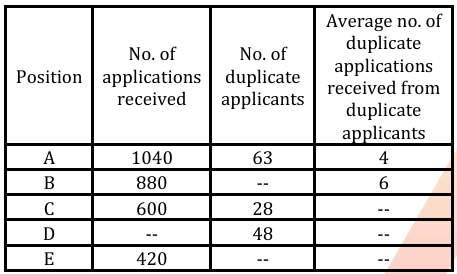
NOTE:- A duplicate applicant is an applicant who has submitted additional (duplicate) application after submitting their original application. All application forms (original + duplicate) received from duplicate applicant were rejected. Remaining all application were accepted. None of the applicants applied for more than one post.
for position C, no. of accepted applications from males is between 150 & 200 while that of females is between 130 & 180. Which of the following can be a possible value (s) of average no. of duplicate applications submitted by duplicate applicants for position C?
A. 11 B. 5 C. 9 D. 13 E. 7
Answer: B. C & E — ConceptFor a duplicate applicant, one original form plus an average of x extra (duplicate) forms are submitted, and ALL of their forms — original and…
- A.
B, C & E
- B.
C & E
- C.
A & D
- D.
B & E
- E.
A, C & D
Attempted by 2 students.
Show answer & explanation
Correct answer: B
Concept
For a duplicate applicant, one original form plus an average of x extra (duplicate) forms are submitted, and ALL of their forms — original and duplicates — are rejected. So for any position:
Rejected = (duplicate applicants) × (1 + average duplicate forms per applicant)
and Accepted = (applications received) − Rejected. Setting the given accepted range against this relation turns the problem into an inequality in x.
Application
From the table, position C: applications received = 600, duplicate applicants = 28. Let x = average no. of duplicate applications per duplicate applicant (the value asked for).
Rejected for C = 28 × (1 + x).
Accepted for C = 600 − 28(1 + x).
Accepted range: males 150 to 200 plus females 130 to 180 → total accepted lies between 280 and 380.
Inequality: 280 ≤ 600 − 28(1 + x) ≤ 380.
Subtract 600 throughout: −320 ≤ −28(1 + x) ≤ −220.
Divide by −28 (inequality direction reverses): 220/28 ≤ 1 + x ≤ 320/28, i.e., 7.86 ≤ 1 + x ≤ 11.43.
Subtract 1: 6.86 ≤ x ≤ 10.43.
Check each value given in the stem against this range: A = 11 (above 10.43), B = 5 (below 6.86), C = 9 (within range), D = 13 (above 10.43), E = 7 (within range).
So the values that fit are 9 and 7 — the combination "C & E".
Cross-check
Substitute back: at x = 9, rejected = 28 × 10 = 280, so accepted = 600 − 280 = 320, inside [280, 380]. At x = 7, rejected = 28 × 8 = 224, so accepted = 376, also inside [280, 380]. At the excluded value x = 11, rejected = 28 × 12 = 336, so accepted = 264, which falls below 280 — confirming the boundary correctly rules it out.