Directions: Read the following pie charts carefully and answer the questions…
2025
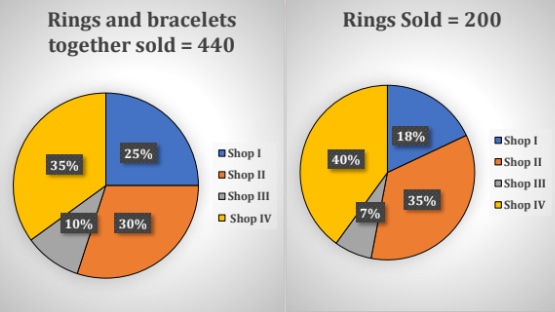
Directions: Read the following pie charts carefully and answer the questions given below. The pie chart I shows the percentage distribution of the total number of rings and bracelets together sold by four shops. The pie chart II shows the percentage distribution of the total number of rings sold by four shops.
The total number of chains sold by shop I is 20% less than the total number of rings sold by shops II and IV together. If the ratio of the total number of chains sold by shop I to II is 4:7, respectively, then find the total number of chains and bracelets sold by shop II.
Answer: C. 272 — In a percentage-based pie chart, a sector's value equals the chart's total quantity multiplied by that sector's percentage share. When two pie charts describe…
- A.
293
- B.
288
- C.
272
- D.
267
- E.
291
Attempted by 7 students.
Show answer & explanation
Correct answer: C
In a percentage-based pie chart, a sector's value equals the chart's total quantity multiplied by that sector's percentage share. When two pie charts describe overlapping categories for the same shops (one chart giving rings-and-bracelets combined, another giving rings alone), subtracting a shop's rings-alone value from its combined value isolates that shop's bracelets figure. Once one term of a given ratio is known, the other term follows by scaling with the ratio's remaining factor.
From Pie Chart II (Rings Sold = 200): rings sold by Shop II = 35% of 200 = 70, and rings sold by Shop IV = 40% of 200 = 80.
Rings sold by Shops II and IV together = 70 + 80 = 150.
Chains sold by Shop I are 20% less than this combined rings figure, so chains sold by Shop I = 80% of 150 = 120.
The ratio of chains sold by Shop I to Shop II is 4 : 7, so chains sold by Shop II = 120 multiplied by 7/4 = 210.
From Pie Chart I (Rings and bracelets together = 440): the combined rings-and-bracelets total for Shop II = 30% of 440 = 132.
Bracelets sold by Shop II = combined Shop II total minus rings sold by Shop II = 132 minus 70 = 62.
Chains and bracelets sold by Shop II = 210 + 62 = 272.
Cross-check: both pie charts' percentages sum to 100% (25+30+10+35 and 18+35+7+40), and 120 is exactly 80% of 150, confirming the 20%-less condition; also 120 to 210 simplifies to 4 to 7, confirming the given chains ratio.
So the total number of chains and bracelets sold by Shop II is 272.