Directions : Read the following pie charts carefully and answer the questions…
2025
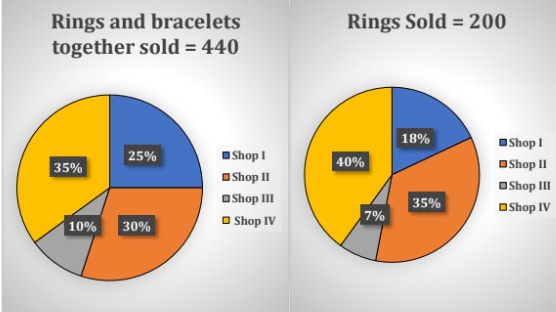
Directions : Read the following pie charts carefully and answer the questions given below. The pie chart I shows the percentage distribution of the total number of rings and bracelets together sold by four shops. The pie chart II shows the percentage distribution of the total number of rings sold by four shops.
The total number of bracelets sold by shops II and IV together is what percentage more or less than the total number of rings and bracelets together sold by shop I (approx.)?
Answer: B. 24% — To find what percentage one quantity is more or less than another, use: percentage difference = (A − B) / B × 100, where B is the quantity mentioned as the…
- A.
5%
- B.
24%
- C.
17%
- D.
33%
- E.
12%
Attempted by 12 students.
Show answer & explanation
Correct answer: B
To find what percentage one quantity is more or less than another, use: percentage difference = (A − B) / B × 100, where B is the quantity mentioned as the base ("...than B"). When two linked pie charts share overlapping categories but have different grand totals, always convert each chart's percentage share into an actual count against that chart's OWN total before combining or comparing figures across the two charts — percentages from charts with different totals can never be combined directly.
Shop | Rings + Bracelets (Chart I) | Rings (Chart II) | Bracelets (derived) |
|---|---|---|---|
Shop I | 110 | 36 | 74 |
Shop II | 132 | 70 | 62 |
Shop III | 44 | 14 | 30 |
Shop IV | 154 | 80 | 74 |
Convert Chart I's percentage shares to counts using its stated total of 440 (rings and bracelets together): Shop I = 25% of 440 = 110; Shop II = 30% of 440 = 132; Shop III = 10% of 440 = 44; Shop IV = 35% of 440 = 154.
Convert Chart II's percentage shares to counts using its stated total of 200 (rings sold): Shop I = 18% of 200 = 36; Shop II = 35% of 200 = 70; Shop III = 7% of 200 = 14; Shop IV = 40% of 200 = 80.
Get bracelets sold by each shop as (rings-and-bracelets total for that shop) − (rings sold by that shop): Shop II bracelets = 132 − 70 = 62; Shop IV bracelets = 154 − 80 = 74.
Add the two shops named in the question: total bracelets sold by Shop II and Shop IV together = 62 + 74 = 136.
Identify the base/reference quantity named after "than" in the question: the rings-and-bracelets total for Shop I = 110.
Apply the percentage-difference formula: (136 − 110) / 110 × 100 = 26 / 110 × 100 ≈ 23.6%, which rounds to approximately 24% more.
Cross-check: the four shops' derived bracelet counts must add up consistently with the chart totals. 74 + 62 + 30 + 74 = 240 bracelets, and 240 (bracelets) + 200 (rings) = 440, which matches Chart I's stated grand total exactly — confirming the derived shop-wise bracelet figures are correct before using them in the comparison.
Therefore, the 136 bracelets sold by Shops II and IV together is about 23.6% more than the 110 rings-and-bracelets sold by Shop I, which rounds to approximately 24% more.