Directions : Read the following pie charts carefully and answer the questions…
2025
Directions : Read the following pie charts carefully and answer the questions given below. The pie chart I shows the percentage distribution of the total number of rings and bracelets together sold by four shops. The pie chart II shows the percentage distribution of the total number of rings sold by four shops.
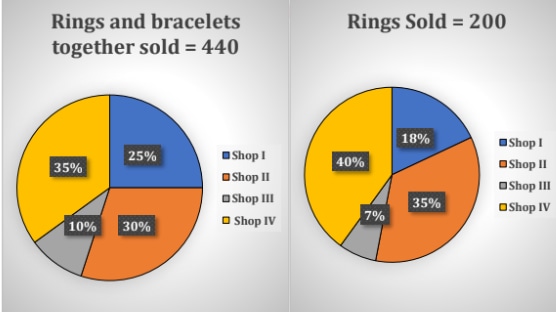
If the number of rings sold by shop V is 20% more than that of shop IV and the ratio of the number of bracelets sold by shops II and V is 31:29, respectively, then the total number of rings and bracelets together sold by shop II is how many more or less than that of shop V?
Answer: C. 22 — Concept In a pie chart, a sector's value = (sector percentage ÷ 100) × that chart's total. When two pie charts describe the same shops but rest on different…
- A.
21
- B.
20
- C.
22
- D.
24
- E.
26
Attempted by 7 students.
Show answer & explanation
Correct answer: C
Concept
In a pie chart, a sector's value = (sector percentage ÷ 100) × that chart's total. When two pie charts describe the same shops but rest on different totals — one for a combined quantity, one for a single component of it — the remaining component is recovered by subtraction: bracelets = (rings and bracelets together) − rings. Two standard relations then close the gap: "p% more than" scales a base by (100 + p) ÷ 100, and a ratio a : b fixes one quantity from the other through a common unit.
Application
From pie chart I (rings and bracelets together = 440): shop II sold 30% of 440 = 132, and shop IV sold 35% of 440 = 154.
From pie chart II (rings = 200): shop II sold 35% of 200 = 70 rings, and shop IV sold 40% of 200 = 80 rings.
Bracelets sold by shop II = combined − rings = 132 − 70 = 62.
Shop V's rings are 20% more than shop IV's rings: 80 × (120 ÷ 100) = 96.
Bracelets of shops II and V are in the ratio 31 : 29. Shop II's bracelets are 62, so one ratio unit = 62 ÷ 31 = 2, giving shop V's bracelets = 29 × 2 = 58.
Shop V's rings and bracelets together = 96 + 58 = 154.
Difference = 154 − 132 = 22. Shop II's total (132) is the smaller one, so shop II sold 22 fewer.
Cross-check
Bracelets across all four shops must total 440 − 200 = 240, and the per-shop bracelet counts 74, 62, 30 and 74 add to exactly 240.
Shop II's bracelets to shop V's bracelets = 62 : 58 = 31 : 29, which matches the ratio given in the question.
Shop V's 96 rings are exactly 1.2 × 80, matching the stated 20% increase over shop IV.
Shop II sold 22 fewer rings and bracelets together than shop V.