

VM Integration in Operating Systems: Resource Pooling, Virtual I/O and Worked Examples
See how a hypervisor connects guests to finite CPU, memory, storage and network pools. Work through admission, fair-share CPU and saturated-network calculations.
KnowledgeGate Team
Exam prep & CS education
Updated 20 Nov 20265 min read
A VM is easy to draw as a box. The harder question is how that box joins a physical host, receives CPU time and memory, reaches storage and a network, yet stays isolated from neighbouring guests. Here, VM integration means connecting a guest and its virtual hardware to the hypervisor's pooled physical resources and management path. Textbooks may cover the same ideas under virtualization architecture, VM resource management or virtual I/O. The earlier Virtual Machines in Operating Systems guide is the canonical treatment of broad architecture, hypervisor taxonomy, full address translation, snapshots and migration. Operational integration starts from three decisions: whether guests fit strictly, how saturated CPU and network pools divide by weight, and which virtual I/O path carries each allocation. The wider CS Fundamentals path supplies the surrounding OS concepts.
1. VM integration exposes four resource-pool boundaries
The stack starts with physical CPU, RAM, NIC and disk. The hypervisor presents each VM with vCPUs, guest-physical memory, a virtual NIC (vNIC) and virtual disk. The guest OS and applications occupy the top layer.
Integration presents a stable interface, maps resources, schedules requests, enforces isolation and accounts for use. Pooling lets several guests draw from one managed host pool.
Trapping, address translation and virtual-device paths are mechanisms. Reservations, caps, weights and placement rules are policies. The Operating Systems for GATE study guide supplies the broader revision route.
2. CPU and memory accounting starts from finite host capacity
A vCPU is a schedulable virtual processor; here, a pCPU is one physical scheduling context. Two vCPUs do not guarantee two dedicated pCPUs. The hypervisor schedules them on available pCPUs.
CPU overcommit time-shares more runnable vCPUs than pCPUs, so overlapping demand waits. Configured memory, working set, hypervisor reserve and reclaim or swap are distinct. Virtualization creates no physical capacity.
Address translation supplies an isolation boundary. The guest page table maps a guest virtual address to a guest-physical address, and a second hardware-assisted mapping translates that to host physical memory. Admission math uses configured memory, active working sets and the host reserve.
3. Worked example: admit guests and share CPU
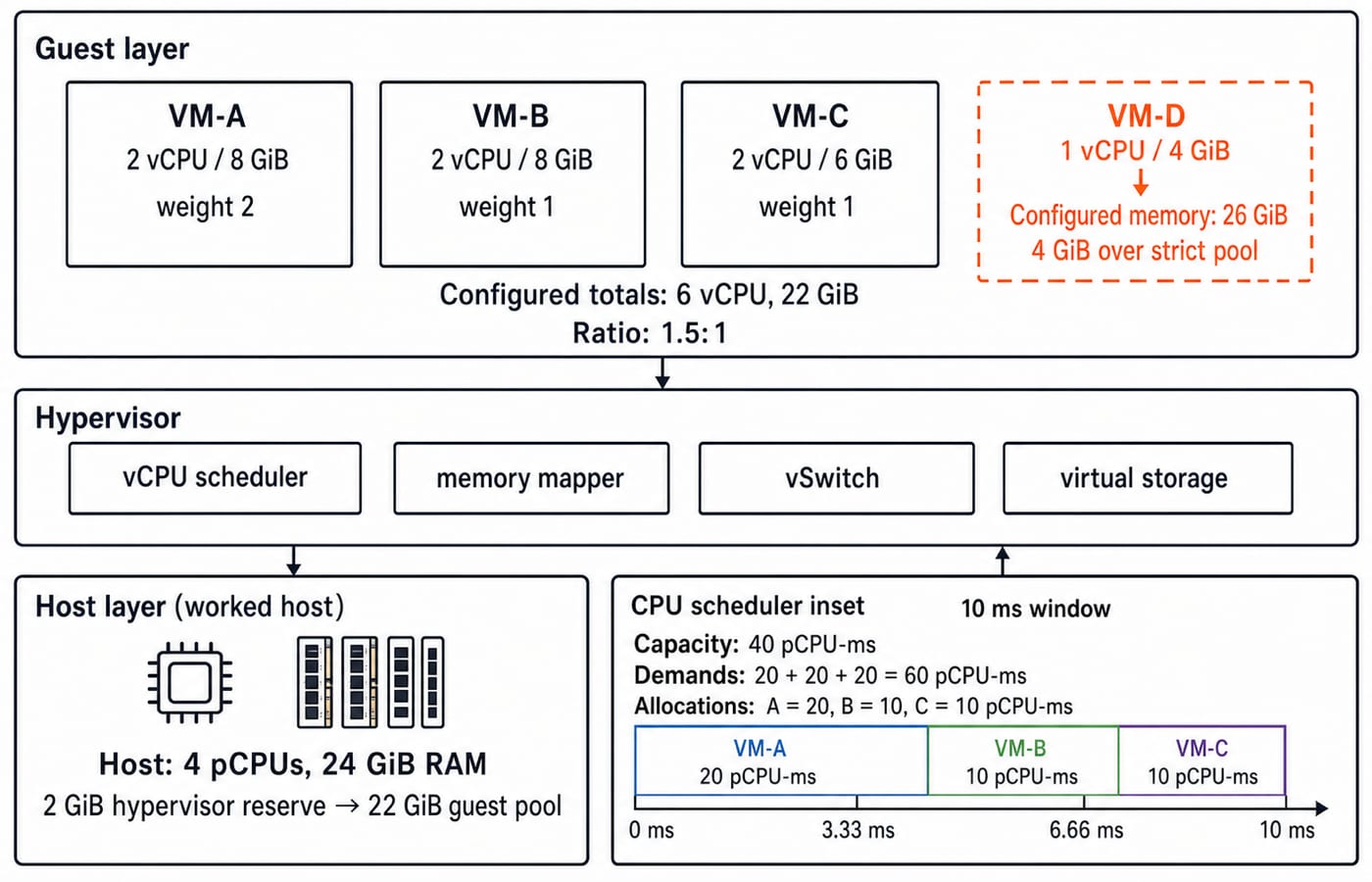
Take a host with 4 pCPUs and 24 GiB RAM. After a 2 GiB hypervisor reserve, the strict guest pool is 24 - 2 = 22 GiB.
Configure A as 2 vCPU and 8 GiB, B as 2 vCPU and 8 GiB, and C as 2 vCPU and 6 GiB. Memory is 8 + 8 + 6 = 22 GiB, leaving 0 GiB headroom. The CPU ratio is 6 vCPU / 4 pCPU = 1.5:1.
Add D with 1 vCPU and 4 GiB. Memory becomes 22 + 4 = 26 GiB, or 4 GiB over the pool, so strict admission fails. Overcommitted working sets A=6, B=5, C=4 and D=3 total 18 GiB, so guests may run initially. At full configurations, 8 + 8 + 6 + 4 = 26 GiB, and 4 GiB must be reclaimed or swapped. Abstraction changes allocation, not capacity.
Over 10 ms, four pCPUs supply 4 x 10 = 40 pCPU-ms. A, B and C each demand 20, totalling 60 pCPU-ms. With weights 2:1:1, A receives 40 x 2/4 = 20 pCPU-ms; B and C receive 40 x 1/4 = 10 pCPU-ms each. The allocations sum to 40. A is satisfied, while B and C each leave 10 waiting. This pedagogical fair-share model is not a vendor scheduler specification.
4. Virtual I/O connects devices and guests
A packet crosses the guest network stack, vNIC driver, hypervisor virtual switch and physical NIC. Storage crosses the guest filesystem, virtual controller and virtual-disk mapping. The guest sees virtual devices while the hypervisor maps real ones.
Path | How it works | Main benefit | Trade-off |
|---|---|---|---|
Emulation | Presents a familiar device and translates operations | Broad guest compatibility | Extra translation work |
Paravirtual driver | Uses a virtualization-aware interface | Less emulation overhead | Requires guest support |
Passthrough | Assigns a physical function more directly | Lower mediation overhead | Weaker sharing and harder migration or portability |
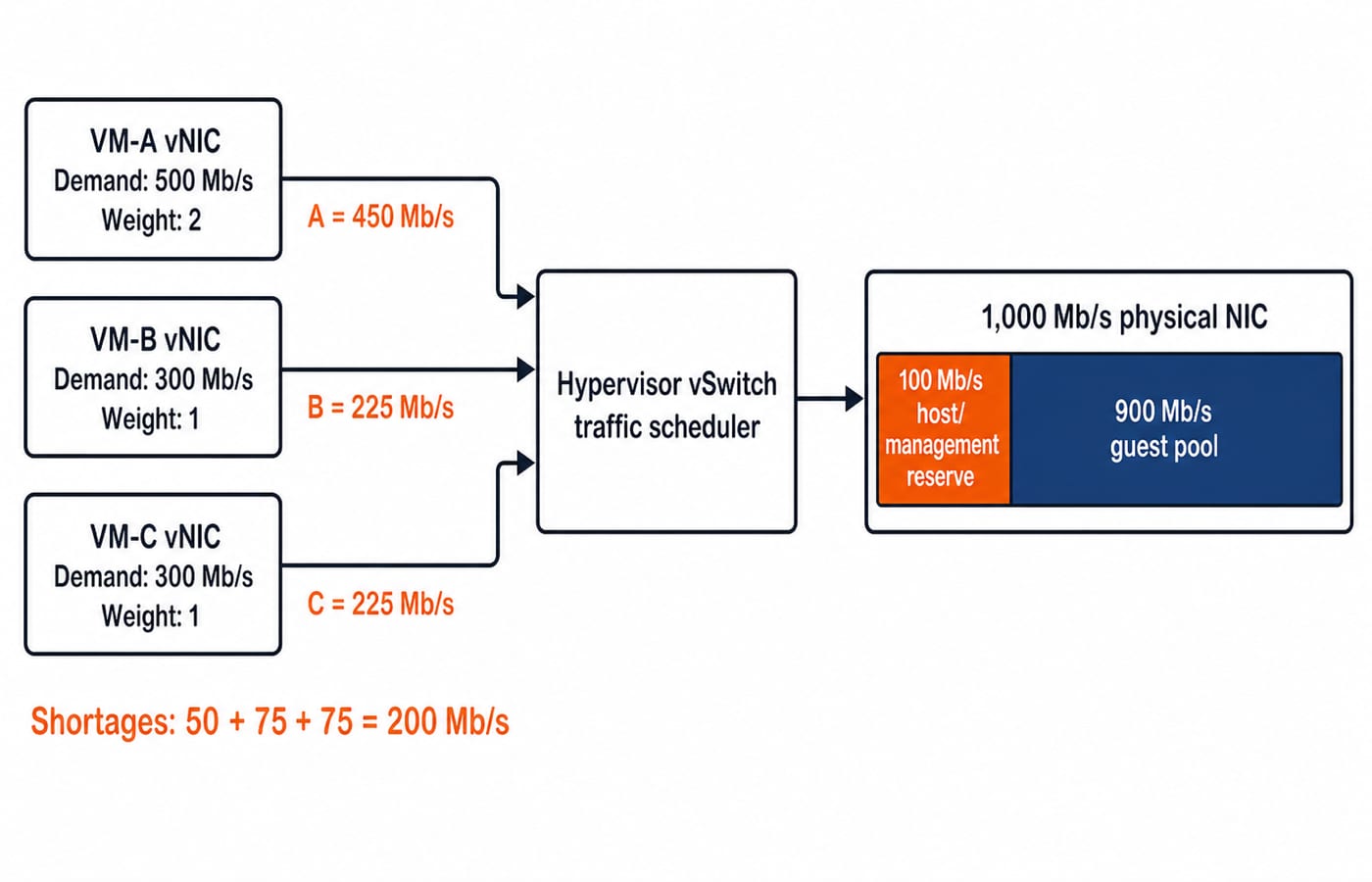
From a 1,000 Mb/s link, reserve 100 Mb/s for host traffic, leaving 900. A, B and C demand 500, 300 and 300, totalling 1,100 Mb/s. With weights 2:1:1, A gets 900 x 2/4 = 450 Mb/s; B and C get 900 x 1/4 = 225 Mb/s each. Shortages are 50, 75 and 75, exactly the 200 Mb/s excess. Protocol overhead would reduce application throughput.
5. Lifecycle events change the resource ledger
Defining a VM records configured vCPU, RAM, disk and vNIC limits but consumes no CPU time until its vCPUs become runnable. Boot activates device paths and working sets, so admission must consider both configured ceilings and current demand.
A snapshot increases storage use. Migration consumes network bandwidth and requires source and destination capacity while state moves. Both events alter the resource ledger even when the guest configuration stays unchanged.
Pausing vCPUs reduces CPU demand but may retain RAM. Disconnecting a vNIC removes that network path without erasing memory. Deleting a snapshot may reclaim storage but does not shut down the guest.
6. Isolation constrains mappings inside a shared pool
Privilege boundaries, memory translation, device mediation and permissions prevent cross-VM control. Pooling is controlled sharing.
VM-A's guest-physical page 0x12000 may map to host frame 0xA3000, while VM-B's page 0x12000 maps to 0xD8000. Identical guest addresses do not mean identical host memory. A's translation must not reach B's frame.
Translation, contention, virtual I/O and reclaim add workload-dependent costs. Isolation and low overhead are separate properties.
7. Common resource-pooling traps
Keep these resource-pooling corrections ready:
A vCPU is not automatically a dedicated physical core.
Subtract the hypervisor reserve before summing strict guest capacity.
Configured RAM is not the active working set.
Strict admission and overcommit policy answer different questions.
Weights divide a saturated pool; they do not create extra capacity.
CPU and memory overcommit have different consequences.
Protocol overhead can make application throughput lower than the link allocation.
Emulation, paravirtual I/O and passthrough are different device paths.
Exam questions on resource pooling ask you to calculate strict admission, distinguish configured from active demand, divide saturated CPU or network pools, and trace vNIC or storage requests.
Drill: (1) A 16 GiB host reserves 2 GiB. Do 6, 4 and 5 GiB guests fit strictly? (2) What do four pCPUs provide over 5 ms? (3) Split 600 Mb/s by 2:1:1.
Answers: (1) No. 16 - 2 = 14 GiB, but 6 + 4 + 5 = 15 GiB, a 1 GiB shortage. (2) 4 x 5 = 20 pCPU-ms. (3) 600 x 2/4 = 300 Mb/s, then 150 Mb/s each.
8. VM integration: the short version
Virtual hardware faces the guest; the hypervisor maps and schedules it. Pools stay finite. Isolation separates addresses and devices. Capacity problems subtract reserve, sum demand and state policy.
The CPU interval held 40 pCPU-ms, never 60. The 22 GiB pool faced 26 GiB demand, creating 4 GiB pressure. Recompute both from the host numbers, then redraw the two figures from memory.
For complete-course learning, continue with ZERO TO HERO. For placement-focused preparation, use Computer Science Fundamentals for Placements by Sanchit Sir.
Go deeper with the full courseOperating System
Keep learning
Virtual Machines in Operating Systems: Hypervisors, Isolation and a Worked Resource Plan
Follow one three-VM host plan from the hypervisor layer to CPU scheduling, address translation, virtual I/O, isolation, snapshots and migration.
Updated 19 Aug 20266 min readOperating Systems
Deadlock in Operating Systems: Four Conditions and Worked Resource-Allocation Graphs
Learn why a cycle proves deadlock only for single-instance resource types, then trace a three-process deadlock and a multiple-instance escape sequence.
Updated 28 Oct 20266 min read59 viewsOperating Systems

Virtual Memory in Operating Systems: Paging, TLB and Page Replacement with Worked Examples
Follow one virtual address through the TLB and page table, then calculate page faults, replacement traces and working-set pressure step by step.
Updated 26 Aug 20266 min read70 viewsOperating Systems
Virtual Memory and Demand Paging MCQs: 12 solved questions with explanations
Virtual memory and demand paging MCQs for GATE, UGC NET and placement: address translation, page-table size, effective access time, thrashing, frames.
Updated 29 Oct 20268 min read105 viewsOperating System MCQs