UP Police Computer Operator Job Profile: Salary, Duties and Promotion Path
Understand the UP Police Computer Operator Grade-A role, its duties, historical pay matrix, probation, transfers, and selection-based promotion path.
KnowledgeGate Team
Exam prep & CS education
Updated 12 Aug 20265 min read112 views
After selection, does Computer Operator Grade-A mean routine typing, technical support, police work, or all three? It is a technical Group C cadre post supporting police computer systems, and the 2011 service rules place it inside the police service for discipline without handing it investigation powers. Pay arrives as a matrix range rather than one advertised figure, and every step up the ladder is a selection rather than a date.
Related reading: Computer Operator eligibility credentials and typing speed and accuracy preparation.
UP Police Computer Operator Grade-A is a technical police cadre post
The official Uttar Pradesh Police Computer Staff Service Rules, 2011 describe a Group C service. They treat members in Grades A, B and C, and Programmer Grade-2, as police officers for the privileges, liabilities, penalties, punishments and protection stated there. Service discipline therefore applies from day one, while the work itself stays technical.
Label | What it means | What it does not mean |
|---|---|---|
Technical cadre | Work connected with police computer operations | A generic private-sector data-entry role |
Police-service member | Service discipline and responsibilities under the rules | Automatic investigation authority |
Grade-A | Direct-entry grade in the 2011 ladder | A guarantee of immediate promotion |
Use the UP Police Computer Operator Exam Prep category for exam-specific preparation, and the UP Police Computer Operator 8-week preparation plan if typing speed and Office skills still need building before the selection stages.
The job profile spans records, systems and user support
The official UP Police Computer Centre page lists seven unit-level activity families: hardware strategy, software development, personnel training, computerisation and networking coordination, central database management, police-website maintenance and web-enabled police-public interfaces. Those seven describe the unit's remit; a Grade-A appointee is assigned a slice of them, with software, shift, access rights and reporting line set by the posting.
Possible assigned task | Evidence to retain | Boundary |
|---|---|---|
Database correction | Source reference and audit trail | Do not alter an unverified field |
Access incident | Ticket, timestamp and escalation | Do not bypass permissions |
Web update | Approved copy and publication check | Do not publish unofficial information |
Worked duty example: clear a technical queue without losing control
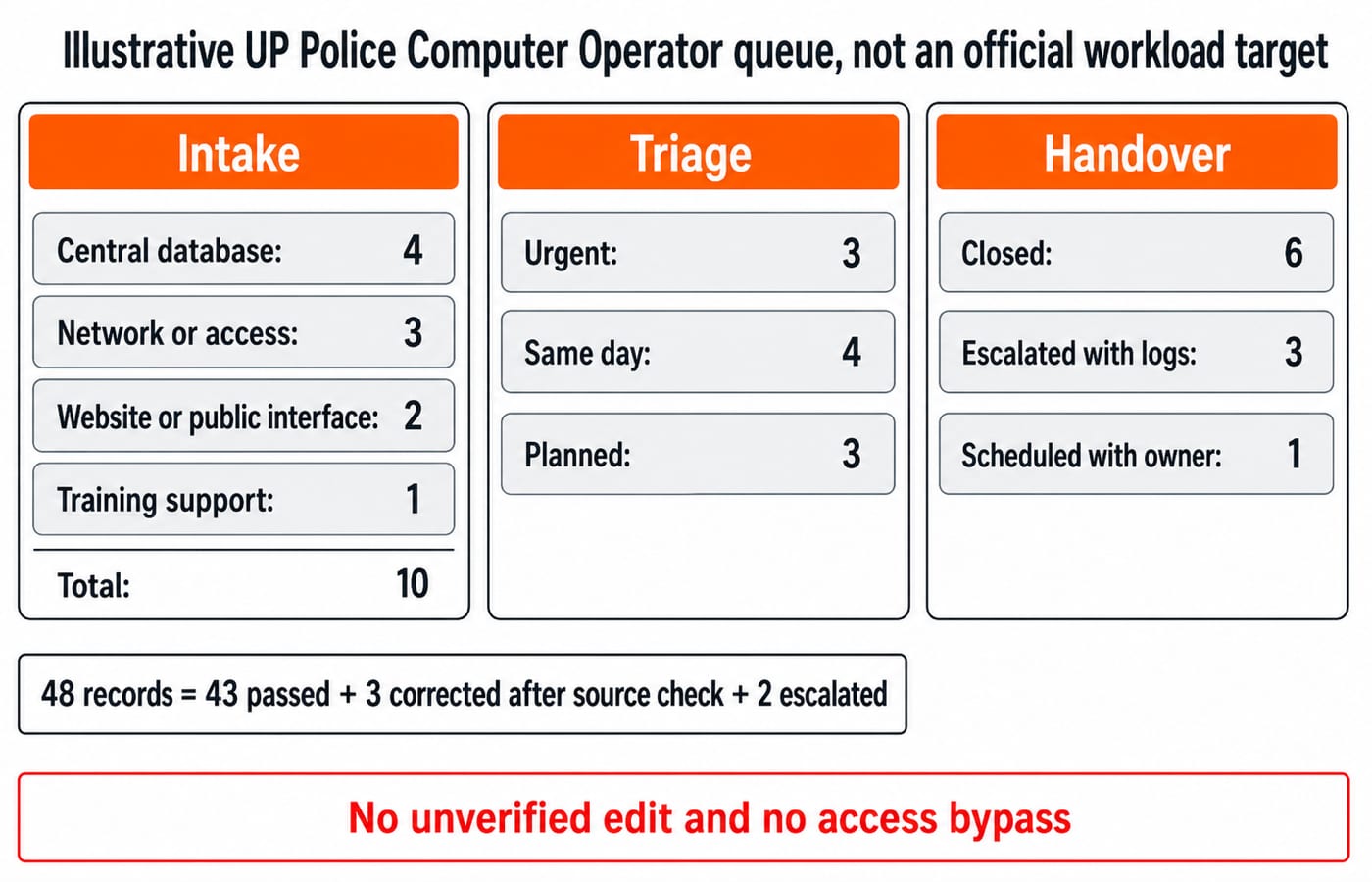
Take an illustrative day, sized for teaching rather than lifted from an official workload sheet. Intake has 4 central-database items + 3 network or access tickets + 2 website or public-interface checks + 1 training-support request = 10 items. Triage assigns 3 urgent incident items + 4 same-day validation or update items + 3 planned items = 10.
Now check a batch of 48 records. Of these, 43 pass approved validation, 3 have correctable source-format errors and are resubmitted after verification, and 2 contain conflicting source values and are escalated. The check is 43 + 3 + 2 = 48. For each change, the operator records the source, change, time and decision owner.
At handover, 6 closed + 3 escalated with logs + 1 scheduled with an owner = 10. Visible ownership matters more than forcing every item into the closed column.
The pay matrix is not the same as monthly in-hand salary
The UPPRPB direct-recruitment notice dated 29 December 2023 stated the pay in both forms: the old pay band of Rs 5,200 to Rs 20,200 with grade pay Rs 2,400, and the pay-matrix range of Rs 25,500 to Rs 81,100 that replaced it. Those were that cycle's advertised terms. Rs 25,500 is the entry cell of a range a whole career moves through and Rs 81,100 its far end, so neither is a joining, gross or in-hand salary.
Basic pay is the applicable matrix cell. Gross pay adds admissible allowances. In-hand pay then subtracts statutory and personal deductions. Dearness allowance, house rent, transport, pension contribution, income tax and insurance move with the rules in force and the posting city, so they are read off your own payslip.
Put the shape into index units, with basic pay set at 100: 100 basic units + 38 allowance units + 12 other admissible units = 150 gross units. Then 150 - 16 statutory or retirement units = 134, and 134 - 4 other deduction units = 130 in-hand units. In-hand lands at 130 against a basic of 100 and a gross of 150, which is why a matrix cell quoted as a salary misleads in both directions.
Training, probation and transfer shape the first years
Under the older 2011 framework, computer-related training may be prescribed. A substantive appointee is placed on probation for two years. Cadre personnel may also be transferred or attached to a district, unit or place within Uttar Pradesh according to requirement and authorised orders. Two years is the stated period rather than a fixed one: extension sits with the department, and confirmation is decided on your record.
For a first-month evidence log, 5 validated record batches + 3 network-incident handovers + 2 authorised web-update checks + 2 training-support tasks = 12 items. Record the date, source, action, approver or escalation, and outcome. A log like this is what turns a probation period into evidence when confirmation is decided.
The career path runs from Grade-A to specialist responsibility
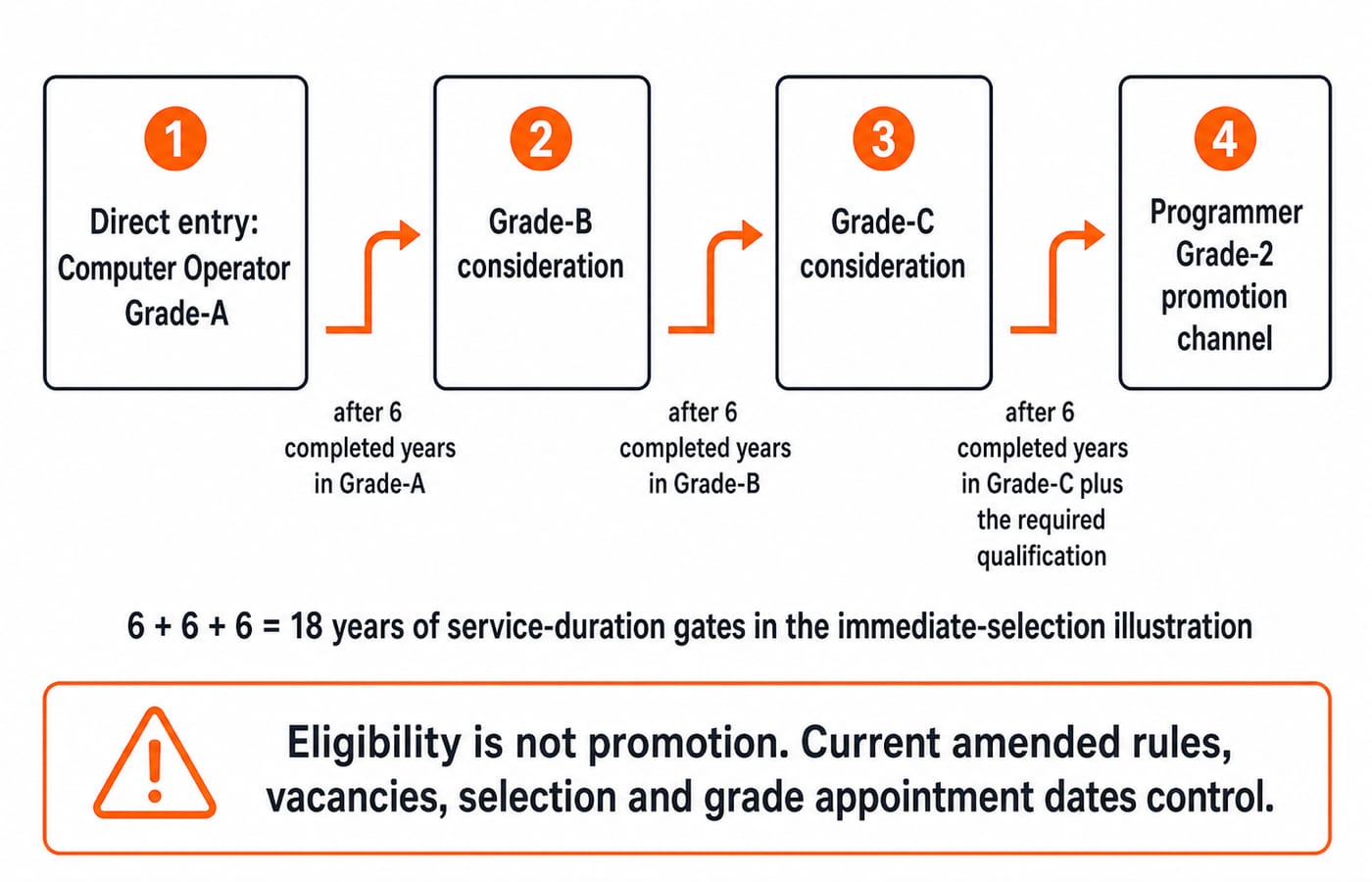
The 2011 rules set Grade-A as direct recruitment. They describe Grade-B eligibility for substantively appointed Grade-A staff after six completed years, then Grade-C eligibility after six completed years in Grade-B. They also provide a 50 percent promotion channel to Programmer Grade-2 for qualified Grade-C staff after six completed years in that grade. Later amendments and current promotion circulars control.
An immediate-selection illustration is:
Year 0: join Grade-A.
Year 6: reach the duration gate for Grade-B consideration.
If selected and appointed immediately for this illustration, Year 12: reach the Grade-B duration gate for Grade-C consideration.
If selected again immediately, Year 18: reach the Grade-C duration gate for the Programmer Grade-2 channel, subject to the required qualification.
The arithmetic is 6 + 6 + 6 = 18 years of grade-specific gates, and each gate opens a consideration rather than an appointment. Substantive status, the required qualification, the selection itself, service record, vacancies in the higher grade and your own grade-appointment dates all move the real timeline away from that 18.
Decide whether the role fits, then prepare for selection
Ask five questions: Can you protect data accuracy, follow access controls, document handovers, support users patiently and accept mobility under the rules? In short, the job combines computer operations with police-service discipline. Its pay matrix is not in-hand salary, and promotion is selection-based.
Study concepts with the UP Police Computer Operator Course and build timed practice with the UP Police Computer Operator Test Series. The SSC CGL posts and preference guide is worth reading for the habit of comparing posts on duties and service conditions before ranking them. For UP Police terms, the latest UPPRPB notice and your own appointment letter are the documents that decide.
Keep learning
UP Police Computer Operator DBMS and SQL: Learn Tables, Keys and Queries with a Police-Records Database
Build one fictional police-records database from schema to SQL. Learn key types, relationships, 3NF, table constraints and exact query results from consistent data.
Updated 18 Aug 20266 min read70 viewsUP Police Computer Operator
UP Police Computer Operator Typing Test: Build Speed Without Losing Accuracy
Build typing speed without letting errors undo the gain. This practice plan separates Hindi and English, tracks accuracy, and turns each weak attempt into a focused repair drill.
Updated 16 Aug 20265 min readUP Police Computer Operator
UP Police Computer Operator PYQs: Diagnose Recurring Skill Gaps
Turn solved papers into a ranked repair list. Tag the recurring errors, repair the exact skill behind each one, then measure the change with a fresh 18-question mixed check.
Updated 14 Aug 20265 min readUP Police Computer Operator
UP Police Computer Operator Cyber Safety: Threats and Safe Handling
Learn to recognise common cyber threats, protect operational data and choose a safe first response through practical workstation scenarios.
Updated 10 Aug 20264 min readUP Police Computer Operator