UP Police Computer Operator PYQs: Diagnose Recurring Skill Gaps
Turn solved papers into a ranked repair list. Tag the recurring errors, repair the exact skill behind each one, then measure the change with a fresh 18-question mixed check.
KnowledgeGate Team
Exam prep & CS education
Updated 14 Aug 20265 min read
You may have done PYQs and still lose marks while finding a host range, copying an Excel reference, or separating a key from a non-key attribute. Do not add another paper. Turn attempts into a ranked repair list. The UP Police Computer Operator Test Series carries six previous-year papers, from 2013, both 2016 shifts, 2017, 2018 and 2023, and any one of them is enough to start. Those years show what was asked then, not what the next paper will ask.
Read UP Police Computer Operator PYQs as evidence, not a prediction
A past paper tells you what was asked in that year, and nothing more. Question count, marks, negative marking, stage order, syllabus weightage and the typing standard all move between cycles, so read them off the current-cycle notice on the Uttar Pradesh Police Recruitment and Promotion Board website rather than off a 2018 paper.
Review executable skills, not subjects. Replace “Networking weak” with “cannot derive the usable IPv4 range from a /27 prefix”. Replace “Excel weak” with “moves the wrong row or column when copying a mixed reference”. The method in Why PYQs Beat Buying Another Question Bank works because a named failure can be repaired and retested.
Build an 18-question recurrence grid
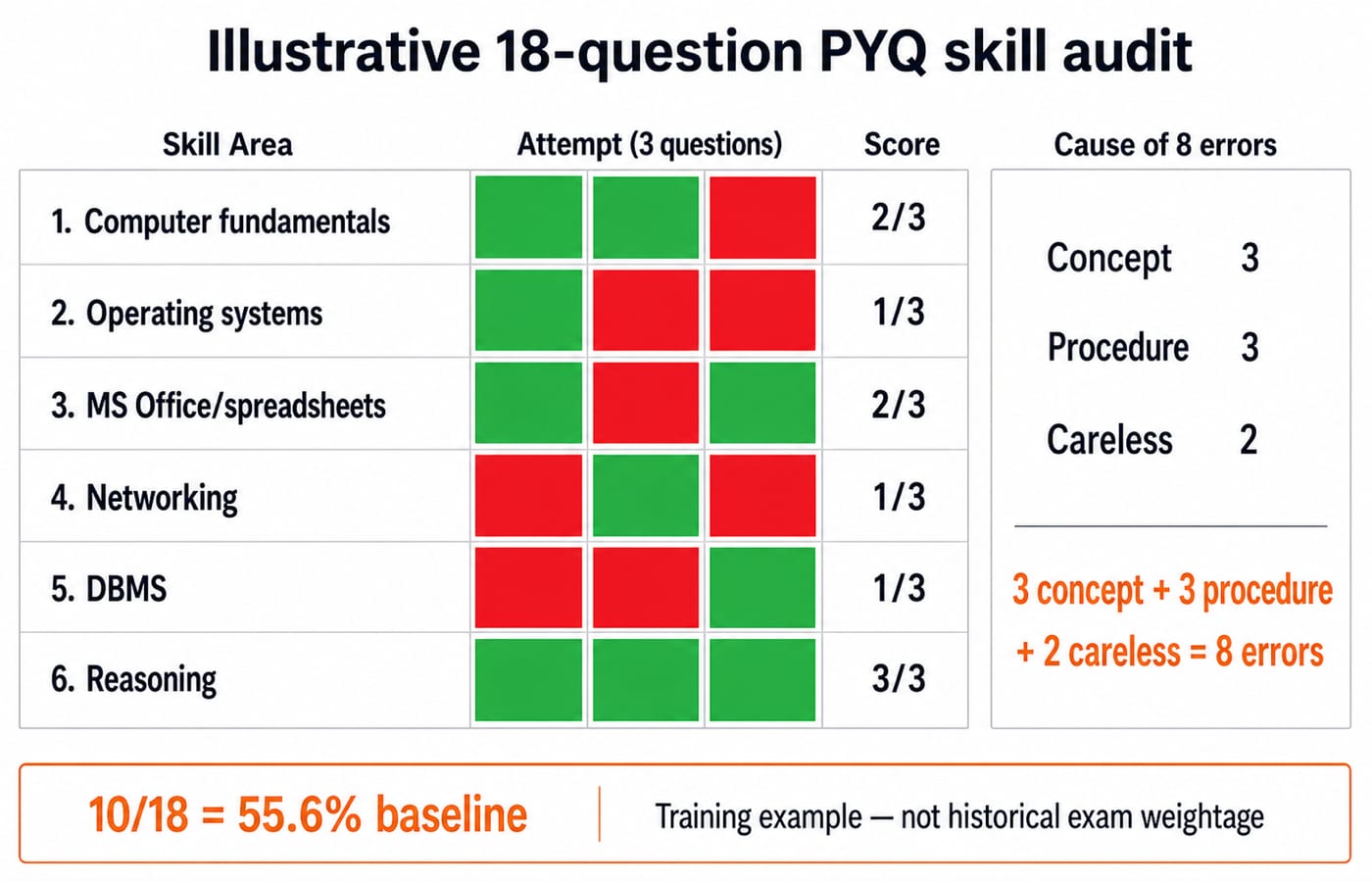
Take 18 questions from one previous-year paper and tag every attempt against six skills. A filled-in sheet looks like this:
Skill | Correct |
|---|---|
Computer fundamentals and data representation | 2/3 |
Operating systems | 1/3 |
MS Office and spreadsheets | 2/3 |
Networking | 1/3 |
DBMS | 1/3 |
Reasoning | 3/3 |
The baseline is 2 + 1 + 2 + 1 + 1 + 3 = 10 correct out of 18, so 10 / 18 x 100 = 55.6%. Give each miss one primary cause: three concept, three procedure and two careless errors. Operating systems, networking and DBMS have two misses each, so they lead repairs. Reasoning at 3/3 needs maintenance. When recurrence ties, start with the most specific failure because it gives you a clearer repair task and cleaner retest. Use the same skill names on the first audit and the recheck.
Work two small gaps completely: data units and Excel references
For data representation, convert 3.5 MiB to bits:
3.5 x 1024 x 1024 = 3,670,016 bytes3,670,016 x 8 = 29,360,128 bits
Multiplying by 1000 x 1000 treats a mebibyte as a decimal megabyte. Stopping at 3,670,016 gives bytes, not bits.
For spreadsheets, suppose D2 contains =$B2*C$1. Copy it one column right and one row down to E3. The result is =$B3*D$1: column B stays fixed, row 2 moves to 3, column C moves to D, and row 1 stays fixed. Read each dollar sign as a lock on the coordinate that follows it. Check both references separately before rebuilding the formula.
Work the technical gaps: subnet boundaries and a DBMS key
For 192.168.10.64/27, host bits are 32 - 27 = 5, giving 2^5 = 32 addresses. The network is .64; the next block begins at .96, so the broadcast is .95. The usable range is .65 through .94, with 32 - 2 = 30 usable hosts. Calling .64 to .96 usable includes the network address and next block.
For R(A,B,C) with A -> B and B -> C, begin with A+ = {A}. Apply A -> B to get {A,B}, then B -> C to get {A,B,C}. This contains every attribute. A is a single attribute, so there is no smaller non-empty subset left to test, and A is therefore a candidate key for this relation.
Use the UP Police Computer Operator Complete Course when repeated misses show that networking, database concepts, operating systems or fundamentals need structured rebuilding. The SSC CGL Tier 2 computer-knowledge practice can supply transferable practice, but it is not evidence for UP Police weightage or pattern.
Match each error type to a different repair
For a concept error, state the rule, study an example, then solve two variants. Try 10.0.5.128/27: network .128, next block .160, broadcast .159, usable range .129 to .158, and 30 usable hosts.
For a procedure error, use a checklist. For subnets, use prefix -> host bits -> block size -> network -> next block -> broadcast -> usable range. For spreadsheets, use inspect each $ sign -> move row -> move column -> reconstruct formula.
For a careless error, use one final check: a 12-question set with four concept, four procedure and four trap items. Treat 10/12 as your own pass mark, then retest after 48 hours and again after seven days.
Run a seven-day repair cycle and measure the change
Plan six 60-minute sessions, six hours total. Day 1 audits the 18 questions. Day 2 repairs data units and spreadsheet references. Day 3 handles the operating-systems gap in your log. Day 4 covers subnets. Day 5 covers DBMS keys and dependencies. Day 6 uses an 18-question mixed check. Keep Day 7 for recovery or one moved session.
The baseline is 10/18 = 55.6% and the recheck is 14/18 = 77.8%. Causes move from 3 + 3 + 2 = 8 to 1 + 2 + 1 = 4. The error count halves. Your own numbers will differ; what matters is that the same 18-question sheet is scored twice, so the change is measured rather than felt. If you miss a day, move that block to Day 7 or the next cycle. Do not merge missed sessions into a rushed late-night block.
Use the course, papers and tests as one feedback loop
The Test Series carries 13 unit tests, six previous-year papers and seven full-length mock tests. A previous-year paper discovers gaps, a unit test isolates one repaired skill, and a full-length mock checks it under mixed, timed work. Use the complete course for concept rebuilding and the Test Series for practice.
The short version: tag the exact skill, count repeated misses, choose the matching repair, then retest after a gap. For wider routes, use the Govt Job Exam Preparation Courses category. Your next paper should produce more than a score. It should produce the next repair decision.
Keep learning
UP Police Computer Operator DBMS and SQL: Learn Tables, Keys and Queries with a Police-Records Database
Build one fictional police-records database from schema to SQL. Learn key types, relationships, 3NF, table constraints and exact query results from consistent data.
Updated 18 Aug 20266 min read70 viewsUP Police Computer Operator
UP Police Computer Operator Typing Test: Build Speed Without Losing Accuracy
Build typing speed without letting errors undo the gain. This practice plan separates Hindi and English, tracks accuracy, and turns each weak attempt into a focused repair drill.
Updated 16 Aug 20265 min readUP Police Computer Operator

UP Police Computer Operator Job Profile: Salary, Duties and Promotion Path
Understand the UP Police Computer Operator Grade-A role, its duties, historical pay matrix, probation, transfers, and selection-based promotion path.
Updated 12 Aug 20265 min read112 viewsUP Police Computer Operator
UP Police Computer Operator Cyber Safety: Threats and Safe Handling
Learn to recognise common cyber threats, protect operational data and choose a safe first response through practical workstation scenarios.
Updated 10 Aug 20264 min readUP Police Computer Operator