UP Police Computer Operator Preparation Plan: 8 Weeks for Theory, Typing and Office Skills
A practical 12-hour weekly schedule that develops written-test recall, English and Hindi typing, office-tool control and an evidence-based review habit together.
KnowledgeGate Team
Exam prep & CS education
Updated 26 Jul 20265 min read
A candidate can finish every theory lecture and still reach the skill stage without stable typing. Another can type daily but fail to build enough written-test recall. Both failures come from running the tracks one after another, so this eight-week schedule keeps theory, timed questions, English and Hindi keyboard practice, and office-tool drills alive together from Week 1, on 12 hours a week. If you have fewer hours, scale every track proportionally instead of dropping one.
Build the source card and four baselines before Week 1
Create a five-field source card from the official UPPRPB website: active advertisement URL | notice date | latest corrigendum date | written syllabus page | skill-test instruction page. Verify it for your cycle before naming any section, duration, marking, language, speed, accuracy or keyboard-layout rule. Use the UP Police Computer Operator Exam Prep hub to find study material once that card is filled. UPPRPB's notification and its notified skill-test software decide what actually qualifies, so treat every number in this plan as your own practice metric.
Take a worked case. Neha's 80-question written baseline is 46 correct + 22 incorrect + 12 unattempted = 80. She attempted 46 + 22 = 68, giving 46 / 68 x 100 = 67.6% accuracy on what she attempted.
In 10 minutes, she types 270 English words with 18 incorrect: 27 WPM gross speed and (270 - 18) / 270 x 100 = 93.3% accuracy. Hindi is 205 words with 16 incorrect: 20.5 WPM and 92.2%. Her office drill takes 17 minutes for a 280-word notice and 4 x 5 table, with 6 errors. Those four numbers, written accuracy, English speed, Hindi speed and office time, are the baselines to beat.
Weeks 1-2: build concepts without postponing the keyboard
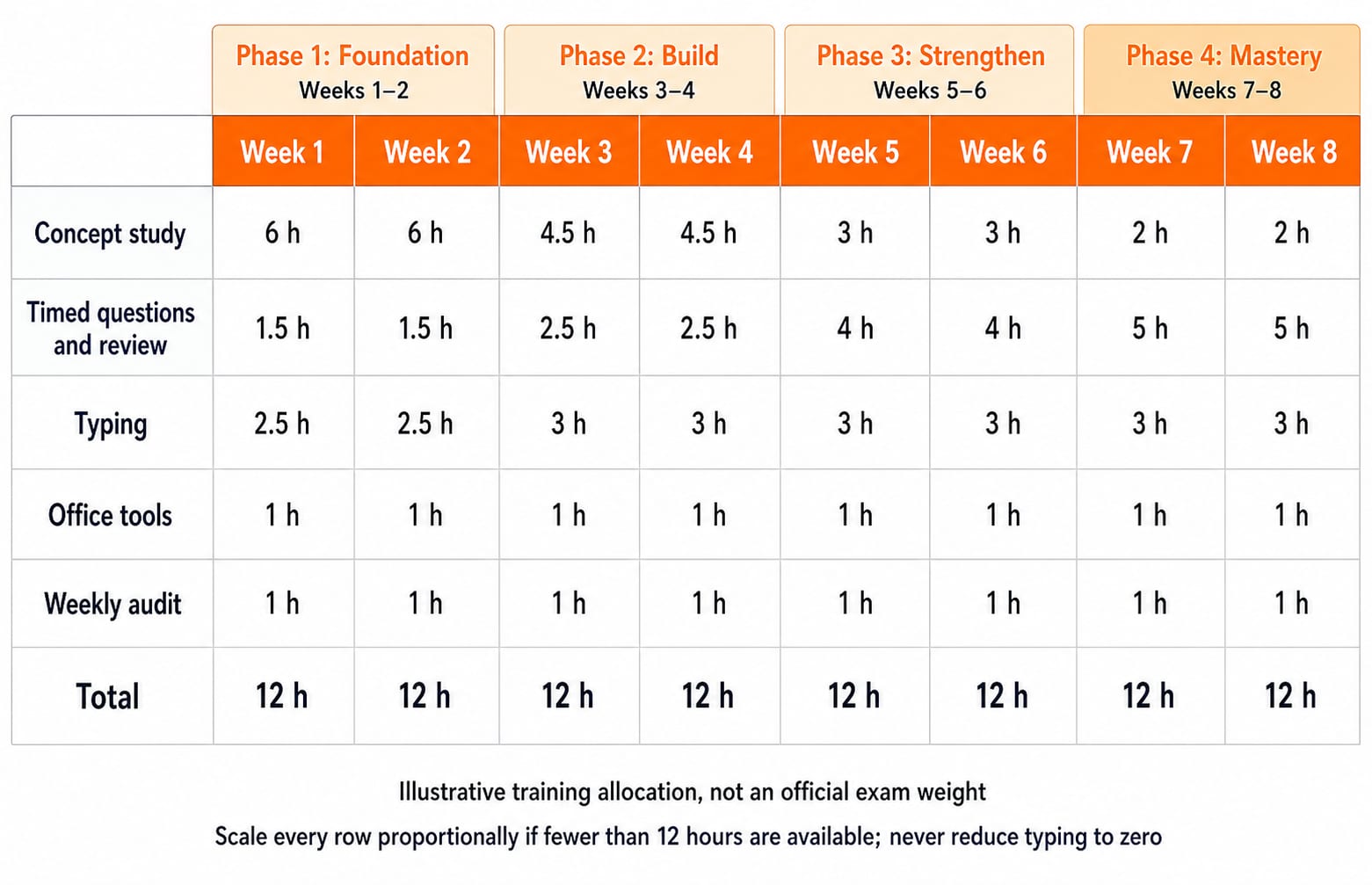
Allocate each week exactly: 6 hours concepts, 1.5 hours short question sets, 2.5 hours typing, 1 hour office tools and 1 hour review. That is 6 + 1.5 + 2.5 + 1 + 1 = 12 hours.
Use six 60-minute concept blocks, three 30-minute question sets, six 25-minute typing drills, two 30-minute office drills and two 30-minute error-log reviews. Week 1 maps the official syllabus and repairs the weakest confirmed theory basket. Week 2 adds the next two baskets and revisits every Week 1 error. Follow the UP Police Computer Operator Course only after matching its units to that syllabus.
Finish each concept block with 10 closed-book prompts. A score of 6/10 or lower returns to review; 7/10 or higher enters a mixed set. Keep Sunday as reserve or rest, not compulsory study.
Weeks 3-4: turn recall into keyboard and office-tool control
Rebalance each week to 4.5 hours concepts, 2.5 hours questions, 3 hours typing, 1 hour office tools and 1 hour review. Split typing into six 30-minute drills: 5 minutes slow accuracy, 15 minutes timed passage and 10 minutes correction. Track omissions, substitutions, spacing, punctuation and wrong keys separately.
In Week 3, recreate a 280-word public notice with one centred title, three numbered instructions and a 4-column x 5-row table. Build a 12-row spreadsheet with Set, Attempted, Correct, Incorrect, column totals and Accuracy = Correct / Attempted. That one sheet is the dashboard the later weeks read from.
In Week 4, reuse the source without copying your first file. Move from 17 minutes and 6 errors towards 14 minutes and at most 3 errors. The MS Office for CS teaching exams guide has the formatting and table drills to reuse here. Take its exercises, not its syllabus.
Weeks 5-6: let timed written sets drive revision
Each week gives 3 hours to concept repair, 4 to timed sets and analysis, 3 to typing, 1 to office practice and 1 to audit. Week 5 uses two 60-question sets, one 30-question set and 90 minutes of review: 120 + 30 + 90 = 240 minutes.
Week 6 uses one 80-question set at 80 minutes, two 40-question sets at 40 minutes each, and 80 minutes of review: 80 + 80 + 80 = 240 minutes.
Neha's 60-question set has 38 correct + 14 incorrect + 8 unattempted = 60. With 52 attempted, 38 / 52 x 100 = 73.1%. Classify the 14 errors as 6 concept gaps, 4 misreads, 3 calculation slips and 1 unsupported guess. Repair them with 45 minutes on concepts, 25 minutes re-solving and 20 minutes on a fresh 20-question check.
Borrow the error-classification method from the SSC CGL mock-test strategy. Use the UP Police Computer Operator Test Series for timed practice once your source card is filled.
Weeks 7-8: integrate, rehearse and taper
The weekly split becomes 2 hours theory repair, 5 hours written rehearsal and analysis, 3 hours typing, 1 hour office tools and 1 hour audit. Week 7 uses two 90-minute mixed sets, two 45-minute reviews and one 30-minute retest: 180 + 90 + 30 = 300 minutes. Once the notification confirms the paper's duration, promote one controlled set to a full-format mock without changing the weekly total.
Week 8 uses a 90-minute mixed set, 60 minutes analysis, three 30-minute weak-area retests and two 30-minute decision drills: 90 + 60 + 90 + 60 = 300 minutes. Stop adding content after the last major rehearsal. Keep the final 48 hours to familiar retrieval cards, short accurate typing and sleep-preserving review.
Use one dashboard to decide what receives the next hour
Neha's 80-question set moves from 46 correct + 22 incorrect + 12 unattempted (46 / 68 = 67.6%) to 58 correct + 12 incorrect + 10 unattempted (58 / 70 = 82.9%).
English moves from 270 words with 18 incorrect to 315 with 12: 31.5 WPM and (315 - 12) / 315 x 100 = 96.2%. Hindi moves from 205 words with 16 incorrect to 255 with 13: 25.5 WPM and 94.9%. The office drill drops from 17 minutes and 6 errors to 11 minutes and 1 error.
Keep the passage band, 10-minute window and error rule constant. After two flat typing checks, shift 60 minutes from repeat lectures to two 30-minute drills. If written accuracy is flat, swap a 60-minute office block for a 30-minute weak-area set and 30-minute review. Change one hour and reassess next week.
Recover missed days and choose the next step
If Tuesday's 90-minute session is lost, recover 60 minutes on Sunday and remove one 30-minute low-value rewatch. Do not punish Wednesday. If three days disappear, run a 7.5-hour week: 2.5 hours theory, 2 hours questions and review, 2 hours typing, 30 minutes office practice and 30 minutes audit. Resume normally next week.
Avoid four traps:
Delayed typing becomes short contacts from Week 1.
Gross WPM alone becomes speed, accuracy and error types.
Collected shortcuts become a timed document and spreadsheet.
Passive explanations become a closed-solution retry.
Verify the source card, record all four baselines, start Week 1 and audit every Sunday. KnowledgeGate carries over 900 UP Police practice questions spread across every recruitment in the force, so pull the computer, office and reasoning topics out of that pool. Use the course for structured learning and the test series for timed practice.
Keep learning
UP Police Computer Operator DBMS and SQL: Learn Tables, Keys and Queries with a Police-Records Database
Build one fictional police-records database from schema to SQL. Learn key types, relationships, 3NF, table constraints and exact query results from consistent data.
Updated 18 Aug 20266 min read72 viewsUP Police Computer Operator

UP Police Computer Operator Typing Test: Build Speed Without Losing Accuracy
Build typing speed without letting errors undo the gain. This practice plan separates Hindi and English, tracks accuracy, and turns each weak attempt into a focused repair drill.
Updated 16 Aug 20265 min readUP Police Computer Operator

UP Police Computer Operator PYQs: Diagnose Recurring Skill Gaps
Turn solved papers into a ranked repair list. Tag the recurring errors, repair the exact skill behind each one, then measure the change with a fresh 18-question mixed check.
Updated 14 Aug 20265 min readUP Police Computer Operator

UP Police Computer Operator Job Profile: Salary, Duties and Promotion Path
Understand the UP Police Computer Operator Grade-A role, its duties, historical pay matrix, probation, transfers, and selection-based promotion path.
Updated 12 Aug 20265 min read112 viewsUP Police Computer Operator