IBPS SO IT Officer Job Profile: Duties, Skills and Career Path
Understand what an IT Officer may handle in a participating bank, how CS knowledge supports operational work, and which career directions the role can open.
KnowledgeGate Team
Exam prep & CS education
Updated 17 Sep 20265 min read
Knowing the Professional Knowledge syllabus does not automatically tell you what the job feels like. Does an IBPS SO IT Officer spend the day coding, restoring branch systems, responding to security alerts, or coordinating vendors? Any of these may appear, depending on the participating bank, posting and assigned team. The role combines banking technology work, the skills it demands and several possible career directions.
IBPS SO IT Officer job profile at a glance
The current CRP Specialist Officers notice on the official IBPS website identifies the post as IT Officer (Scale I) for participating banks. IBPS runs the common selection process, but the allotted bank decides the actual team, location, applications, controls and daily responsibilities.
This is a specialist technology role serving banking operations. It is not simply a software developer post, and it does not follow the same generalist track as a Probationary Officer. See how IT Officer and PO roles differ before choosing between them. The wider banking and insurance exam page can help you compare related specialist and generalist routes.
IBPS handles selection; each participating bank sets the team, systems, shifts, promotion rules and service conditions. The officer's workstream, incident thresholds and authority therefore come from bank policy. Confirm eligibility and service conditions in the current IBPS notification and allotted-bank documents.
The five workstreams an IT Officer may handle
Most IT Officer assignments involve production and user support, application or core banking support, network and infrastructure support, cyber security and access control, or projects and vendors, though few officers handle all five:
Production and user support: watch alerts and record action through incident tickets.
Application or core banking support: examine logs and manage controlled change requests.
Network and infrastructure support: inspect availability dashboards and configuration records.
Cyber security and access control: perform access reviews and preserve audit evidence.
Projects and vendors: validate test results, review service reports and write escalation notes.
Depending on the assignment and delegated authority, an officer may troubleshoot directly, validate a vendor fix, coordinate with a data centre or branch team, or approve and document a controlled change. The boundary between doing and governing matters. Planned patching, testing and reviews can be scheduled, but a failed payment service, login outage or security alert can reorder the day.
Worked example: contain a login failure after a release
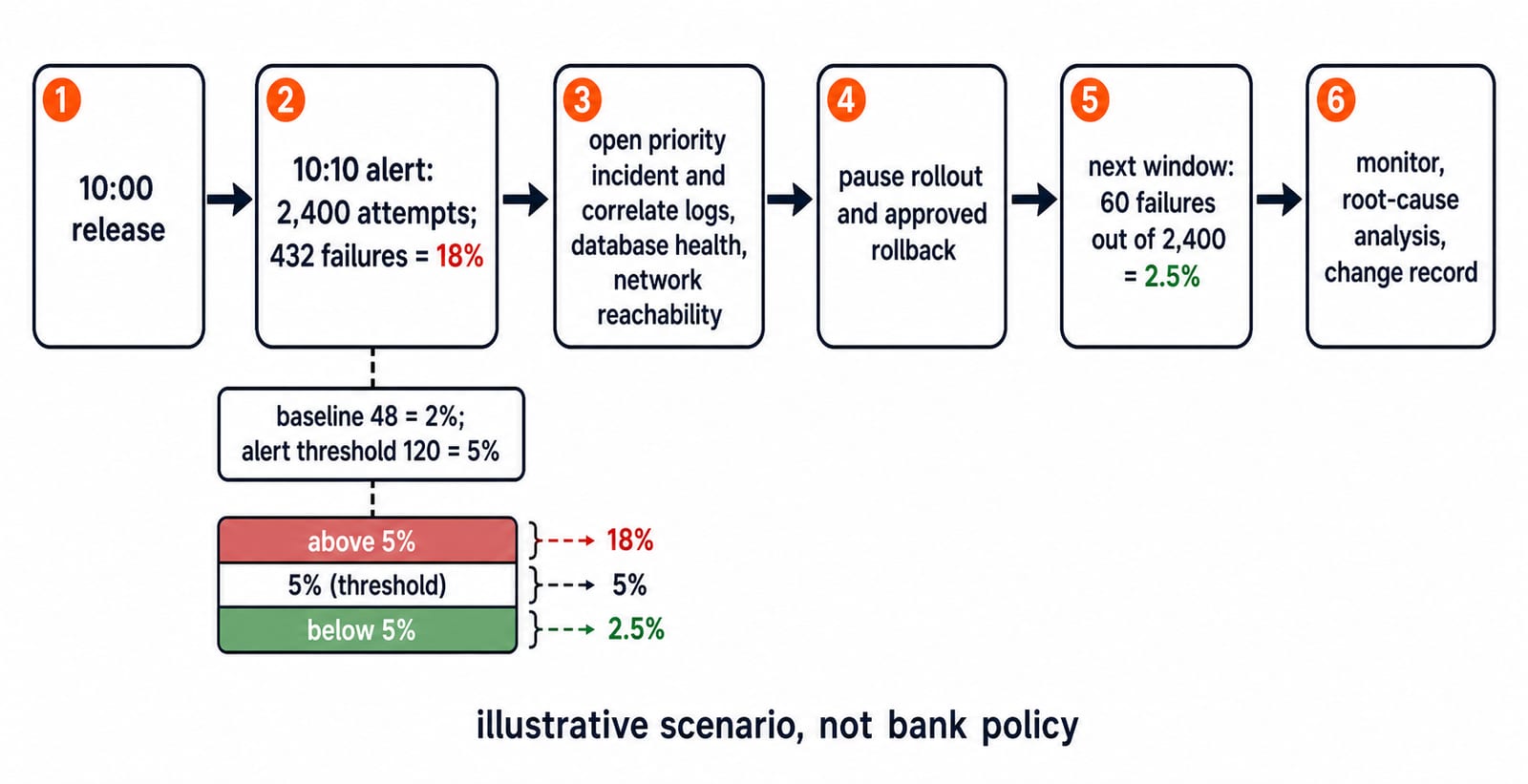
Consider a hypothetical incident with invented figures. A release goes live at 10:00. From 10:00 to 10:10, the service receives 2,400 login attempts and the failure rate rises from a 2% baseline to 18%.
Calculate each figure before acting. Baseline failures are 2,400 x 2% = 48. Observed failures are 2,400 x 18% = 432. The release window therefore has 432 - 48 = 384 additional failures. An illustrative 5% alert threshold equals 2,400 x 5% = 120 failures.
The officer acknowledges the alert, opens a priority incident, and correlates the spike with the 10:00 release. Next come application logs, database health and network reachability. The team pauses further rollout, obtains the required rollback approval, rolls back, and checks another 2,400-attempt window. At 2.5%, failures are 2,400 x 2.5% = 60. That is below the 120-failure threshold, but monitoring and a root-cause record still follow.
This scenario tests numerical judgement, logging, networking and database basics, change control, escalation, verification and documentation.
Skills that turn computer science knowledge into banking operations
Skill | Applied task |
|---|---|
Computer Networks | Trace DNS, routing, TLS and connectivity faults. |
Operating Systems | Check processes, services, logs, permissions and resource use. |
DBMS and SQL | Diagnose data and performance issues safely. |
Software engineering and APIs | Test releases, integrations and failure handling. |
Security | Apply identity, least privilege, vulnerability response and evidence handling. |
Technical knowledge is only half the job. Incident management, change control, vendor coordination, prioritisation and audit-ready writing turn a diagnosis into safe action. You also need to explain risk to non-technical colleagues. A correct answer is incomplete if it cannot be applied under controls. Use the IBPS SO IT Officer networking guide to connect network concepts with Professional Knowledge preparation.
How an IT Officer's workday changes when an incident arrives
A workday usually mixes planned delivery with controlled interruption:
Workday point | Planned work | If an incident intervenes |
|---|---|---|
Opening handover | Review overnight alerts, open tickets and known changes. | Confirm service impact, severity and the incident owner before other work. |
Core work block | Investigate requests or prepare a tested, approved change. | Pause the planned deployment, preserve logs and check the application, database and network. |
Control block | Complete access reviews, evidence checks or change records. | Apply approval, least-privilege and evidence requirements to containment and recovery. |
Coordination block | Review vendor work or coordinate with branch and data-centre teams. | Set an update cadence, assign actions and track rollback or recovery decisions. |
Closure | Update tickets, documentation and the next handover. | Verify recovery, record the timeline and carry unresolved risks into the handover. |
The bank sets shifts, branch visits and on-call duties, so no universal minute budget applies. The durable sequence is handover, planned work, controlled interruption, verification and documented closure. An outage moves delivery work without removing controls or communication.
IBPS SO IT Officer career path: how scope grows
The officially named entry point is IT Officer (Scale I). Scope can grow through three capability stages, although the allotted bank controls designations and promotion rules:
Controlled execution: own tickets, inspect logs, follow access and change procedures, preserve evidence and escalate beyond delegated authority.
System ownership: take responsibility for a component's health, recurring problems, controlled changes and vendor follow-through.
Service or technical leadership: coordinate cross-team reliability, security controls, audits, projects or people across a wider technology service.
An officer may specialise in infrastructure, databases, cyber security, applications, data or digital channels, or move towards vendor, programme, people or operational leadership. These are directions, not guaranteed titles or timelines.
Fit check and the next preparation step
Use these six prompts to separate developable skills from hard role-fit constraints:
I enjoy troubleshooting.
I document changes.
I stay calm in incidents.
I explain risk plainly.
I will learn banking workflows.
I balance technical depth with controls.
Treat discomfort with incident pressure, control discipline or bank-specific work allocation as a reason to investigate before applying. Documentation and risk explanation can improve with practice, but one strength cannot cancel a non-negotiable mismatch. Compare adjacent paths if the role's operating conditions do not fit.
The short version: this role combines CS fundamentals, reliable operations, security awareness and coordination. For preparation, use the IBPS SO IT Mains course or, if shortlisted, the IBPS SO IT interview course.
Keep learning
IBPS PO Preparation Mistakes: 7 Errors That Cost Final Selection
Hard work is not enough when attempt counts, new resources and rigid timetables hide weak accuracy. Replace seven common errors with measurable habits.
Updated 4 Oct 20265 min readIBPS Exams
IBPS PO Last 60 Days Plan: Revision, Mocks and Error Repair
Turn the final 60 days into a measured cycle of diagnosis, revision, mocks, retests and tapering, with worked schedules for a realistic 14-hour week.
Updated 29 Sep 20264 min readIBPS Exams
IBPS PO Cutoff Trends: Set a Defensible Target Score
Learn how to separate IBPS PO cutoff history by cycle, stage, category and denominator, then turn comparable Main values into a transparent practice target.
Updated 25 Sep 20265 min readIBPS Exams
IBPS PO Previous Year Analysis: Recurring Question Formats and Attempt Priorities
See what genuinely recurs across IBPS PO papers, solve representative format drills, and turn your own accuracy and speed into a practical attempt priority.
Updated 24 Sep 20265 min readIBPS Exams