UP Police Computer Operator Typing Test: Build Speed Without Losing Accuracy
Build typing speed without letting errors undo the gain. This practice plan separates Hindi and English, tracks accuracy, and turns each weak attempt into a focused repair drill.
KnowledgeGate Team
Exam prep & CS education
Updated 16 Aug 20265 min read
A higher WPM number feels encouraging until corrections, skipped words and wrong characters pull accuracy down. The opposite trap is a nearly clean passage that remains too slow. The Board's 29 December 2023 notice set reference lines of 25 Hindi WPM, 30 English WPM and 85% accuracy, and both numbers have to clear on the same attempt. Confirm the notice that applies to your recruitment cycle, then start reading speed and accuracy as two separate figures.
Start with the official speed and accuracy boundary
The Uttar Pradesh Police Recruitment and Promotion Board's 29 December 2023 direct-recruitment notice required at least 25 WPM in Hindi, at least 30 WPM in English and 85% accuracy with those speeds. It also named Unicode InScript as the Hindi keyboard layout.
Those four points are what the 2023 notice states. It does not fix the test duration, passage size, correction rules, error weights, number of attempts or software, so read the notice and test instructions issued for your own cycle. The written stage that runs alongside this skill test is covered on the UP Police Computer Operator Exam Prep page.
Measure speed and accuracy separately in one baseline
Start with a 15-minute practice diagnostic. Fifteen minutes is long enough for fatigue and drift to show, and short enough to repeat every day. Two measures come out of it:
Gross practice WPM = total words typed / practice minutes
Simple practice accuracy = correct words / total words typed x 100
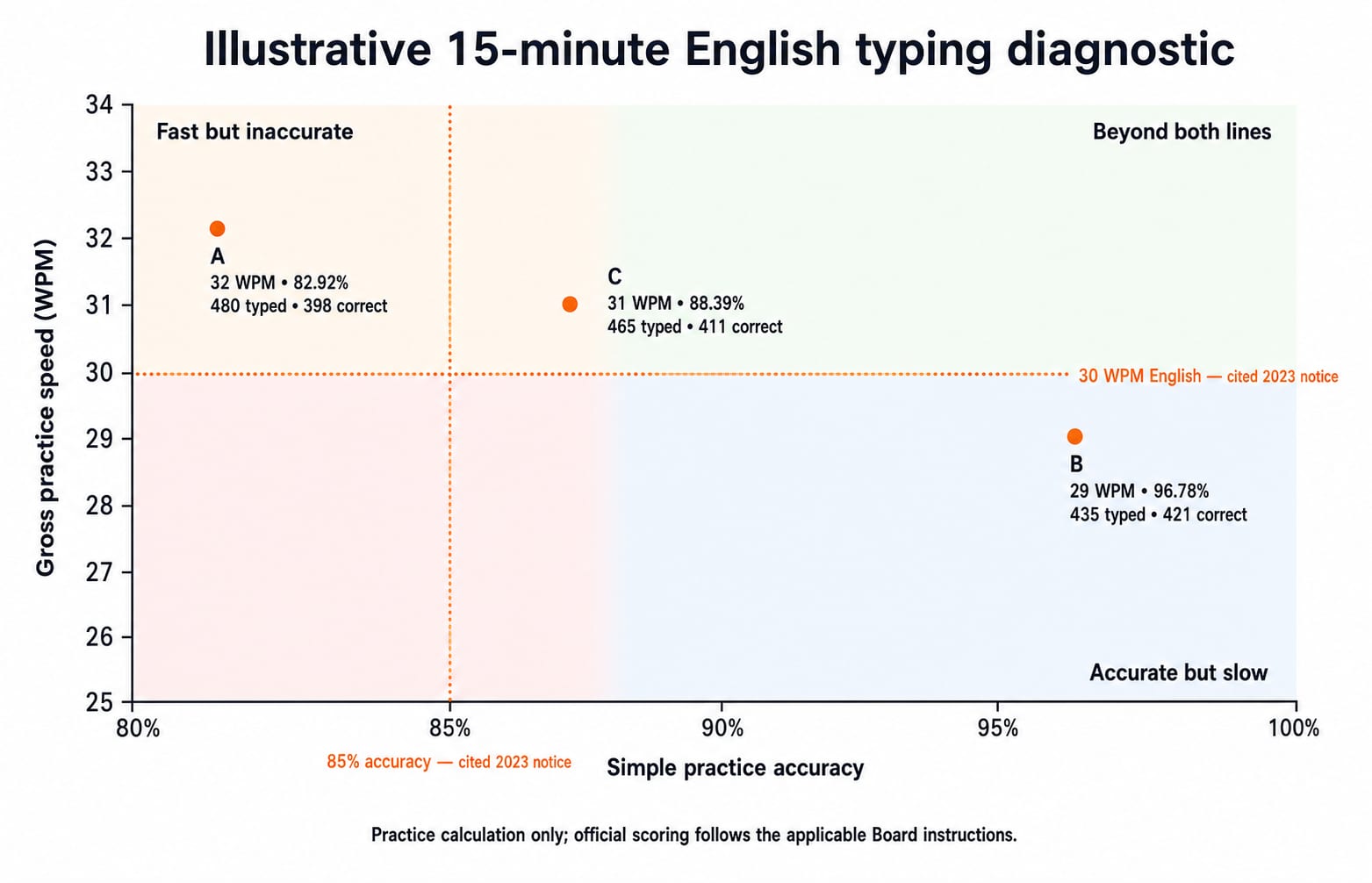
For three English attempts, the calculations are:
Attempt | Speed calculation | Accuracy calculation | Reading |
|---|---|---|---|
A | 480 / 15 = 32 WPM | 398 / 480 x 100 = 82.92% (82 errors) | Fast, but below 85% |
B | 435 / 15 = 29 WPM | 421 / 435 x 100 = 96.78% (14 errors) | Accurate, but below 30 WPM |
C | 465 / 15 = 31 WPM | 411 / 465 x 100 = 88.39% (54 errors) | Beyond both reference lines |
Read both figures together, because neither column is a bonus that cancels the other.
Only Attempt C clears both English lines. Attempt A typed 45 more words than Attempt B, and those 3 extra WPM arrived with 68 extra errors, which is the whole trade in one row. More typed words cannot rescue poor accuracy, and very high accuracy cannot rescue insufficient speed.
Train Hindi InScript and English as separate motor patterns
One combined WPM figure can hide the weaker language. Keep separate log rows with these columns: language | layout | total typed | correct | WPM | simple accuracy | top error.
For Hindi, practise Unicode InScript, the layout the 2023 notice named. InScript keeps vowels and matras under the left hand and consonants under the right, so the finger sequence for a Hindi word has nothing in common with the QWERTY habit you build in English. Phonetic transliteration types Devanagari from Roman spelling, a third pattern that cannot stand in for InScript practice.
Speed = 390 / 15 = 26 WPM
Simple accuracy = 342 / 390 x 100 = 87.69%
This row clears both cited Hindi lines, 25 WPM and 85%, but only by one word per minute and 2.69 accuracy points. A margin that thin will not survive an unfamiliar passage, so treat those lines as the floor you train above, not a result to bank. The file handling and shortcut drills in UP Police Computer Operator MS Office: File Types and Keyboard Shortcuts keep your hands on the keys instead of the mouse.
Turn every failed attempt into an error-repair list
Do not record a vague total called "typing mistakes". Split every marked error into five buckets: omitted word, substituted word, spelling or character error, spacing or punctuation error, and unintended addition.
For an illustrative 300-word practice copy, the audit might be:
6 omissions + 5 substitutions + 4 spelling or character errors + 3 spacing or punctuation errors + 3 additions = 21 errors
The largest bucket decides the drill. With six omissions, slow the visual scan and copy short phrase chunks. With five substitutions, drill the confused key pair. For three spacing or punctuation errors, retype each affected sentence three clean times. Then test a fresh passage so memory does not inflate the result. Keep the bucket counts for every attempt in one log: a bucket that shrinks for three sessions and then returns is fatigue, not skill, and needs a shorter session rather than a harder drill.
Build a seven-day speed ladder with an accuracy guardrail
Practise for 45 minutes daily: 5 minutes of layout warm-up, 15 minutes of English copy, 15 minutes of Hindi InScript copy and 10 minutes of error review. On Days 1 and 2, prioritise clean keystrokes. From Days 3 to 5, increase pace only after the previous two attempts reach a 90% practice-accuracy guardrail. The 90% sits above the cited 85% on purpose, so a harder passage still lands you above the line, not on it.
Use Attempt C for English checkpoints: 31 WPM gives 155 words after 5 minutes, 310 after 10 and 465 after 15. The Hindi row at 26 WPM gives 130, 260 and 390 words. Check yourself against those counts mid-copy instead of guessing at the pace. If you are running the wider schedule in the UP Police Computer Operator Preparation Plan: 8 Weeks for Theory, Typing and Office Skills, this ladder is one of its typing weeks up close.
On Day 6, repeat the weakest error bucket across ten short sentences. On Day 7, run both timed copies and compare WPM, simple accuracy and the top error with Day 1. If you miss a day, continue next day. Do not double the workload.
Rehearse the decision process, not just the keyboard
Before each copy, record the language, keyboard layout and passage source. During practice, glance at the 5, 10 and 15-minute checkpoints without stopping the clock. Learn to feel them against a wall clock, because the test interface may not display them.
For concentration training, correct immediately only if you notice the mistake within the current word. Otherwise continue, and mark the location once time ends. On test day the software decides which corrections it accepts, so read its instructions before you start.
Finish with a four-line audit: speed line met? | accuracy line met? | largest error bucket? | one change for the next copy? Attempt A needs accuracy repair. Attempt B needs pace work. Attempt C needs to maintain both on a fresh passage.
Keep typing practice and written preparation in the right lanes
The short version: verify the current Board notice, log Hindi and English separately, calculate speed and practice accuracy, repair the largest error bucket, then retest on a fresh passage. If your cycle's notice sets different numbers, only the two reference lines move; the measuring, the buckets and the guardrail are unchanged.
Use the UP Police Computer Operator Course for the written-exam concepts and the UP Police Computer Operator Test Series for question practice under time. Neither of them can put your fingers on the keys, so keep the daily Hindi InScript and English typing routine running on its own track alongside them.
Keep learning
UP Police Computer Operator DBMS and SQL: Learn Tables, Keys and Queries with a Police-Records Database
Build one fictional police-records database from schema to SQL. Learn key types, relationships, 3NF, table constraints and exact query results from consistent data.
Updated 18 Aug 20266 min read70 viewsUP Police Computer Operator

UP Police Computer Operator PYQs: Diagnose Recurring Skill Gaps
Turn solved papers into a ranked repair list. Tag the recurring errors, repair the exact skill behind each one, then measure the change with a fresh 18-question mixed check.
Updated 14 Aug 20265 min readUP Police Computer Operator

UP Police Computer Operator Job Profile: Salary, Duties and Promotion Path
Understand the UP Police Computer Operator Grade-A role, its duties, historical pay matrix, probation, transfers, and selection-based promotion path.
Updated 12 Aug 20265 min read112 viewsUP Police Computer Operator
UP Police Computer Operator Cyber Safety: Threats and Safe Handling
Learn to recognise common cyber threats, protect operational data and choose a safe first response through practical workstation scenarios.
Updated 10 Aug 20264 min readUP Police Computer Operator