IISc Administrative Assistant Job Profile: Pay Structure and Office Reality
Understand the IISc Administrative Assistant role through its official job description, an honest pay-matrix reading, and a realistic office-file workflow.
KnowledgeGate Team
Exam prep & CS education
Updated 9 Aug 20265 min read
The title Administrative Assistant and a pay level do not tell you what the working day feels like. Is the post mainly data entry, reception, file processing, or responsibility for an entire office flow? IISc places it in Group C on Pay Matrix Level 5, a displayed basic-pay range of 29,200 to 92,300 rupees, and the duties run well past typing: registers, file movement, fact checking and meeting coordination. Recruitment terms below follow the IISc advertisement dated 29 May 2026.
1. Place the post correctly before judging it
The IISc advertisement dated 29 May 2026 described this as direct recruitment to a Group C Administrative Assistant post. Direct recruitment means the vacancy is filled from open applications rather than by internal promotion, so the advertisement itself is your entry point and its terms are the ones that bind you.
The companion broad job description covers office functions under administrative manuals and SOPs, including document processing, meetings, visitors, events and related protocol. The role is broader than typing or reception, but it is not a policy-making officer role. The assistant supports an office, remains accountable for its files and materials, and moves accurate information to the Officer-in-Charge.
KnowledgeGate's IISc Administrative Assistant category covers preparation for this recruitment route, and the wider government jobs category covers the neighbouring Group C office posts you may be weighing against it.
2. Read the pay matrix without inventing an in-hand figure
The IISc advertisement dated 29 May 2026 states Pay Matrix Level 5 under the 7th CPC, displaying a range of 29,200 to 92,300 rupees. It also says the post carries the usual allowances admissible under IISc rules in the corresponding pay scale. Employees appointed to Institute service on or after 1 January 2004 are covered by NPS, according to the same notice.
Read the range carefully. 29,200 rupees is the lower displayed basic-pay cell for this notice. 92,300 rupees is the top cell of the level, reached through annual increments over years of service, not the first month's salary.
gross pay = applicable basic pay + allowances currently admissible under IISc rules
take-home pay = gross pay - NPS contribution - other applicable deductions
Without your own allowance rates and deduction figures, those two lines are as far as the arithmetic honestly goes. Any in-hand figure you see quoted for this job elsewhere has filled those blanks with an assumption, so read it as somebody's estimate and not as a commitment in the notice.
Warning: An older recruitment notice may show a different pay level. Match every pay claim to the exact advertisement number and date that applies to you.
3. Follow one document through a realistic office day
The broad job description connects receiving and registering papers with maintaining the Section Diary, File Register and File Movement Register. It also expects fact checking, error flagging, reference to rules or precedents, drafting, reporting, coordination and submission to the Officer-in-Charge.
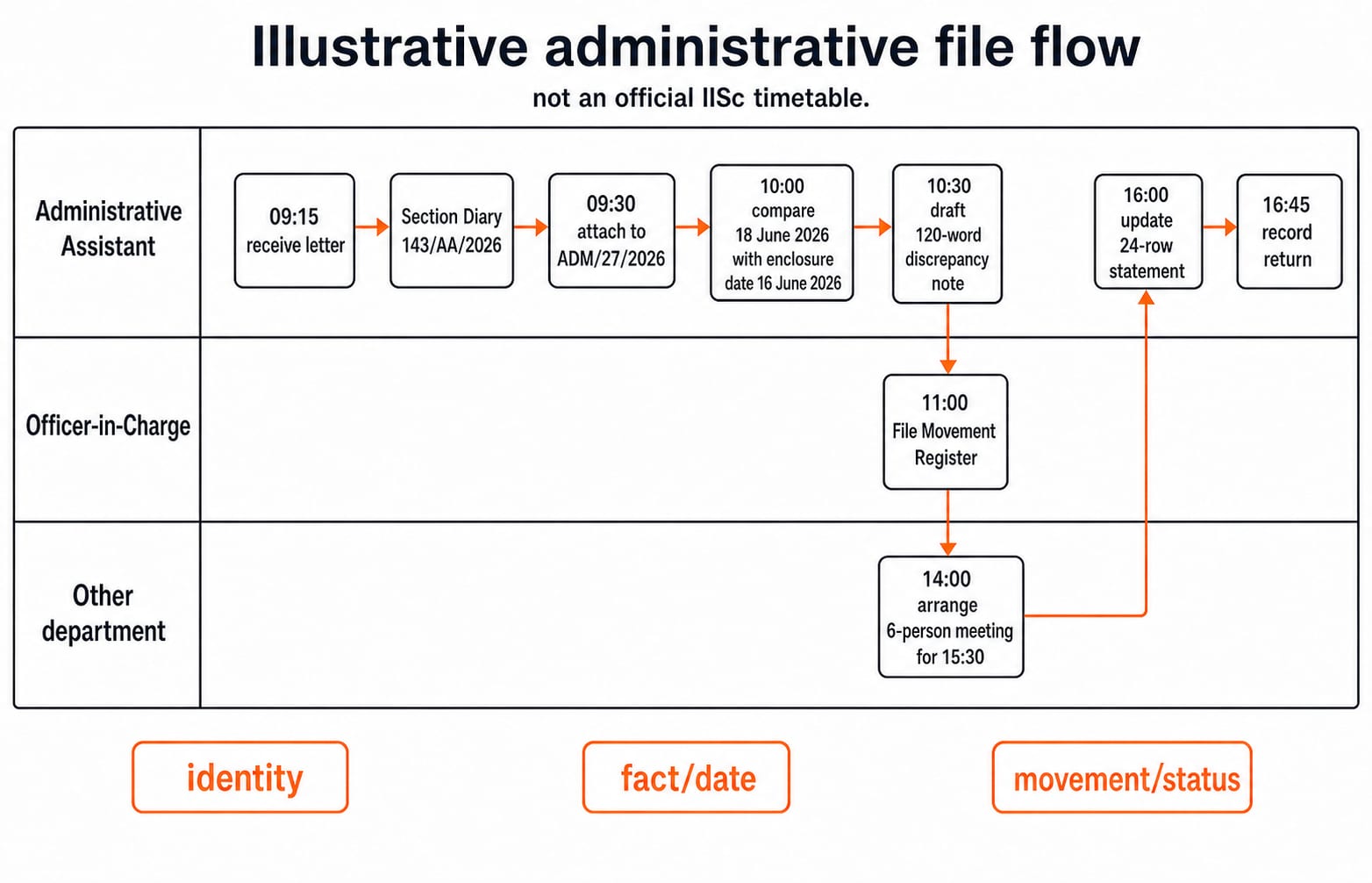
The file numbers and timings below are invented, but the sequence follows the registers the job description names. At 09:15 an assistant receives a letter and creates Section Diary entry 143/AA/2026. At 09:30 it is attached to file ADM/27/2026. At 10:00 the assistant notices that the letter says 18 June 2026 while its enclosure says 16 June 2026. At 10:30 the assistant drafts a 120-word note identifying the mismatch and asking which date controls. At 11:00 movement to the Officer-in-Charge is entered. At 14:00 the assistant arranges a six-person meeting for 15:30. At 16:00 a 24-row status statement is updated. At 16:45 the returned file is recorded.
The value lies in each traceable, accurate hand-off. The record shows what arrived, what was checked, where it moved, what decision was needed and what happened next.
4. Accuracy is part of the job, not a final proofreading step
Checking happens at four levels: accurate transcription, factual consistency, alignment with a relevant rule or precedent, and a clear statement of the required decision. Silently choosing 18 June or 16 June would hide a conflict. The proper action is to identify both sources, flag the difference and request a determination while preserving the audit trail.
A raw forwarded email gives no analysis. A note saying only "please advise" is scarcely better. A useful note states the two dates, their source pages, the applicable deadline rule if known, and the exact decision needed. IISc's broad job description includes checking facts, flagging errors, identifying rules and precedents, and suggesting possible action.
5. The essential skill stack is writing, office software and ERP awareness
The IISc broad job description calls for simple, grammatically correct English documents, efficient use of MS Word, Excel, PowerPoint and Access, and an understanding of ERP modules. Do not assume a software version, typing speed or test format unless the applicable notice states one. KnowledgeGate's IISc Admin Assistant MS Office workflow walks through the Word and Excel tasks these duties generate.
Turn the illustrative 24-row status statement into a practice task. Create six columns: reference number | received date | subject | owner | due date | status. Plant one duplicate reference, one missing due date and the 18 June versus 16 June conflict. Then identify all three issues, write a 60-word correction email, and prepare a three-bullet meeting note.
6. The office reality is variety, coordination and possible reassignment
IISc's broad job description says Administrative Assistants may support offices dealing with admissions, thesis processing, salary and scholarship, procurement, library or laboratories. They are expected to work across organisational boundaries and may be reassigned as Institute needs change. Do not assume a fixed unit, cabin, schedule or permanently narrow task list.
The role officially involves departmental liaison, meeting coordination, records, reports and accountability for office materials. Someone who wants only isolated data entry will find that follow-through demanding. Someone comfortable with detail, shifting queues and stakeholder communication will suit it better.
KnowledgeGate's SSC CGL posts preference guide sets out a method for ranking office postings by their duty mix rather than by title, and the same exercise works here once you read the duties from the IISc advertisement itself.
7. Short version and next step
Use this six-line fit check:
Can maintain traceable registers.
Can draft clear English.
Checks facts before forwarding.
Can use office software accurately.
Can coordinate without losing ownership.
Accepts that office assignment may change.
If several answers are no, practise the file flow before deciding that the post fits you. Use the pay level and range in the applicable dated IISc advertisement, and never treat basic, gross and take-home pay as the same figure.
Check the official IISc careers page first for the current terms and documents. Then use KnowledgeGate's IISc Administrative Assistant 2026 course for structured preparation.
Keep learning
IISc Administrative Assistant Arithmetic: Master Percentages, Ratios and Data Interpretation
Learn to choose the right base, connect fractions with ratios, and solve percentage and data interpretation questions through fully worked examples.
Updated 14 Aug 20265 min readIISC Administrative Assistant
IISc Administrative Assistant Mock Analysis: Balance Every Section
A total score cannot tell you whether concepts, question selection, speed or guessing caused the loss. Use this worked five-section review to diagnose one mock and plan a balanced repair week.
Updated 11 Aug 20266 min readIISC Administrative Assistant
IISc Administrative Assistant English: Build Accuracy for Office Work
Train English accuracy through office-style grammar checks, precise sentence correction, fact retrieval, proofreading and a repeatable practice loop.
Updated 7 Aug 20265 min readIISC Administrative Assistant
IISc Administrative Assistant Syllabus: A Learn, Practise and Revise Map
Turn the official five-section syllabus into a practical study map. Learn the concepts, practise under time and revise from a focused error ledger.
Updated 4 Aug 20266 min readIISC Administrative Assistant