UP Police Computer Operator Computer Fundamentals: Binary, OS and Network Basics
Connect binary, hardware, operating systems and networking through one data journey, then test the model with conversions, scheduling and subnet examples.
KnowledgeGate Team
Exam prep & CS education
Updated 23 Jul 20266 min read
Candidates often revise binary, hardware, operating systems and networks as separate lists, so changed wording makes a known fact look new. Follow one piece of data through representation, processing, storage and communication, and the four stop behaving like four separate chapters.
Use one data journey to connect the four topics
A user enters decimal 45 on a keyboard. The value is represented as the 8-bit pattern 00101101. A running application keeps it in RAM, while the operating system schedules the application's process and saves its file to an SSD. A network interface sends the data through a switch and, when the destination is on another subnet, a router.
Classify by role: 45 and 00101101 are representations; the keyboard, RAM, SSD and NIC are hardware; scheduling is OS resource management; the SSD provides storage; and the switch or router performs networking.
These four never sit in one unit. In our UP Police Computer Operator course, Computer Fundamentals carries number systems, number representation and input-output organisation; Computer Networks carries data communication, Ethernet and IP addressing; and operating-system basics sit with the Windows, Linux and Unix material, next to database concepts, MS Office and Boolean algebra. A question that names a value, a device and an address is drawing on two or three of those units at once, so unit-wise recall alone will not settle it.
Bits describe data, hardware performs or stores operations, the OS manages hardware for programs, and network devices move frames or packets. One object can cross every layer without making them interchangeable. For broader UP Police Computer Operator preparation, start from the wider Govt Jobs collection.
Convert binary by place value, not by guesswork
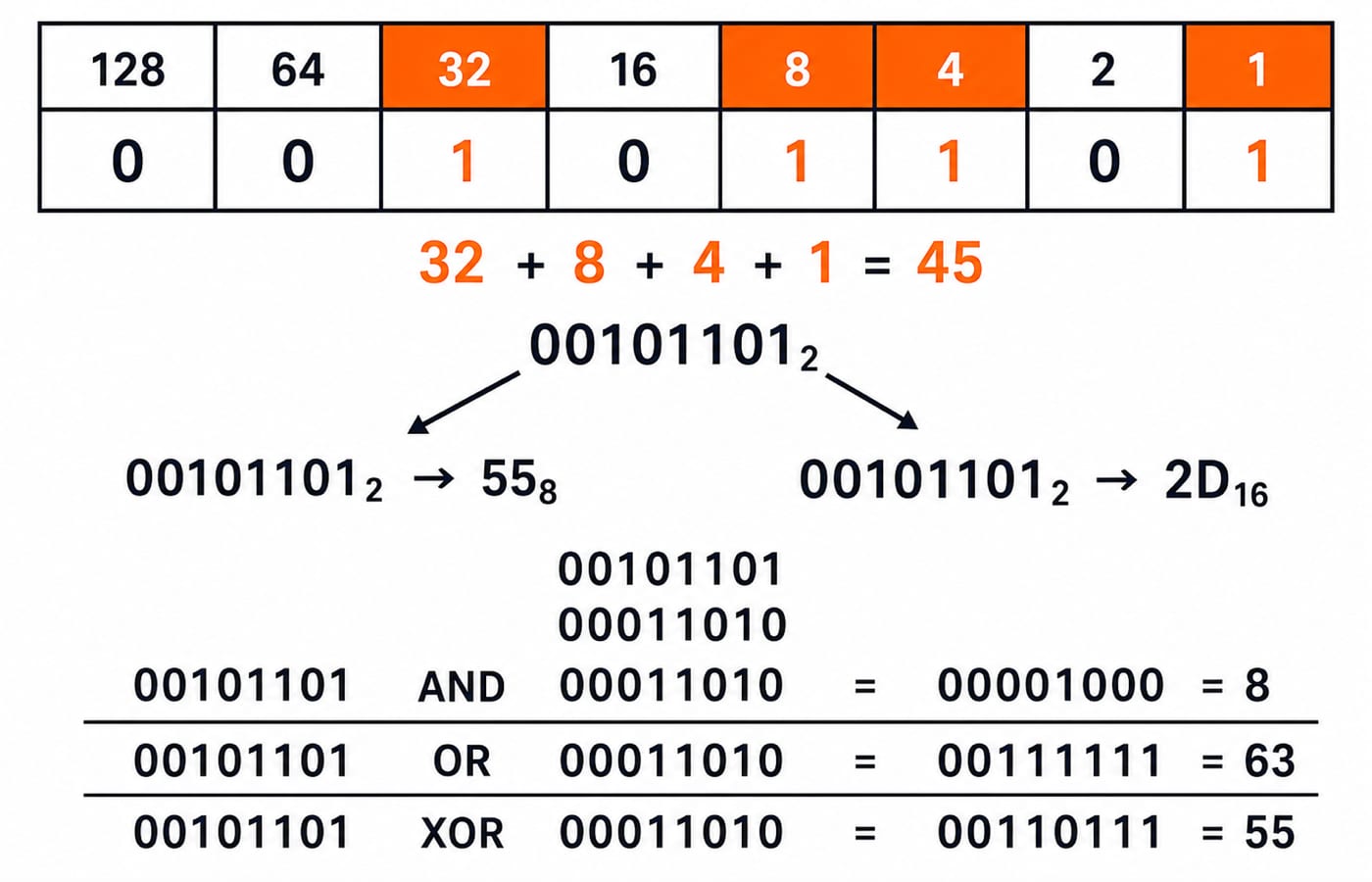
For decimal 45, select the powers of two that add to it:
45 = 32 + 8 + 4 + 1
Against 128, 64, 32, 16, 8, 4, 2, 1, this gives 00101101_2. Grouping from the right in fours gives 0010 1101, or 2D_16. Grouping in threes gives 00 101 101, or 55_8.
Reverse-check: 2 x 16 + 13 = 45, and 5 x 8 + 5 = 45. Therefore:
45_10 = 00101101_2 = 55_8 = 2D_16
10110110_2 = 128 + 32 + 16 + 4 + 2 = 182_10 = B6_16 = 266_8
AND needs two aligned 1 bits, OR at least one, and XOR exactly one:
  00101101
  00011010
AND 00001000 = 8
 OR 00111111 = 63
XOR 00110111 = 55
Practise the method with Number System MCQs: 12 Solved.
Classify hardware by function and data location
Function, not capacity or appearance, decides the class.
Item | Function-first classification |
|---|---|
Keyboard | Input device |
24-inch monitor | Output device |
CPU control unit | Coordinates instruction execution |
ALU | Performs arithmetic and logic |
8 GB RAM | Primary volatile memory |
512 GB SSD | Secondary non-volatile storage |
NIC | Communication interface |
One 4 KiB page contains 4 x 1024 = 4096 bytes. Sixteen pages contain 16 x 4096 = 65,536 bytes, or 64 KiB. Units decide the answer here: KiB fixes the multiplier at 1024, while KB is read as 1000 bytes in some contexts and 1024 in others.
RAM holds 00101101 temporarily, the CPU processes it, the SSD retains it after shutdown, and the NIC transmits it. RAM does not process data, and the OS is not hardware.
Treat the operating system as a resource manager
Recall five OS actions: scheduling chooses CPU time, memory management allocates RAM, file management organises data, device management coordinates I/O through drivers, and protection controls access. report.exe on an SSD is a program. Loaded into RAM and scheduled, it becomes a process.
Let P1 arrive at 0 with burst 5, P2 at 1 with burst 3, and P3 at 2 with burst 1.
FCFS runs P1 0-5, P2 5-8, P3 8-9. Waiting times are 0, 5 - 1 = 4, and 8 - 2 = 6, so the average is (0 + 4 + 6) / 3 = 10/3 = 3.33.
Non-preemptive SJF also starts with P1, the only available process at time 0. It then runs P3 5-6 and P2 6-9. Waiting times are 0, 5 - 2 = 3, and 6 - 1 = 5, so the average is (0 + 3 + 5) / 3 = 8/3 = 2.67.
Both runs use the same arrival times and bursts, so the whole gap between the two averages comes from the ordering rule. Continue with OS Basics MCQs: 12 Solved.
Choose the network device from the boundary it crosses
A repeater regenerates a weakened signal. An access point connects wireless clients to a LAN. A switch forwards Ethernet frames inside a LAN using MAC addresses. A router forwards IP packets between networks. A modem converts access signals. These devices are not synonyms.
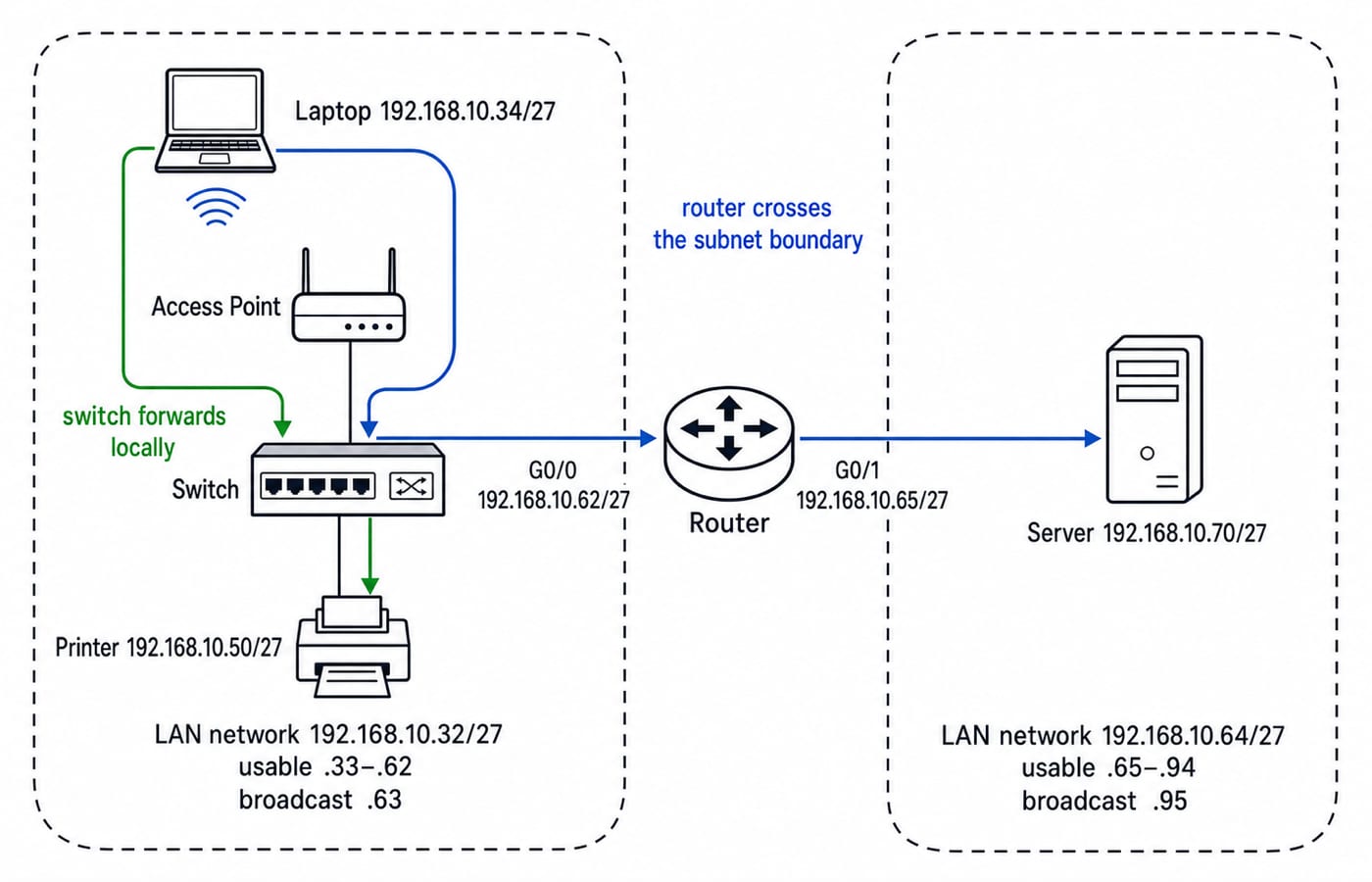
For 192.168.10.34/27, the mask is 255.255.255.224. A /27 has a block size of 256 - 224 = 32, so the containing block runs from .32 to .63:
Network:
192.168.10.32Usable hosts:
192.168.10.33to192.168.10.62Broadcast:
192.168.10.63
Printer 192.168.10.50/27 is inside that block, so a switch forwards locally. Server 192.168.10.70/27 belongs to 192.168.10.64/27, with usable range .65 to .94 and broadcast .95. Reaching it crosses a subnet boundary and requires a router.
Solve mixed classification questions with a fixed sequence
Use four passes: underline the value and base, identify the resource or function, locate the boundary, then eliminate options from the wrong layer.
Apply it to this question: "A process stores 45_10 as 00101101_2 in RAM and sends it from 192.168.10.34/27 to 192.168.10.70/27. Which components manage CPU time and cross the network boundary?"
The OS scheduler manages CPU time, and the router crosses the boundary. RAM stores live data, the switch handles the LAN, and binary is the representation.
2D_16equals45_10, not29, becauseDrepresents decimal13.A saved file remains on the SSD after power-off, while its process does not remain in volatile RAM.
192.168.10.50/27is local to.34/27, while.70/27is not, because.63ends the first block.
The syllabus and paper details for the current recruitment cycle are published by the Uttar Pradesh Police Recruitment and Promotion Board at uppbpb.gov.in.
Repair the traps that cause avoidable errors
10110_2is16 + 4 + 2 = 22, not10,110. The base changes each digit's weight.The rightmost binary digit has place value
2^0. Starting from the left reverses the weights.RAM is volatile working memory, not permanent storage. SSD retains saved data after power-off.
The CPU executes instructions, while the OS manages resources. Calling the CPU the OS confuses hardware with software.
Two hosts in the same
/27need local switching. Choosing a router ignores the subnet calculation.Hosts in different
/27networks need routing. Choosing only a switch ignores the boundary.
Run a 60-second audit: write the base as a subscript, expand one place-value line, label volatile and non-volatile, name the OS function as a verb, calculate the subnet boundary, then select the device.
Watch the wording swap. "Forwards frames using MAC addresses" identifies a switch. "Forwards packets between IP networks" identifies a router. A multilayer switch can do both, so read the function the question states rather than the device name you recognise.
Short version and the next practice step
45_10 = 00101101_2 = 55_8 = 2D_16.RAM is volatile, while SSD is non-volatile.
The OS manages processes, memory, files, devices and protection.
A switch stays inside the LAN, while a router crosses network boundaries.
Use the UP Police Computer Operator course to build the syllabus in a structured sequence. Use the UP Police Computer Operator Test Series for unit tests, mock tests and previous-year-question practice.
Without looking back, rework the 45 conversion, the P1/P2/P3 schedule, and the 192.168.10.34/27 subnet decision. If an answer is wrong, revise that layer before attempting mixed questions from our 50,000+ practice questions.
Keep learning
UP Police Computer Operator DBMS and SQL: Learn Tables, Keys and Queries with a Police-Records Database
Build one fictional police-records database from schema to SQL. Learn key types, relationships, 3NF, table constraints and exact query results from consistent data.
Updated 18 Aug 20266 min read70 viewsUP Police Computer Operator

UP Police Computer Operator Typing Test: Build Speed Without Losing Accuracy
Build typing speed without letting errors undo the gain. This practice plan separates Hindi and English, tracks accuracy, and turns each weak attempt into a focused repair drill.
Updated 16 Aug 20265 min readUP Police Computer Operator

UP Police Computer Operator PYQs: Diagnose Recurring Skill Gaps
Turn solved papers into a ranked repair list. Tag the recurring errors, repair the exact skill behind each one, then measure the change with a fresh 18-question mixed check.
Updated 14 Aug 20265 min readUP Police Computer Operator

UP Police Computer Operator Job Profile: Salary, Duties and Promotion Path
Understand the UP Police Computer Operator Grade-A role, its duties, historical pay matrix, probation, transfers, and selection-based promotion path.
Updated 12 Aug 20265 min read112 viewsUP Police Computer Operator